
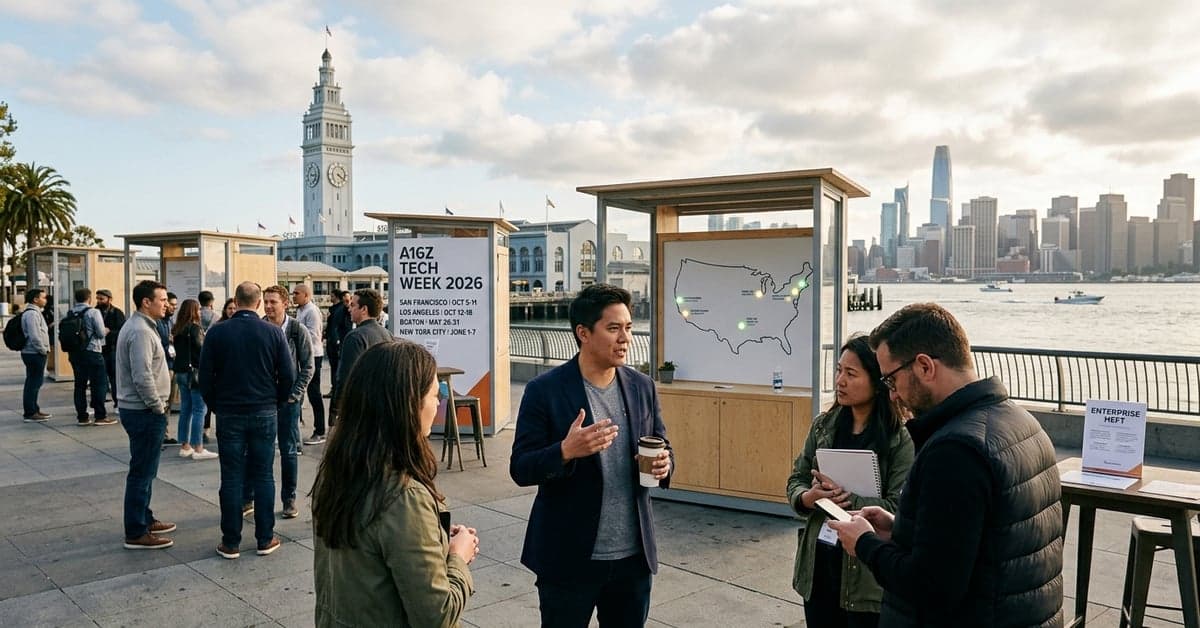
October 5–11, 2026: San Francisco opens a16z Tech Week 2026. Los Angeles follows October 12–18. Boston runs May 26–31, and New York City June 1–7. According to the official Tech Week site, last year’s SF and LA weeks drew more than 1,000 separate events across the two cities.
What’s locked: dates and cities for a16z Tech Week 2026
a16z Tech Week 2026 will span four hubs: Boston (May 26–31), New York City (June 1–7), San Francisco (October 5–11), and Los Angeles (October 12–18). The organizers describe it as a decentralized conference. Hundreds of sessions pop up citywide, from hackathons and product lunches to panels and evening meetups, each run by individual startups, funds, and communities. The host brand stays light; the city becomes the venue.
Event submissions are open for the October stops. The site invites companies to pitch their formats—panels, happy hours, hackathons, or something more inventive—through a dedicated portal at tech-week.com/host. That review process covers San Francisco and Los Angeles, with approvals on a rolling basis, per the organizers’ FAQ.
Last year’s volume—over 1,000 events across the Bay Area and Los Angeles, per the Tech Week site—sets a clear expectation for 2026: dense calendars, packed venues, and a lot of informal deal talk spilling into after-hours.
How the Tech Week 2026 format shapes deal-making
a16z Tech Week 2026 isn’t one expo hall with a keynote stage. It’s a marketplace of moments. That structure pushes discovery and serendipity over centralized programming. Founders can anchor their own demos, then walk a few blocks to meet investors between sessions. Investors can sample ten early-stage pitches before lunch, then switch neighborhoods for a late-day roundtable.
The upside is surface area. The downside is noise. With hundreds of overlapping gatherings, attention fragments fast. Hosts compete for the same RSVP windows and the same high-intent attendees. In that context, curation beats scale. A tight theme, a short format, and a clear ask tend to win the room. The 2026 circuit—Boston in May, New York in June, SF and LA in October—also gives teams a phased runway. You can test your narrative in Boston, refine it in New York, then go bigger in San Francisco and Los Angeles when the calendar peaks.
Why the speaker slate points to enterprise AI
The featured slate on the Tech Week site spans operators and investors. The list names IBM chief executive Arvind Krishna, HubSpot co-founder Brian Halligan, WHOOP founder Will Ahmed, and Twitter co-founder Biz Stone, alongside a16z partners David Haber, Anish Acharya, Jorge Conde, Seema Amble, Jonathan Lai, and others. That mix signals founder stories, go-to-market lessons, and capital views in equal measure.
Krishna’s inclusion is notable. At IBM’s Think 2026, his team framed the “agentic enterprise” and hybrid cloud as the next phase of AI operations, with on-demand keynotes available on IBM’s event site. The Think 2026 page highlights sessions like “Win the enterprise AI race,” “Orchestrate, accelerate and govern the agentic enterprise,” and “Accelerate AI ROI with hybrid cloud.” If those themes follow him into the city circuits, founders should expect sharper conversations around orchestration, governance, and real ROI—less hype, more implementation detail.
That shift would fit the moment. The 2024–2026 arc moved from flashy demos to deployment constraints: data access, model economics, unit testing for agents, procurement, and security. Bringing big-enterprise operators into a decentralized founder week suggests the center of gravity is tilting toward workable stacks and measurable payback.
What to expect across the 2026 circuit
Boston’s late May debut likely trends toward earlier-stage software and AI-in-research stories. New York’s early June run leans into fintech, enterprise sales motion, and partnerships. By October, San Francisco’s calendar becomes the magnet for developer tooling, AI infrastructure, and open-source showcases, with Los Angeles balancing that out through media-tech and creator ecosystems. The Tech Week page points to that breadth: hackathons, community meetups, panels, lunches, and branded experiences.
Expect sponsor-backed anchor events to set the daily rhythm, then dozens of neighborhood sessions to fill in. For attendees, time-boxed routes will matter. Pick a neighborhood per half-day, stack two or three sessions that compound, and leave buffer for a spontaneous coffee. That’s where many intros start. For hosts, the right collaborator—a design partner, a customer advocate, a respected operator—will cut through more than a longer guest list.
Why a16z Tech Week 2026 matters for founders and funds
a16z Tech Week 2026 lands at a useful moment. Budgets are opening again. AI pilots are graduating to owned roadmaps. The presence of enterprise operators like Krishna, paired with veteran founders and active partners, points to a year where practical AI stacks meet capital and customers in the same room. IBM’s Think agenda, posted publicly with keynotes on demand, shows where large buyers’ heads are: governance, orchestration, and payback windows. Those are the questions startup demos will have to answer to win.
The format also spreads risk. If your Boston story falls flat, you have two weeks to tune for New York. If October’s SF or LA slots are oversubscribed, smaller, sharper gatherings nearby can still capture the right ten people. In a citywide series, precision is a strategy, not an afterthought.
By the time San Francisco opens on October 5, the signal from Boston and New York will be clear. Teams that show working integrations, responsible data practices, and believable unit economics will dominate the week. For founders and funds betting on AI’s operator era, a16z Tech Week 2026 looks set to reward detail over volume—and meetings that turn into roadmaps. For more on this, see bloomberg.com and nytimes.com.
Related reading: Meta AI • NVIDIA • AI & Big Tech