
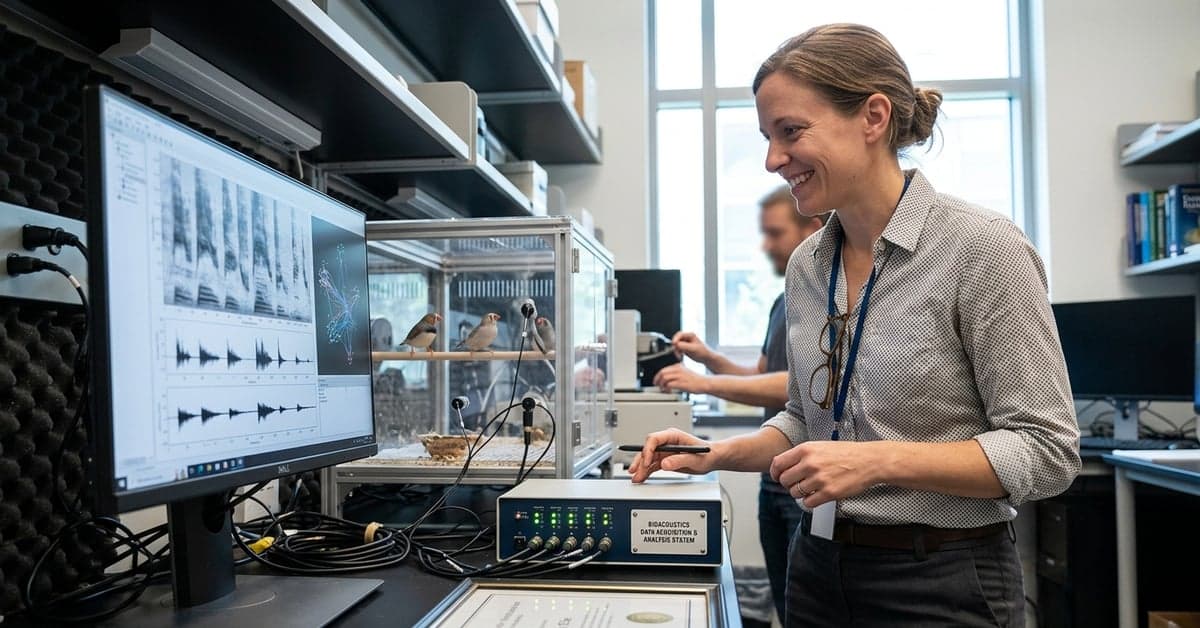
On June 26, 2026, The Guardian reported that neuroscientist Julie Elie won a $100,000 prize for work decoding zebra finch calls with artificial intelligence, describing how the birds announce who they are and what they are doing (The Guardian, June 26, 2026). The award puts AI birdsong decoding on center stage—and raises bigger questions about how far these tools can go beyond catchy demos.
A $100,000 nod to AI birdsong decoding
According to The Guardian’s account, Elie’s research teases apart identity and behavior signals in zebra finch vocalizations using machine learning. That’s not a parlor trick. It marks a shift from vague talk of “animal language” toward measurable information in calls: who’s calling, what context they’re in, and how individuals sign their messages.
This is where the work matters. Bird vocal repertoires are rich and structured, and even common species can produce thousands of variants. As background, the Cornell Lab of Ornithology explains how songbirds stitch notes, trills, and timing into species- and individual-specific patterns that change with season and social context (Cornell Lab). AI can map those patterns faster than human coders working clip by clip.
But faster isn’t the story. Better labeling is. In many projects, the bottleneck is not model size, it’s the meaning tied to each audio clip—who produced it and when, which behavior it accompanied, which individuals were present. The prize highlights that the field is rewarding careful annotation and experimentally grounded claims, not just bigger models.
From hype to careful “birdsong translation”
Public attention has swung between grand promises—“talking to animals”—and skepticism. The evidence today points to a middle path. Machine learning can sort vocal types, track individuals, and predict likely contexts. That’s valuable translation in practice, even if no one is chatting with a finch.
Recent bioacoustics projects rely on broad datasets and transfer learning, then test outputs with classic animal-behavior methods. Open repositories like Xeno-canto supply millions of crowd-sourced recordings. These help models learn what’s typical and what’s rare, across places and seasons. The win reported by The Guardian reinforces that field-tested models—those checked against labeled individuals and observed behaviors—will beat slick, unvalidated demos.
The reaction function in science here is straightforward: when models predict more than taxonomy—such as identity or behavior—researchers need clean ground truth. That means banded birds, synchronized video, and controlled contexts. AI birdsong decoding becomes credible when it agrees with the data biologists already trust.
Why the methods matter for conservation and fieldwork
Decoding structure in calls can change monitoring. If algorithms can tell individuals apart or flag breeding behavior from sound alone, one person with a microphone can survey more habitat with higher resolution. That saves time and reduces disturbance, two wins for conservation planning.
There’s also a safety valve: better models reduce false positives, which cut the cost of follow-up checks in the field. For agencies setting species protections or forestry schedules, precision carries budget weight. It also shapes confidence when plans face legal scrutiny.
But method choices carry responsibility. Playback experiments—broadcasting calls to test animal responses—can shape behavior. Ethicists in animal-behavior research advise restraint and clear justification for any intervention. The Association for the Study of Animal Behaviour offers guidelines on minimizing harm and bias in field studies (ASAB ethics). If AI suggests a call “means” something, researchers still need to verify with designs that respect those standards.
There’s a second caution. Cross-species analogies can mislead. Human language has grammar and recursion; bird calls follow other rules. Work like Elie’s, as described by The Guardian, doesn’t claim to find a hidden human-like language. It maps information structure specific to zebra finches. That restraint is a strength.
What comes next for birdsong translation research
Three fronts look ripe. First, richer labels. Many archives log species and location, but not individual identity or social setting. Field teams pairing RFID tags or visual IDs with mics can close that gap. Better metadata multiplies the value of every recording.
Second, more resilient models. Field audio is messy: wind, insects, overlapping singers. Progress will come from training on hard negatives and from models that express uncertainty instead of forcing a label. That helps managers decide when to trust a detection.
Third, tooling for non-specialists. Local rangers, NGOs, and citizen scientists need clear feedback—what was heard, how sure the model is, and what would improve it. Tools that explain their calls in plain terms will spread faster than those that chase one benchmark. Serious projects already build on open datasets and shared practices, as community hubs like Xeno-canto show.
Expect scrutiny to grow with the promise. If AI birdsong decoding influences land-use permits or endangered-species listings, methods sections will be read as closely as results. Transparent training data, auditable code paths, and repeatable analyses will matter as much as accuracy scores.
Why this prize signals a turning point
The $100,000 award matters less for the amount than the message. Funding is flowing to grounded, behavior-linked decoding work, not just speculative “animal language” headlines. Elie’s zebra finch findings, as reported by The Guardian, reward rigor: connect calls to identity and context, show the tests, and keep claims inside the evidence.
That approach lines up with how bioacoustics matured over decades. Before deep learning, researchers already knew calls carried rich social information. AI now scales that insight to millions of files and thousands of sites. The win is speed and scope, not a wholesale rewrite of animal communication.
For readers tracking where AI is actually changing science, this is the signal. The frontier is careful translation inside each species’ world: identity, intent, timing. That’s enough to help conservation today. It’s also a firmer base for bigger questions tomorrow.
The story began with zebra finches and a prize. The broader impact lands in forests, grasslands, and labs that need reliable tools. If the field keeps choosing validation over hype, AI birdsong decoding will shift from a headline phrase to standard kit in wildlife work.
Related reading: Meta AI • NVIDIA • AI & Big Tech