
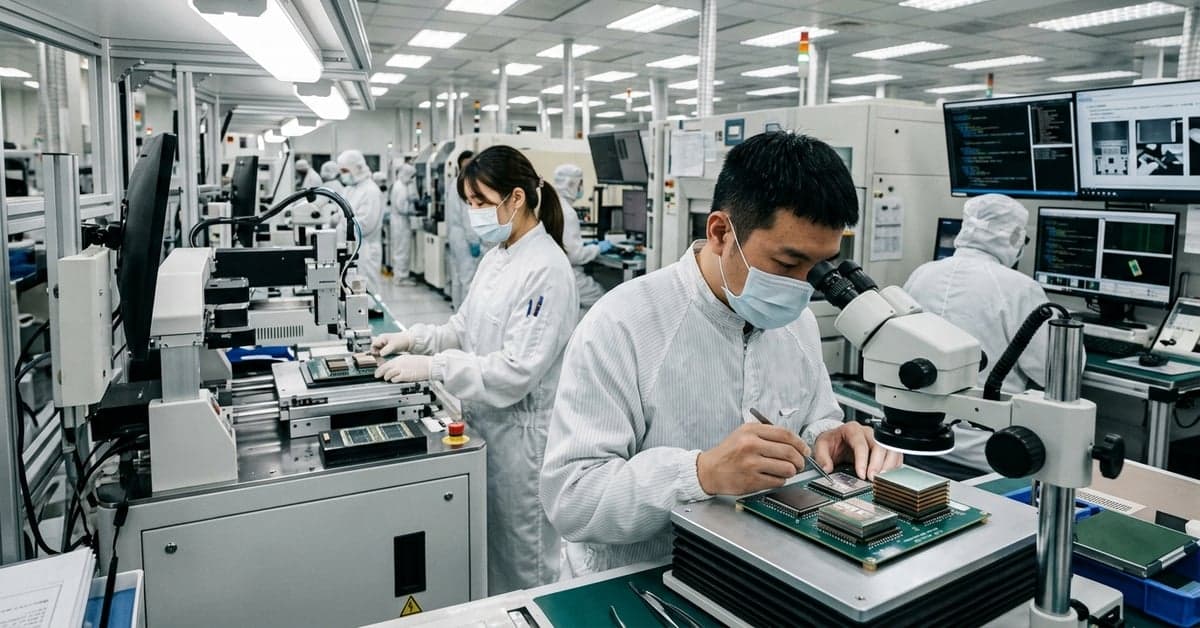
By June 29, 2026, the AI chipmaker rally had turned parts of Asia’s stock market into outliers. Some chip manufacturers have tripled in value since January, lifting regional indexes, according to The Guardian on June 29, 2026.
What the AI chipmaker rally looks like in Asia
The gains are concentrated in suppliers that sit behind the headline brands. Foundries, packaging houses, and component makers tied to data center demand are seeing the fastest moves, The Guardian reported on June 29, 2026. That dynamic helps explain why Asia-Pacific benchmarks are tracking higher even on days when U.S. mega-caps tread water. Index families such as those published by MSCI can swing quickly when a handful of chip names surge.
The market action points to a bigger shift. AI spending is rippling beyond model developers into the upstream hardware stack. It’s a classic capital cycle story for semiconductors, but on a compressed timeline. Investors are paying for capacity that will not fully arrive for quarters, sometimes years. That mismatch is where exuberance can creep in.
How the surge is flowing into pensions
Exposure is not limited to day traders or sector ETFs. On June 28, 2026, The Guardian reported that technology and AI stocks make up as much as 12% of most balanced Australian superannuation funds, meaning typical retirement savers hold a meaningful slice of this cycle. As the AI chipmaker rally drives Asia tech stocks higher, passive portfolios tied to broad indexes inherit that volatility, often without explicit consent from end investors.
For pension trustees, the question is less about timing the top and more about concentration. If a handful of suppliers carry benchmarks, a reversal can hit diversified savers harder than expected. That’s a governance issue as much as an investment one. Groups like the OECD have long warned that hidden concentrations can magnify drawdowns in supposedly balanced funds.
What is powering the supplier boom
Demand is spilling across the semiconductor supply chain. Cloud and hyperscale customers continue to add compute, memory, and networking at a rapid clip to train and serve larger models. Equipment and materials firms are pulling forward orders to meet that need, a pattern the Semiconductor Industry Association has tracked across past capex upcycles.
Enterprise interest also matters. Conference calendars into 2027 — such as the AI & Big Data Expo North America slated for May 24–25, 2027 — point to a still-filling pipeline for corporate AI projects. That helps explain why investors buy upstream “picks and shovels” while waiting for clearer revenue signals from software. The current AI semiconductor rally is a wager that the buildout phase has multiple legs left.
Risks to watch as the boom matures
The speed of the move is itself a warning. Supply additions take time, and bottlenecks can shift from wafers to advanced packaging or from memory to networking. If one link tightens, revenue recognition across the chain can slip. At the same time, higher rates or changes in data center spending plans can reset multiples quickly.
There’s also the index effect. When mega-cap winners dominate benchmarks, tracking them guarantees exposure. That can be fine on the way up. It hurts more on the way down. Investors should ask how much of their performance hinges on a few chip suppliers, and what it would take for that thesis to change. Market concentration is not new, but the pace of this cycle makes it sharper.
Policy risk sits in the background. Export controls, industrial subsidies, and permitting for new power and water resources can alter growth curves. Those factors rarely fit neatly into valuation models. They still move prices.
For now, the AI chipmaker rally is doing what booms do: pulling capital forward, rewarding early risk-takers, and tempting latecomers to chase. Savers who own broad funds should recognize their indirect stake and decide whether that’s still the right exposure. Traders will watch supply ramps and order books. Everyone else can expect a bumpier ride if leadership narrows further — a feature, not a bug, of cycles built on scarce capacity. For more on this, see reuters.com and nytimes.com.
Related reading: Meta AI • NVIDIA • AI & Big Tech