
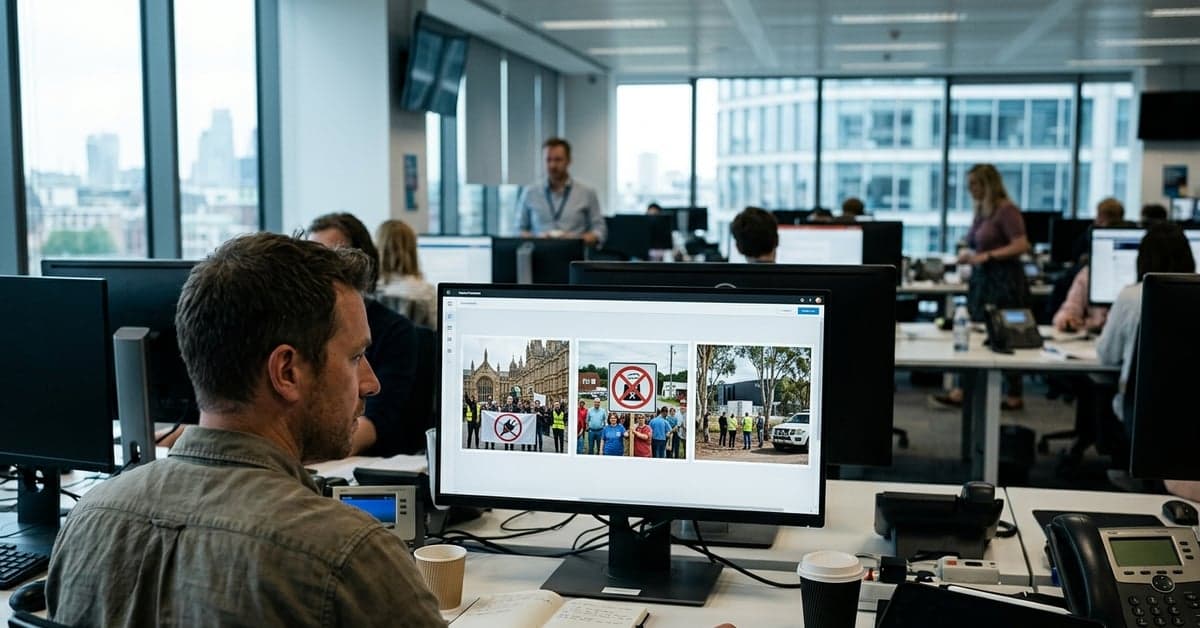
On August 28, 2026, The Guardian’s AI desk logged a string of stories about power, water and politics around new computing sites — and the pattern is hard to miss. From Westminster to Canberra, and in small‑town Virginia, the AI datacentre backlash is no longer a niche complaint. It’s a movement with numbers, names and near‑term policy bets attached.
What triggered the AI datacentre backlash this week
Two decisions framed the mood. In the UK, Labour rejected Green party deputy leader Zack Polanski’s call to “slam the brakes” on permits for AI facilities, according to The Guardian’s AI coverage on August 28, 2026. The party is still signaling welcome for investment, but not a blank cheque.
On the same date, Guardian Australia reported Energy Minister Chris Bowen would not offer any special carve‑out for states using fossil fuels to power datacentres, even as new conditions are set for projects. The message from Canberra: growth must sit inside decarbonisation plans, not outside them. Both lines — keep building, tighten the rules — sketch the uneasy center of current policy.
Across the Atlantic, public consent is fraying. In Danville, Virginia, residents are challenging a proposed campus at Berry Hill, citing secrecy and strain on local resources. The dispute was detailed by The Star (August 29, 2026), which also noted a Heatmap finding that three‑quarters of Americans now oppose a data centre near their home — up from 42% a year earlier, as cited in that report. That swing explains why siting fights are spreading far from national capitals.
Why the politics are converging
The Guardian’s recent newsletters and podcasts have kept returning to the same material realities: megawatts, megalitres and land. Datacentres don’t just use electricity; they seek guaranteed supply, often on tight timelines. They don’t just use water; they need it when heat waves peak. That means conflict with households, farmers and grid planners. The International Energy Agency has warned that demand from datacentres and networks is rising fast, with system‑level planning needed to keep pace.
Politicians are now translating those frictions into rules that voters can see. The UK stance signals no moratorium, but more conditions. Australia’s position links approvals to the energy mix and grid constraints. Local U.S. campaigns, like in Danville, are forcing disclosure, hearings and, in some cases, ballot measures. Taken together, the AI datacentre backlash is moving procurement from a corporate schedule to a public one.
How data center opposition is reshaping siting math
Developers used to optimize for three things: cheap power, fiber and land. That model is stale. Based on the political signals reported by The Guardian and the community pushback described by The Star, the new siting math adds three filters up front:
- Guaranteed low‑carbon capacity: Not just renewable credits, but contracted clean generation tied to project load. Without that, approvals slow.
- Water risk disclosure: Cooling choices, heat‑rejection plans and peak‑day operations must be spelled out, with alternatives for drought conditions.
- Community cash flow: Host‑town payments, rate relief, or tangible upgrades (parks, substations, broadband) that arrive before full build‑out.
This is less a values debate than a sequencing problem. Communities want proof that benefits arrive early and are durable. Grids want capacity that does not raid reliability margins. Investors want schedule certainty. Meeting all three at once is the only way to shrink the protest window.
Power and water: the pressure points voters understand
Protests rarely cite chip counts or parameter sizes. They cite taps and lights. The Guardian’s AI section this week featured repeated questions over whether towns should host facilities that can outdraw entire neighborhoods in summer. Those questions are not abstract: U.S. federal guidance flags datacentres as one of the largest concentrated loads in commercial buildings, while urging efficiency gains and heat‑reuse where feasible, per the U.S. Department of Energy.
Expect more local bargaining over three design levers. First, on‑site generation and storage that actually runs during grid peaks, not just on paper. Second, water‑free or hybrid cooling for hot months, backed by public dashboards. Third, heat capture for district systems where density allows it. These aren’t silver bullets, but they convert abstract harm into visible mitigation.
What happens next for builders and governments
The near‑term path is clear. In the UK, planners are likely to demand stronger energy and water guarantees before turning dirt, in line with the caution highlighted by The Guardian on August 28, 2026. In Australia, the Bowen line implies that projects tied to fossil‑only grids will face steeper conditions, or go slower, until clean capacity catches up. In places like Danville, projects that press ahead without early community dividends will keep triggering lawsuits, petitions and, at times, reversals.
For companies, the practical fix is to move mitigation from the back of the slide deck to the front of the capital plan. Pre‑fund clean power that is additional to the grid. Publish summer operating playbooks. Set up independent monitoring and give locals the data in real time. These steps won’t end every fight, but they answer the precise doubts that drive the AI datacentre backlash.
Governments have homework too. They can bundle siting with grid upgrades that households also feel, like feeder reinforcements that cut outages, or heat‑pump programs powered by the same clean plants that serve the new load. If voters can point to benefits on their street before the first server racks hum, the politics change fast.
The story The Guardian captured this week — reassurance from London, conditionality from Canberra, rejection from a Virginia town hall — points to one conclusion. AI capacity will keep growing, but only where projects win a social license measured in kilowatts, litres and trust. Builders who plan for that reality will ship on time. Those who don’t will keep meeting the same answer at the microphone. For more on this, see bloomberg.com and nytimes.com.
Related reading: NVIDIA • Meta AI • AI & Big Tech