
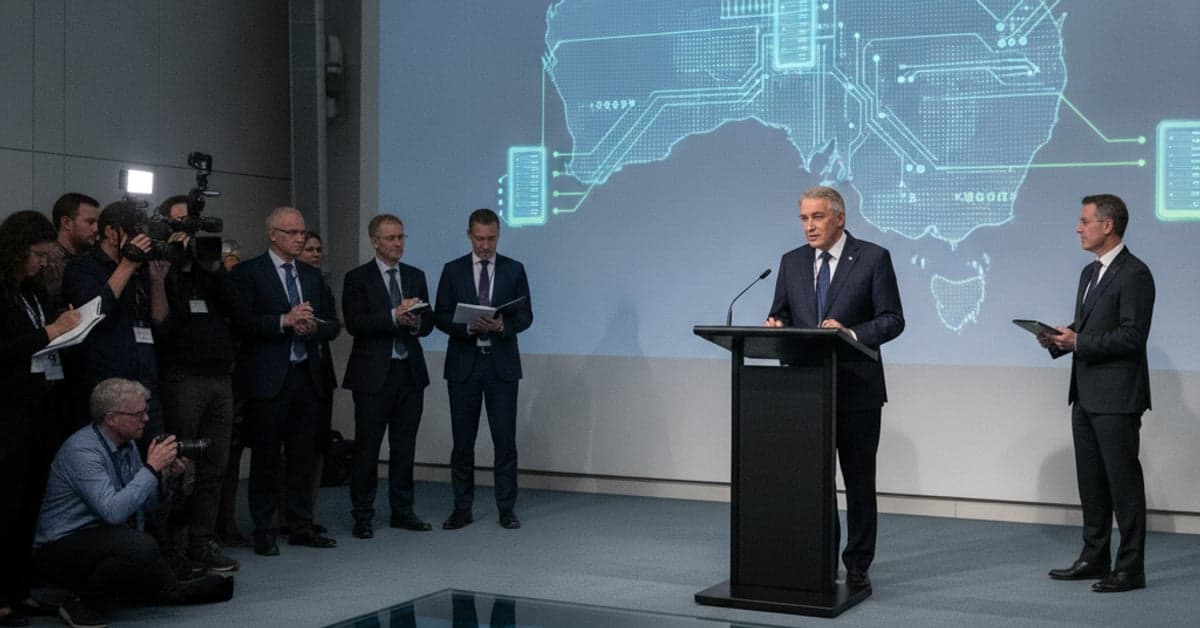
On July 14, 2026, Prime Minister Anthony Albanese pledged to fast-track approvals for datacentres to shore up AI investment, The Guardian reported. The move puts permitting on a faster clock as companies weigh where to build their next high‑density server halls. It also sets up a hard policy trade‑off that will test energy, planning, and cultural policy at once.
What fast-track approvals change for Australia AI data centers
Albanese’s promise is designed to cut time from permit to break ground. According to The Guardian, Canberra wants to signal that hyperscalers and chipmakers will not get stuck in red tape. In practice, fast-tracking often means a single approvals pathway, clearer timelines, and coordinated state and federal reviews. That reduces uncertainty on carrying costs and construction sequencing.
Speed alone won’t settle the bigger question: can sites secure the megawatts, water, and land they need on a reliable schedule? The Australian Energy Market Operator’s Integrated System Plan lays out what it will take to add new generation, storage, and transmission across the National Electricity Market. Any fast-track regime that ignores connection queues and grid works risks announcing projects that can’t be energized on time. That’s the bottleneck investors watch.
Why data centre energy use could test the AI push
The power curve for AI training and inference is steep. The International Energy Agency has warned that data centre electricity demand is rising quickly and could keep climbing as models scale; its overview of the trend is a useful baseline for policymakers and communities weighing trade‑offs (IEA analysis). The Guardian, citing new reporting on July 11, 2026, said data centres have driven big tech’s emissions to roughly a third of those of France. However you slice the math, the policy signal is clear: pairing new load with new clean supply is now a permitting question as much as it is an energy planning task.
That puts siting strategy under a sharper lens. Renewable‑rich zones with transmission headroom will move first. Urban fringe locations may still attract builds if firming and substation upgrades pencil out. Australia AI data centers that can co‑time construction with grid augmentations will enjoy a real advantage over rivals racing on similar timelines abroad.
Copyright is the second front in Labor’s AI fight
On July 14, 2026, Industry and Science Minister Ed Husic said weakening copyright to benefit AI companies would betray Labor’s ethos, The Guardian reported the same day. That stance tracks with weeks of pushback from artists and rights holders, amid reports of lobbying to water down protections in training data law. A July 11, 2026 Guardian piece described a split within Labor over how far to bend to industry demands.
The politics matter for builders as much as the ethics do for creators. Licensing clarity affects model training costs and legal risk. If Canberra fast‑tracks sites while holding a firmer line on copyright, domestic deployment could tilt toward inference, fine‑tuning, and privacy‑sensitive workloads. That mix would still need space and power, but it would shape which models run, how data is handled, and where value accrues.
What investors, councils, and workers should watch next
Expect a rush of announcements, then a sorting between paper projects and shovel‑ready builds. Four markers will separate the two:
- Grid‑ready sites: capacity at the nearest substation, a feasible connection date, and a path to long‑term power purchase deals.
- Water and heat plans: recycled water options, air‑side economization, or heat reuse tied to district needs.
- Local approvals: clear noise, traffic, and construction hours conditions that reduce appeal risks and delays.
- Data rights posture: contracts and compliance aligned with Australia’s AI Ethics Principles (government framework) and any copyright guidance that follows.
For councils, the prize is tax base, jobs in construction and operations, and anchoring adjacent businesses. For unions, training pipelines that map electricians, plumbers, and controls technicians into higher‑paid roles will matter more than ribbon‑cuttings. For universities and TAFEs, aligning programs with facilities management and chip packaging could keep more value onshore.
Australia AI data centers will be the most visible measure of the policy turn. If fast permits come with credible energy plans and clear data rules, the country can win a meaningful slice of the next cloud build‑out. If they don’t, projects will stack up on paper while power and litigation slow the real work. For more on this, see bloomberg.com and nytimes.com.
Related reading: Meta AI • NVIDIA • AI & Big Tech