
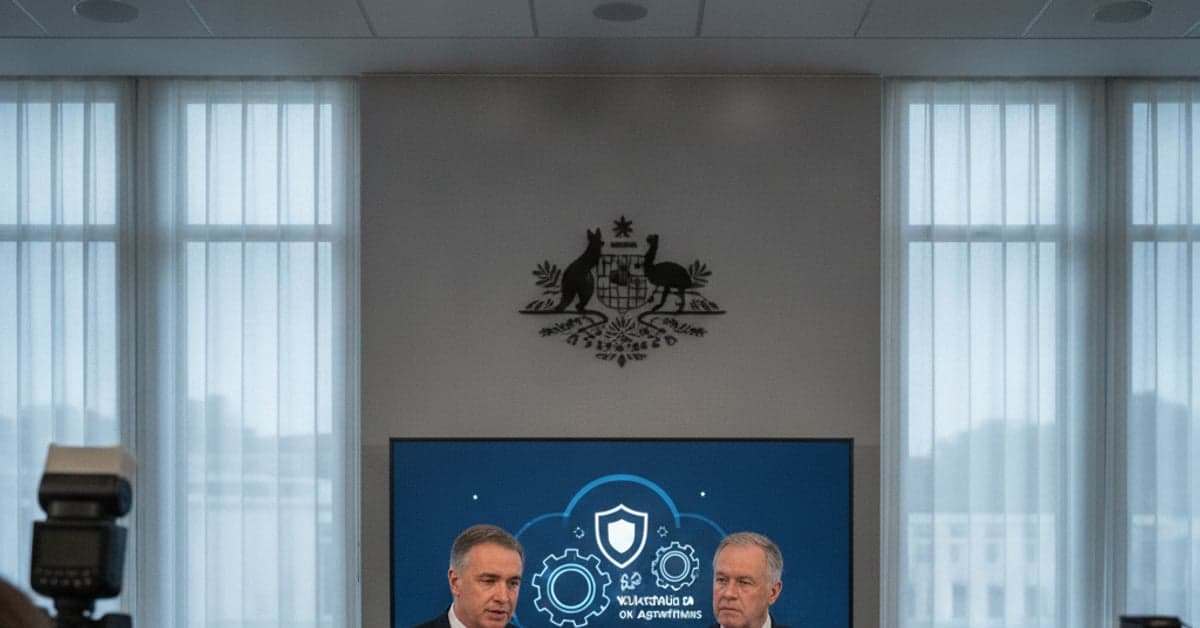
On July 19, 2026, the Australian government moved to curb automated decisions in public services under new national rules, paired with a Labor push for a digital duty of care law, according to The Guardian. The shift places guardrails on algorithms inside agencies rather than only on consumer tech, and it signals a post‑Robodebt reset. The Australia AI decision-making rules aim to put a human back on the hook for outcomes that change people’s lives.
What Canberra announced on July 19
The Guardian reported that the plan focuses on government use of automated AI decision-making and a separate legislative push to create a digital duty of care for platforms. The first governs how agencies can rely on algorithms to assess benefits, compliance, or eligibility. The second would set platform obligations to reduce foreseeable harms to users. Put together, they clarify who is responsible when a model quietly makes or nudges a call that affects citizens.
The policy comes after the Royal Commission into the Robodebt Scheme found illegal debt notices were issued using automated income averaging, with weak oversight and poor accountability. The Commission’s final report in July 2023 detailed how system design failures and blurred responsibility led to harm and unlawful debts (Royal Commission report). By tightening rules around agency automation, Canberra is trying to stop that pattern from repeating.
Why the Australia AI decision-making rules land now
Two forces have converged. First, the political and legal fallout from Robodebt has made automated decision-making a live risk for every portfolio. Second, models are easier to deploy than ever. Without explicit checks, they spread quickly from “assistive” triage tools into systems that tip the balance on a person’s benefit or penalty.
Global guidance sets a template. The OECD’s approach to trustworthy AI calls for human oversight, transparency, and recourse in high-stakes use (OECD AI Principles). The U.S. National Institute of Standards and Technology frames AI risk management around context, documentation, and measurement (NIST AI RMF). Australia’s move aligns with this direction but addresses a specific gap: binding expectations when an agency lets an algorithm steer an outcome.
The Guardian’s account links the policy to a new national plan and a duty of care push. That pairing matters. It puts responsibility both upstream, on procurement and deployment inside government, and downstream, on platforms whose recommendation and moderation systems shape what Australians see and report.
What may change inside agencies
Details of implementation were not published in The Guardian’s brief, but the shape of reform is predictable given past failures and global norms. Expect mandatory mapping of where models make or inform decisions, impact assessments for high-risk uses, and clear assignment of decision ownership to a human official. Agencies will likely need to publish plain-language descriptions of automated tools, the data they use, and the avenues for review.
Procurement will get stricter. Vendors pitching case management, identity, or risk scoring tools should anticipate tougher evidence requirements and audit rights. Documentation of training data lineage, performance across cohorts, and known failure modes will move from nice-to-have to table stakes. If Canberra follows the direction signaled by privacy regulators, agencies will also have to justify data minimization and retention choices (OAIC guidance on AI and privacy).
For frontline staff, the biggest difference may be accountability. An officer who signs off on a benefits decision can no longer assume the system got it right. That will slow some workflows, at least at first. It could also rebuild trust for people who want to know a human is answerable when the facts are wrong.
Duty of care: what the parallel push means
The linked digital duty of care proposal goes after a different risk surface: platforms that amplify harmful content or enable abuse. The Guardian frames it as a Labor effort to legislate platform responsibilities. That would move Australia toward regimes in the U.K. and E.U., where platforms must assess systemic risks and act to reduce them. The effect on AI is indirect but significant, because ranking, recommendation, and moderation systems are all model-driven.
If enacted, a duty of care could force clearer explanations when automated tools demote, remove, or promote content. It may also pressure platforms to open up to independent research and give users better appeal channels. For agencies, this dovetails with the Australia AI decision-making rules by creating a more consistent expectation of transparency across public and private decisions shaped by models.
The stakes after Robodebt
The reference point remains the Robodebt saga. According to the Royal Commission, the program inverted the burden of proof onto recipients and relied on a flawed data-matching design that lacked proper legal basis. Automation didn’t just scale efficiency; it scaled error and harm. That is the cautionary tale this policy seeks to answer.
The coming test is whether new guardrails stop quiet drift. Today’s “assistive” tools become tomorrow’s determinants when pressure mounts to cut queues or hit targets. Clear lines—what a system can recommend, what it can decide, and when a person must review—are the measure of success for any Australia AI decision-making rules.
What to watch next
Three signals will show if this shift has teeth. First, timelines. Agencies need deadlines to inventory automated tools and publish risk assessments. Second, procurement clauses. Standard contracts should include audit rights, disclosure of model updates, and obligations to fix harmful drift. Third, recourse. Citizens must have simple ways to contest an automated outcome and reach a person with authority to reverse it.
Scrutiny will follow. State auditors, ombuds, and civil society groups will likely test compliance with freedom-of-information requests and case studies. Courts will examine whether a “human in the loop” is real oversight or a rubber stamp. International partners will watch how Australia operationalizes these controls, comparing them against frameworks from the OECD and NIST.
If Canberra delivers on the promise sketched by The Guardian, Australia could become a reference case for post‑scandal governance of public-sector AI. If it stalls, old incentives return and new systems will make old mistakes—just faster. The moment calls for precise rules, published evidence, and ownership of decisions end to end. That is the bar the Australia AI decision-making rules now set. For more on this, see bloomberg.com and nytimes.com.
Related reading: Meta AI • NVIDIA • AI & Big Tech