
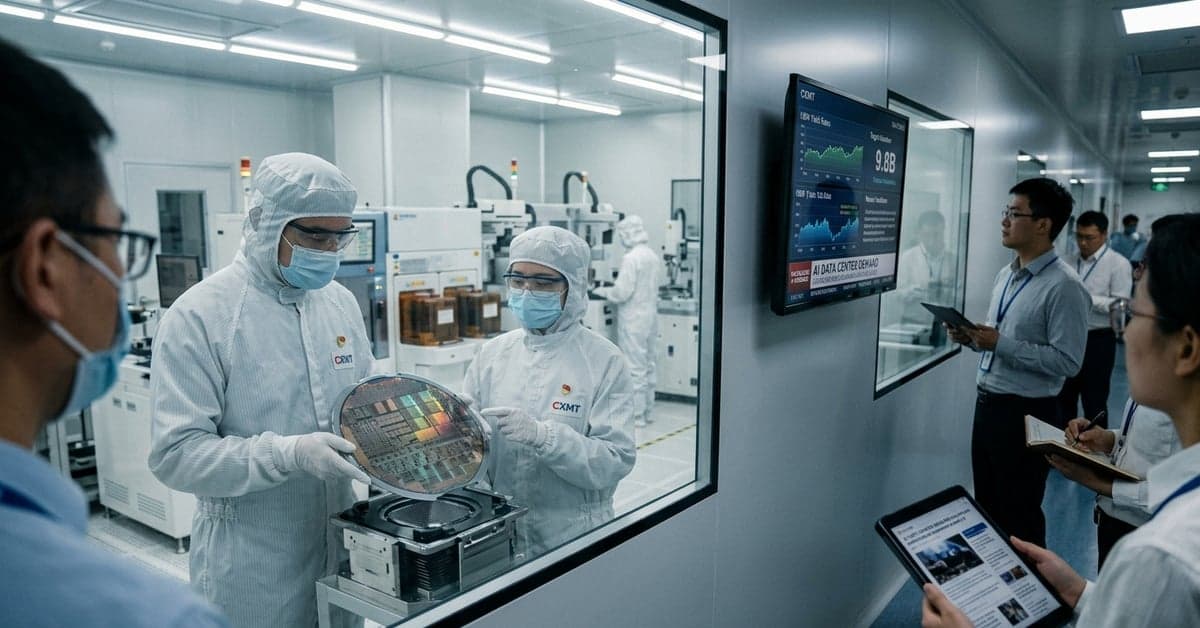
SCMP says CXMT targets a $9.8 billion listing
China’s ChangXin Memory Technologies is preparing a listing that could raise about US$9.8 billion, according to the South China Morning Post on July 16, 2026. The report said the CXMT IPO would be China’s second-biggest this year, riding a rush of capital into chips as AI data centers devour more memory. If the timetable holds, this will test investor appetite for a capital-intensive business that scales only with relentless spending.
The CXMT IPO is more than a financing event. It is a policy moment. Beijing wants a domestic memory champion that can feed AI server builds without leaning on foreign suppliers. That ambition now meets the math of fabs, yields, and product roadmaps.
What the SCMP report implies about the CXMT IPO
SCMP frames the raise around a surge in global memory demand driven by AI infrastructure. That checks out. Training clusters and inference farms buy DRAM in bulk and pay premiums for performance bins. But the spread between commodity DRAM and the high-end memory used in AI accelerators has widened. The proceeds from a CXMT IPO must bridge that gap.
Today’s AI buildouts center on high-bandwidth memory, or HBM, stacked close to GPUs to feed data fast. IEEE Spectrum offers a clear explainer on why HBM matters for accelerators and why it’s costly to produce (IEEE Spectrum). For CXMT, the question is whether fresh equity can fund the leap from mainstream DRAM into packaging, materials, and testing steps needed for advanced stacks over the next product cycles.
Why a Chinese DRAM listing matters for AI memory
AI buyers don’t just need capacity. They need predictable supply, consistent latency, and thermals tuned for dense racks. A ChangXin Memory listing signals that Chinese cloud and systems firms may lock in local memory supply contracts as they scale domestic AI training. That could change price dynamics for regional customers and limit import exposure if logistics tighten.
There is also a hedge at work. In October 2023, the U.S. Commerce Department expanded chip export controls covering advanced computing and semiconductor tools (U.S. Commerce Department). While those rules target leading-edge compute and equipment, they raise execution risks for any Chinese chipmaker that must plan multi-year tool buys and process migrations. A bigger cash cushion helps absorb schedule slips and vendor workarounds.
If domestic hyperscalers and server OEMs move more orders to a local DRAM source, foreign incumbents face a tougher fight for share in China’s AI racks. Pricing could turn choppier as procurement teams trade off performance, delivery certainty, and government guidance.
The HBM hurdle and how CXMT could spend the money
HBM is the prize. It’s also the budget sink. Moving toward HBM3-class products takes advanced packaging, through-silicon vias, and tight integration with accelerator vendors. Each step costs time and capital. That’s where proceeds from a CXMT IPO would likely concentrate if the company aims at AI workloads rather than only PC and mobile shipments.
The near-term path may be phased. First, push density and power efficiency in conventional DRAM to win servers. Then, develop packaging partnerships to approach HBM performance tiers. The technical milestones are clear; the calendar and tooling paths are not. The industry’s leaders have spent years tuning yields on stacked memory. Late entrants can close ground, but every node migration compounds risk.
Strategy also matters outside the cleanroom. China has promoted domestic tech upgrading for a decade, including through policies often grouped under “Made in China 2025” (Council on Foreign Relations). A successful ChangXin Memory listing would align with that push, signaling to local investors that scale manufacturing in components—less flashy than chips for AI compute, yet essential—can attract large pools of capital.
What to watch ahead of a ChangXin Memory listing
Investors will want concrete markers before pricing day. Look for disclosed capex plans tied to specific process upgrades, not generic expansion lines. Watch for supply agreements with domestic cloud providers covering multi-quarter volumes. Track any visible packaging collaborations that move the roadmap closer to HBM-class stacks.
Risk cuts the other way too. If export controls tighten or key tools remain constrained, ramp timelines could slip. If AI server demand cools or mix shifts away from high-density DIMMs, revenue targets get harder. Those are standard chip-cycle worries, just magnified for a company scaling under policy scrutiny.
The CXMT IPO, if it hits the reported size, would mark a financing win and a credibility test for China’s memory ambitions. Success would put more local memory into Chinese AI racks and could pressure pricing in the region. Miss the yield and packaging milestones, and the market will discount fast. That’s the wager now on the table. For more on this, see bloomberg.com and nytimes.com.
Related reading: Meta AI • NVIDIA • AI & Big Tech