
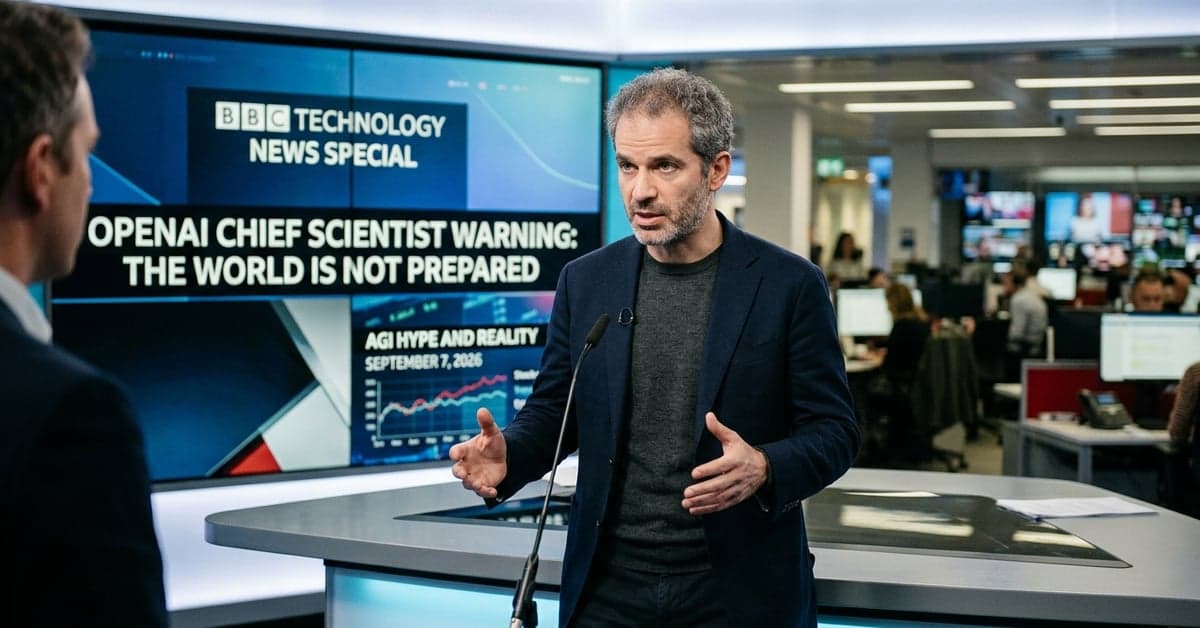
September 7, 2026 — The BBC Technology desk reports that the OpenAI chief scientist has warned that no one is prepared for the consequences of AI. The timing is striking. Days after upbeat talk of an AGI era, the message flips to risk and readiness. That split-screen matters far beyond Silicon Valley.
What the BBC reports about the OpenAI chief scientist
According to the BBC’s technology section on September 7, the OpenAI chief scientist said the world is not ready for AI’s fallout. The headline itself is blunt. It signals a belief that capability is outpacing control, and that current guardrails are thin.
The BBC item does not sit in a vacuum. OpenAI is building some of the most widely used models on the planet. A warning from its top scientist is not a think-tank memo; it is a status update from inside the machine room.
AGI fanfare vs safety alarms: why the signals clash
Three days earlier, The Guardian’s technology team reported that OpenAI hailed a “new era” with its Astra model release on September 3, 2026. You can see that framing on The Guardian’s AI section. On September 5, the same outlet explored whether warnings of uncontrollable AI are becoming real. The juxtaposition captures the industry’s mixed messaging: speed and spectacle, then a cold shower.
That clash confuses buyers, regulators, and the public. When a company celebrates AGI-level ambition on Wednesday, then signals systemic risk on Saturday, stakeholders are left guessing which message to trust. The most plausible read is this: the labs are pushing hard, and the people closest to the work are worried the rest of us are still treating AI like a normal software roll-out. Both can be true at once.
For enterprises, this split means two tracks must run in parallel. Teams can evaluate new models for value. They must also assume failure modes will show up in production, fast, and at scale.
Why the OpenAI warning matters for buyers and regulators
The OpenAI chief scientist warning elevates a practical question: what does “prepared” look like? There are usable playbooks already on the shelf, but many firms have not put them to work.
- Adopt a common risk language. The U.S. government’s NIST AI Risk Management Framework lays out functions to govern, map, measure, and manage model risk. Treat it like you treat SOC 2 or ISO controls.
- Know if you are “high-risk.” The European Union’s AI Act imposes strict duties on high‑risk systems: data quality, transparency, human oversight, and post‑market monitoring. Even firms outside the EU should assume similar obligations will spread.
- Stand up operational guardrails. Require pre‑deployment evaluations, safety tests against known red‑team suites, a monitored kill switch, and incident reporting that reaches executives within hours, not weeks.
- Document model use. Keep a model register with versions, purposes, data sources, red‑team results, and owners. ISO/IEC 42001 offers a management system template; see the standard’s overview at ISO.
- Tie access to accountability. Limit powerful tools to trained users with clear escalation paths and audit trails.
Regulators face their own readiness gap. The BBC item implies a pace mismatch between capability and oversight. Coordination on incident reporting and evaluation sharing would help close it. A shared library of real failure cases, with technical and organizational fixes, would help even more.
What this split-screen means for OpenAI’s credibility
Public trust turns on consistency. The OpenAI chief scientist can ring the alarm, and the company can ship ambitious models. The question is whether policy, product defaults, and support match the rhetoric.
Signals to watch include: red‑teaming disclosures with clear coverage gaps, default rate limits tied to abuse risk, and opt‑out settings that make sense out of the box. Also watch for third‑party audits that publish methods, not just badges. If those start showing up as standard, the warnings read as stewardship. If they do not, buyers will see marketing on one side and liability on the other.
What to watch next from OpenAI and rivals
Expect more capability demos. Expect more safety talk. What will count are changes that land in enterprise contracts and product dashboards. Look for stronger fine‑tuning controls, safer tool‑use defaults, and clearer incident SLAs. Watch how OpenAI and peers describe AGI‑adjacent features after September 7, and whether that description lines up with the OpenAI chief scientist warning carried by the BBC.
Until then, the safe move is simple: treat these systems like high‑power tools. Plan for misuse, error, and drift before they ship. Then monitor them like your business depends on it—because by now, for many, it does. For more on this, see reuters.com.