
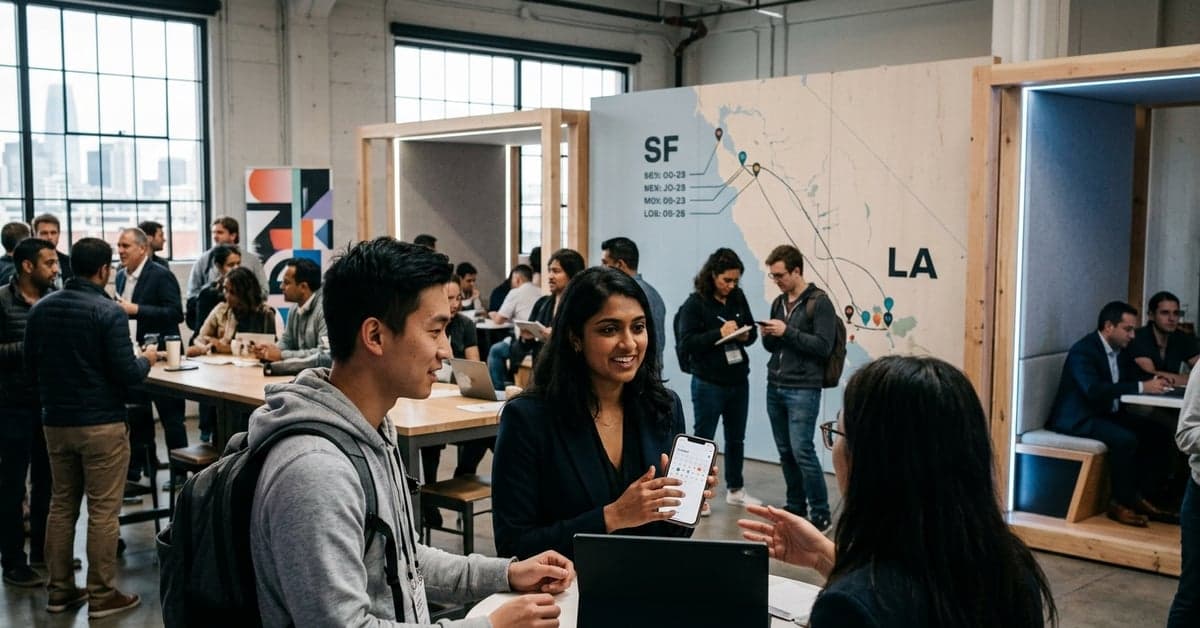
San Francisco will open SF Tech Week 2026 from October 5–11, followed by Los Angeles from October 12–18, according to the official Tech Week site. The series, presented by a16z, returns as a decentralized, citywide program spanning hundreds of founder-led meetups, panels, demos, and hackathons.
The dates matter for anyone planning launches or fundraising around the fall cycle. With SF Tech Week 2026 feeding directly into a second week in LA, founders and investors can stack meetings across both hubs without losing momentum.
Dates, cities, and how the week works
The calendar shows Boston from May 26–31, 2026 and New York City from June 1–7, 2026, then two back-to-back West Coast weeks in October. According to tech-week.com, every gathering is organized individually by startups, VCs, or community groups. It’s a city-spanning schedule rather than a single venue, which shapes how attendees plan their time and where hosts compete for attention.
The format is an a16z-presented decentralized conference, which mirrors the “unconference” style that puts more weight on hosts and micro-communities than on a central stage. For readers unfamiliar with the model, unconference guides outline how distributed sessions can encourage targeted discussions and fast iteration.
SF Tech Week 2026 is framed as the kickoff, with LA picking up where the Bay leaves off one week later. Back-to-back timing tightens travel windows and can compress deal flow into two intense weeks. That’s the draw, and also the challenge: attention is scarce, so event hosts need a clear pitch and a realistic capacity plan.
Who’s headlining SF Tech Week 2026
The featured lineup spans enterprise leaders and startup builders. The site lists IBM CEO Arvind Krishna, Biz Stone (Twitter co-founder), Brian Halligan (HubSpot co-founder), Will Ahmed (WHOOP founder and CEO), Steve Fredette (Toast co-founder), and multiple a16z partners including David Haber, Anish Acharya, Seema Amble, Jorge Conde, and Jonathan Lai. Creative AI and media are represented by Cristóbal Valenzuela of Runway and Shuo Wang of Deel, among others.
The mix signals breadth: enterprise software, payments, creator tools, and bio intersect on the same calendar. For early teams, that cross-traffic can put a niche product in front of investors who weren’t planning to see it. It also means the obvious marquee talks won’t be the only places where momentum builds.
Because the week is decentralized, smaller sessions can punch above their weight if they offer specificity or unique access. Hosts that define a clear audience — and stick to it — usually create better collisions than broad, catch-all panels.
Why LA Tech Week 2026 follows right after
LA Tech Week, scheduled for October 12–18, 2026, “picks up where SF leaves off,” per tech-week.com. The organizers position it as powered by fast-growing companies and sharp investors on the West Coast. That framing makes the second week feel like a continuation rather than a coda, which can keep founders on the road to close loops started in San Francisco.
The back-to-back setup also reduces context switching. An investor can track an idea from prototype demo in SF to a deeper roundtable in LA five days later. For operators, two dense weeks can replace months of scattered travel. Out-of-town attendees hunting for venue clusters might check neighborhood guides from SF Travel and Discover Los Angeles to plan transit and time windows between sessions.
Expect calendars to fill in waves. Hosts often publish event pages as approvals come through, so monitoring the official schedule and mailing lists will matter. The first to announce isn’t always the hardest to get into; some of the most useful gatherings publish late and cap capacity.
Want your event on the calendar? Here’s how to host
Event submissions are open now for San Francisco (October 5–11, 2026) and Los Angeles (October 12–18, 2026), the organizers say. The host portal outlines a review process: submit a proposal, wait for approval, then publish details. The event format is up to the organizer. Popular picks include hackathons, founder AMAs, investor office hours, product showcases, and late-day meetups.
Three practical tips stand out for first-time hosts, drawn from the model described on tech-week.com and prior years’ structure:
- Pick a tight theme. A well-defined audience makes it easier for attendees to self-select and for conversation to go deep fast.
- Decide on capacity early. Intimate sessions can outperform large panels if you promise and deliver access.
- Plan for spillover. If your venue is small, consider a follow-on coffee window nearby for late registrants.
Because the schedule spans a city, not a single campus, logistics matter. Hosts should include transit notes, arrival buffers, and clear instructions in invites. Attendees coming for both SF Tech Week 2026 and the LA follow-on will be balancing travel and calendar holds; crisp details lower friction and increase turnout reliability.
Why this two-week run matters for founders
Concentration creates signal. SF Tech Week 2026 brings hundreds of builders into short walking or rideshare range. The following week in LA extends that same density across a new set of rooms. The effect is cumulative: conversations compound, weak ties get warmer, and decisions happen faster than they would across a quarter of scattered trips.
That doesn’t guarantee outcomes. It does tighten the feedback loop. If you’re testing a pitch, you can refine it three times in one day, then try the revised version with a different audience two days later. The format — a16z’s decentralized approach — rewards specificity and speed much more than broad stagecraft.
The schedule is fixed; attention isn’t. Teams that show up with a clear ask and crisp materials will convert limited windows into real progress. The pages on tech-week.com set the frame. The results will come from what founders and investors choose to do inside it.
For readers plotting the fall, the safest bet is to lock travel early, monitor updates, and pick a few must-attend sessions in each city. Leave space for serendipity. SF Tech Week 2026 starts the run. LA keeps it going. For more on this, see bloomberg.com and nytimes.com.
Related reading: Meta AI • NVIDIA • AI & Big Tech