
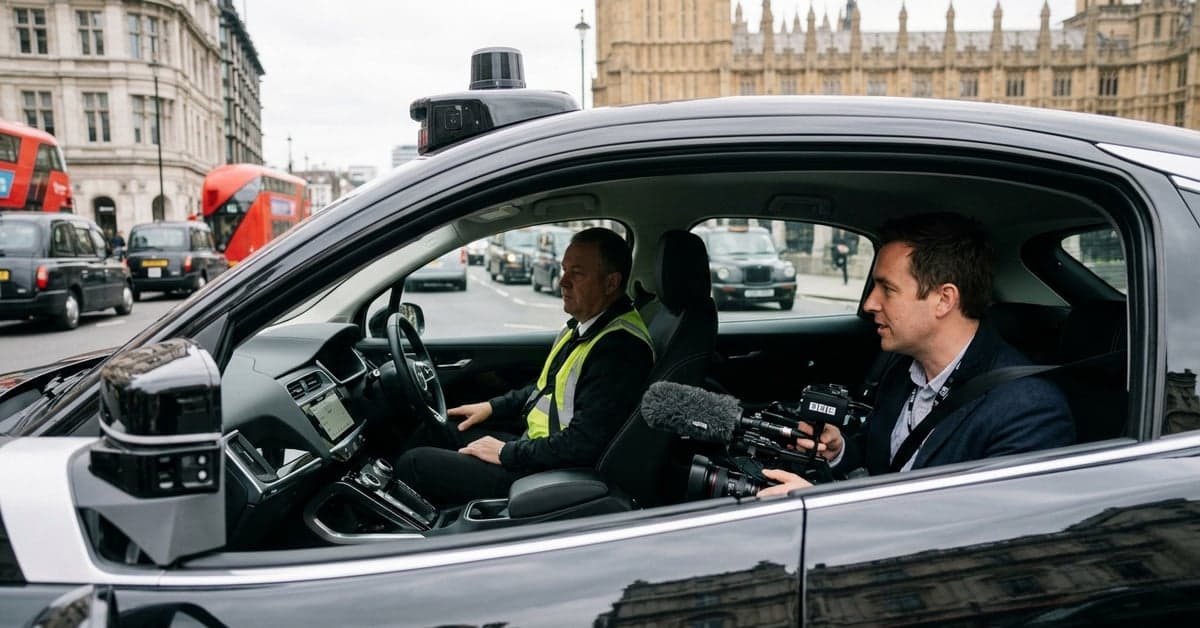
September 3, 2026 — Uber began offering paying passengers rides in self-driving taxis in London, with a trained safety driver behind the wheel. The BBC rode in one during a filmed test around the city, describing the feel of the ride and on-road behavior (BBC Technology). The Guardian framed the debut as London’s first self-driving taxis for hire, marking a long-awaited shift from closed trials to public service (The Guardian).
How the Uber robotaxi London pilot actually works
Uber’s rollout isn’t driverless. A human operator sits in the driver’s seat, ready to take control. That choice mirrors the UK’s step-by-step approach to autonomous vehicles, where the first public-facing deployments emphasize oversight and traceable safety practices. According to the BBC Technology page on September 3, 2026, journalists were able to ride and observe the system’s behavior, giving early riders a sense of what to expect.
In practice, that means passengers get a robot-driven ride, but with a visible fallback layer. It also signals that the service likely operates within a defined envelope — clear weather and mapped roads — until operators and regulators are confident enough to widen the scope. The Guardian described the service as the first for-hire step in London, which is a meaningful line to cross because it blends the realities of city traffic, rider expectations, and platform logistics into one testable product (The Guardian).
The point of this phase is not speed. It’s data. Every mile with a safety driver lets Uber prove where the system performs well, where it hesitates, and which edge cases still trigger a handover. Expect the company to focus on smooth merges, predictable lane changes, and conservative behavior at busy junctions — the traits that make or break confidence on London streets.
UK rules shape today’s ride — and tomorrow’s
London’s launch lands in the shadow of new national law. The UK’s Automated Vehicles Act 2024 sets the framework for authorizing self-driving features, defining responsibilities for companies, and governing how “self-driving” can be marketed. It’s built for real deployments, not just tests. The law also creates an Authorised Self-Driving Entity structure and a safety investigation process, which together aim to keep accountability clear as vehicles take on more of the driving task.
Until a feature is formally authorized under that regime, trial work follows the UK’s Code of Practice for automated vehicle trialling, which stresses safety drivers, clear risk assessments, and engagement with local authorities. That’s why Uber’s London rides include an operator now. It aligns with the current rulebook while the company gathers evidence for any future step toward true driverless service.
The law’s other big lever is language. The AV Act guards how companies describe self-driving capability, so riders aren’t misled about what a car can and can’t do. That matters in a mixed fleet where one ride might be human-driven and the next semi-automated with a safety driver present. Clear labeling reduces the risk that passengers over-trust the tech.
What riders should watch as the service grows
For passengers, the early question is simple: does it feel safe? The answer will come down to conservative decisions at roundabouts, stable gap selection, and how the vehicle behaves when pedestrians make sudden moves. If riders feel a smooth, predictable pattern — even if it’s slightly cautious — trust builds fast. If they sense indecision, it fades.
Coverage and reliability will define convenience. A small service area limits novelty to a one-off experience. A wider footprint, consistent wait times, and normal pricing make it part of a commuter’s toolkit. None of those metrics are fixed on day one, but they’re the ones that push autonomous rides from press demo to habit.
The Uber robotaxi London pilot also raises a practical question for drivers on the platform. In the short term, every robotaxi has a human in the loop, so the launch adds shifts rather than removes them. Longer term, it depends on where authorization lands, what hours the system can operate, and whether insurers and city regulators clear expansion. Those levers, more than the tech alone, decide how fast the mix of human and autonomous rides tilts.
Why today’s cautious rollout is the right one
The UK approach reflects lessons from abroad. In California, state regulators suspended Cruise’s driverless permit in October 2023 after a serious incident, forcing a reset of operations and oversight. That episode underscored how one high-profile failure can set the entire sector back, even when competitors like Waymo continue to run driverless rides in selected areas. The best way to avoid that spiral is not promises; it’s proof, collected on public roads under watchful eyes. The Cruise decision is detailed in the California DMV’s order.
London’s first-for-hire phase aims for exactly that. By keeping a human operator in the seat, companies can expand mileage responsibly, investigate disengagements, and show regulators — and the public — that the system improves over time. If evidence stacks up, the argument for driverless service grows stronger. If it doesn’t, the operator remains the backstop.
What comes next for self-driving taxis in London
Expect incremental steps: longer operating hours, more neighborhoods, tougher weather, and fewer late-stage handovers. Each change will need to fit the AV Act’s authorization pathway and the UK’s trial code, with transparent reporting to maintain trust. The Uber robotaxi London launch puts the company in the room for those decisions, instead of watching from the sidelines.
Two milestones will signal real progress. First, a published, regulator-backed safety case that details performance in London’s specific conditions — narrow streets, complex junctions, cyclists, and dense foot traffic. Second, limited driverless segments, even if geofenced, with clear rules and rapid incident transparency. The BBC’s on-road ride and The Guardian’s framing of the service as the city’s first for-hire deployment show the public is ready to judge this on outcomes, not hype (BBC Technology; The Guardian).
The direction is clear. London doesn’t need the first driverless taxi to win. It needs the safest one that people choose again. If Uber keeps hitting that mark — and if the UK’s legal and oversight structure keeps rewarding hard evidence — the city’s cautious debut could become the model others copy. For more on this, see bloomberg.com.
Related reading: NVIDIA • Meta AI • AI & Big Tech