
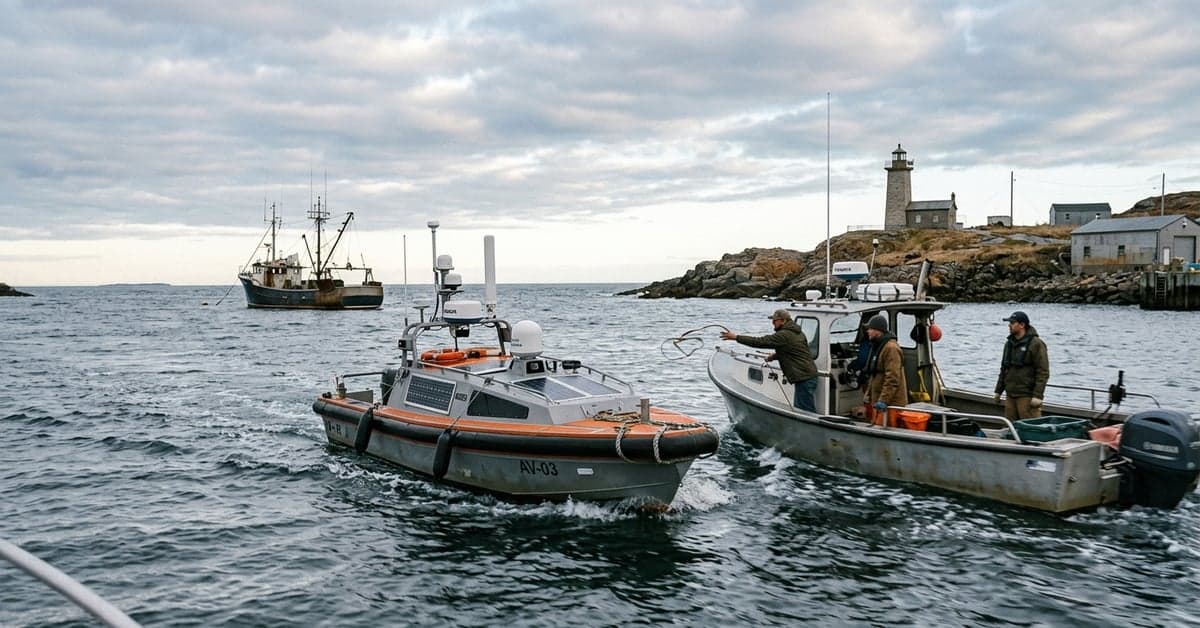
A small robotic vessel has crossed the Atlantic without a crew on board, marking the company’s third attempt at the feat, according to the BBC’s Science & Environment section on September 19, 2026. That autonomous boat crossing is more than a stunt; it shows how AI-driven navigation is maturing in harsh, real-world seas.
What the autonomous boat crossing proves
The BBC reports the craft made it across the ocean unaided, after two prior tries fell short. That track record matters. It suggests the autonomy stack can now handle extended power management, shifting weather, and long gaps without human input. It also hints at better failover planning and safer recovery when sensors falter.
For ocean science, a repeatable autonomous boat crossing lowers the bar to gather data where crewed ships are too costly or risky. Uncrewed surface vessels can run for months, burn far less fuel, and collect continuous measurements. That aligns with the need for denser ocean observations highlighted by agencies like NOAA’s uncrewed systems program, which uses drones and surface robots to monitor storms, fisheries, and carbon cycles.
How maritime AI navigates a moving ocean
Autonomous surface vessels make local decisions on the edge. Cameras, radar, AIS ship transponders, GPS, and inertial sensors feed perception models that spot hazards and track vessels. Planning modules then set short routes to meet a longer voyage plan, while staying within maritime rules.
The hard part is ambiguity. Sea clutter can look like a target. Squalls can wipe sensors. Ship contacts may not broadcast AIS. That is why robust fusion across sensors, conservative collision-avoidance behavior, and verification against COLREGS as interpreted by the International Maritime Organization are central to credible autonomy at sea.
Because bandwidth offshore is limited, much of this runs on embedded compute aboard the hull. That edge AI keeps latency low and decisions local, then compresses and sends summaries shoreward. It’s a design pattern NIST has encouraged for higher-stakes systems through structured risk practices like the AI Risk Management Framework.
Why the crossing matters for climate and ocean science
Long endurance craft can map sea surface temperatures, salinity, dissolved oxygen, and CO₂ exchange over wide tracks. That steady stream helps refine weather and hurricane models, fill blind spots between satellites, and check how heat moves into the deep ocean. A successful autonomous boat crossing widens the radius where such data can be gathered without a research crew.
The emissions math is simple. A small electric or hybrid marine drone consumes a fraction of a crewed ship’s fuel. Multiply a handful of craft into a seasonal fleet, and the carbon savings become material. Less transit time for large vessels and fewer crewed days at sea free budgets for sensors and science.
There’s also resilience. When a storm threatens, operators can route the unit out of harm’s way or intentionally through the edge to sample extreme conditions, as projects like NOAA’s have shown with uncrewed hurricanes missions. The win is twofold: richer datasets, lower risk to people.
Safety, law, and scaling up autonomous vessels
Maritime autonomy isn’t a software-only problem; it’s a system safety problem. Busy shipping lanes, fishing gear, and drifting debris raise collision risk. Engineers add rules-aware planners, redundant power, and remote override. But reliability needs proof across seasons and oceans, not just one successful voyage.
Regulators are moving, but patchily. The IMO’s work on Maritime Autonomous Surface Ships sets a common language, yet national rules and port policies still decide where uncrewed craft can sail. Operators will need clear playbooks for watchkeeping, incident reporting, and handover to human control in traffic separation schemes.
Security is part of that checklist. GNSS spoofing, AIS manipulation, and satellite link loss are real threats. Edge autonomy helps if comms drop, but it raises new questions about software assurance and update processes at sea. Applying structured governance, the kind laid out in NIST’s framework, can turn a one-off voyage into a reliable service.
What to watch after this autonomous boat crossing
Two signals will tell us if this moment sticks. First, repeatability: more crossings on planned schedules, with transparent incident logs. Second, utility: missions that pair autonomy with meaningful science—carbon flux transects, storm sampling, basin-scale temperature lines—so the value outweighs the novelty.
The BBC’s note that this was the company’s third try is a reminder that progress is incremental. Failures teach, and then the system clears the bar. If operators can now plan seasonal routes, integrate with research programs, and win permits along contested coasts, the autonomous boat crossing becomes a building block for ocean observing, not just a headline.
The sea will keep throwing curveballs. That’s fine. The measure of maturity will be how often the AI makes the uneventful choice, documents why, and sails on. For more on this, see nytimes.com.
Related reading: NVIDIA • Meta AI • AI & Big Tech