
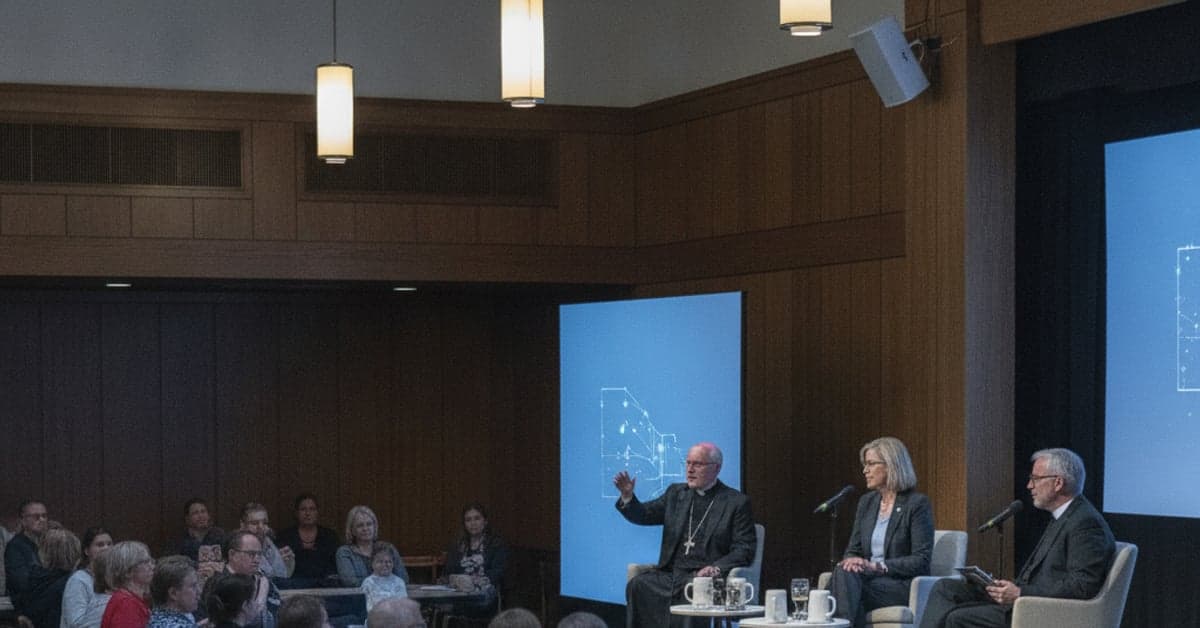
On September 16, 2026 in Omaha, the Nebraska Catholic Conference will host a public AI discussion—“Bishop & Brews”—at the German-American Society at 7 p.m., featuring Archbishop McGovern, State Senator Rita Sanders, and bioethicist Father Kevin FitzGerald, SJ. According to Catholic Voice Omaha, the evening will explore how artificial intelligence is reshaping education, health care, parenting, child protection, data centers and environmental stewardship. The Nebraska AI panel isn’t a tech demo; it’s a civic forum aimed at how families and schools should respond right now.
What the Nebraska AI panel will tackle
The organizers say the discussion ranges from the human person in an algorithmic age to school classrooms, clinics, and the home. Catholic Voice Omaha notes panelists plan to reference a recent encyclical discussion and weigh practical impacts of AI on community life. Expect time on youth safety, classroom tools, and how data-intensive infrastructure touches local neighborhoods. That agenda reflects the questions Nebraskans keep raising: who sets the guardrails for kids, what counts as responsible classroom use, and how Big Tech’s footprint affects energy and water in the state.
Because the panel includes a sitting state senator, the conversation will likely edge into policy, not just pastoral advice. That doesn’t mean bills will be unveiled on stage. It does mean lawmakers are listening for where schools, parents, and faith leaders agree the gaps are.
Why the Omaha AI forum matters for schools and families
Classrooms are adopting chatbots, grading aids, and safety filters faster than many districts can write rules. That’s not abstract. Infosecurity Magazine has tracked a surge in AI-enabled tactics used by criminals and state actors, including ransomware helpers and attack automation, with warnings from major tech companies that the window to respond is shrinking (coverage on August 28, 2026). The outlet also highlighted fresh concerns from the Financial Stability Board on frontier AI risks on September 1, 2026, underscoring that governance gaps can spill into schools and municipalities. Those reports, cited by Infosecurity Magazine, help explain the timing: communities need practical guardrails as AI moves into every device students touch.
Here are focused questions Nebraska parents can take to a principal or school board before new tools roll out:
- What specific classroom uses of generative AI are allowed, and how will teachers disclose those uses to families?
- How is student data protected when third-party AI tools are involved, and who audits vendor claims?
- What’s the plan for AI-enabled cheating and deepfake bullying, and which consequences are spelled out in the code of conduct?
- How will the district test AI tools for bias and accuracy before procurement, and what’s the off-ramp if results fall short?
Districts can anchor those answers to recognized frameworks. The NIST AI Risk Management Framework lays out steps to map uses, measure risk, and manage failures in plain terms. Families don’t need to be engineers to ask whether a district is following that kind of backbone.
Big Tech, data centers, and Nebraska’s footprint
Beyond classrooms, the panel flags data centers and “care for creation.” That’s not an aside. AI has a heavy compute cost, which flows into electricity demand and water use for cooling. The U.S. Department of Energy outlines how facilities can cut consumption through efficient hardware, airflow management, and waste-heat reuse. Those details matter when siting new builds or negotiating community benefits.
For city councils and county boards, the near-term checklist is concrete: require clear reporting on annual power and water use; set targets for efficiency upgrades over time; and write public transparency into local agreements. If a facility promises jobs or infrastructure improvements, document milestones and escalation paths when targets slip. Transparency doesn’t slow growth. It keeps the social contract legible to residents who live next to the infrastructure that runs the internet.
This is where the Nebraska AI panel could add something most tech keynotes don’t: a frank conversation about tradeoffs when global platforms meet local stewardship. Expect community voices to ask how benefits get shared, how emergency services are protected during peak power draw, and how neighborhoods can participate before decisions harden.
How Nebraskans can engage before and after the panel
The format—“Theology on Tap”-style, with brews and open Q&A—invites the questions that don’t fit in a classroom newsletter. If you plan to attend, bring a specific scenario: a homework policy that feels murky, a parental control that failed, or a community concern about a nearby server facility. Specifics force clearer answers than broad hypotheticals.
Can’t make it to Omaha on September 16, 2026 at 7 p.m.? Bookmark the event notice at Catholic Voice Omaha and the Nebraska Catholic Conference channels for follow-on materials. Ask your district to publish its AI classroom policy in one place, with version history and a named contact for feedback. If that page doesn’t exist, propose a deadline to create it.
Expect the Nebraska AI panel to surface two themes: schools need clearer guardrails, and communities want a say in how Big Tech’s infrastructure shows up on their block. Those themes are actionable. Families can push for transparent classroom policies. Local leaders can ask for measurable efficiency gains and public reporting from data centers. And if the conversation in Omaha is any signal, Nebraskans are ready to press for both. For more on this, see bloomberg.com and nytimes.com.
Related reading: NVIDIA • Meta AI • AI & Big Tech