
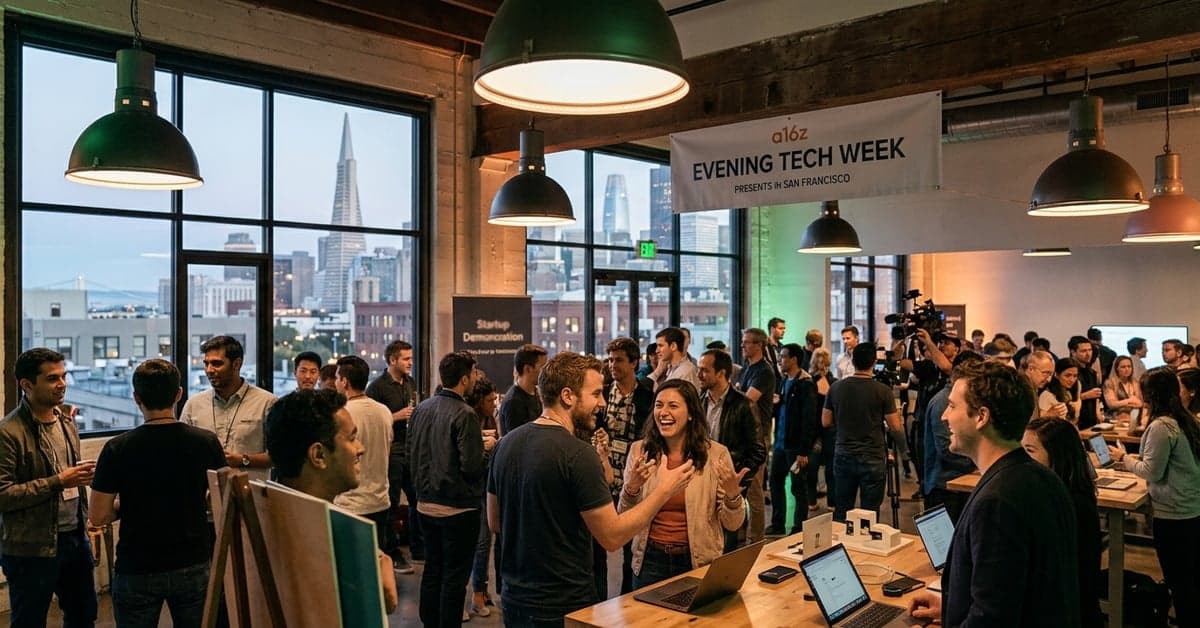
San Francisco will host Tech Week 2026 from October 5–11, followed by Los Angeles from October 12–18, 2026, according to the Tech Week site. Framed as a decentralized tech conference presented by a16z, the week spans hundreds of citywide events run by startups, VCs, and community groups. Event proposals are open now via the official host portal.
Dates, cities, and who’s headlining
The Tech Week site lists two city runs: SF on October 5–11 and LA on October 12–18, 2026. The format remains familiar: seven days of distributed hackathons, meetups, panels, and socials across neighborhoods, rather than one convention center hub. Tech Week is described as a16z’s decentralized series, with each event organized by an individual host and approved through a submission queue. Hosts can apply at tech-week.com/host.
Featured speakers span founders and investors: IBM CEO Arvind Krishna, HubSpot co-founder Brian Halligan, WHOOP founder and CEO Will Ahmed, and Twitter co-founder Biz Stone are among the names listed. The lineup also highlights a16z partners such as David Haber, Anish Acharya, Jorge Conde, Seema Amble, Jonathan Lai, and Bryan Kim, plus leaders like Shuo Wang (Deel), Steve Fredette (Toast), and Cristóbal Valenzuela (Runway). Those names signal a week calibrated for builders, later-stage operators, and dealmakers, not just early-stage pitches.
The sequencing—SF first, LA second—matters. Founders can run Bay Area product sessions early in the cycle, then shift to LA for creator, media, and entertainment-adjacent meetings. According to the event FAQ, the program remains open-calendar and host-driven, which historically rewards teams that book venues and speakers early, then tune formats (AM salons vs. PM mixers) to neighborhood foot traffic.
How a decentralized tech conference changes the calculus
A decentralized tech conference flips the usual trade show dynamic. Instead of paying for a booth in a single hall, teams pick a neighborhood, a time slot, and a format that fits their audience. That increases discovery risk—your panel might sit next to a dozen rival meetups—but it also increases surface area for serendipity. The Tech Week model is built for rapid iteration: small rooms, short sessions, and fast turnarounds between ideas and conversations.
Contrast that with CES, which runs January 6–9, 2027 in Las Vegas, per CES’s official site. CES concentrates the action in a few venues and a single registration funnel. Tech Week disperses it across a city and dozens of RSVP links. The former favors massive launches and pre-booked media tours; the latter favors targeted gatherings and community curation. For startups with more network than budget, a decentralized tech conference often delivers better signal per dollar—if the hosting and programming are tight.
Why the citywide tech festival model favors scrappy teams
The citywide tech festival approach cuts two fixed costs at once: big-booth fees and captive-audience illusions. There’s no default foot traffic. Hosts earn attention with content, timing, and partners. That’s painful for anyone hoping to coast on brand recognition, yet it rewards teams that treat their event like a product with clear positioning and a crisp call to action.
According to the Tech Week site, each event is organized individually by startups, companies, or VCs. That means your sponsors, guest list, and venue all shape the room—and the downstream meetings that week. Builders who pair a hands-on session (demo or code lab) with a smaller, invite-only follow-up often convert better than those chasing one oversized panel. In this model, the decentralized tech conference becomes a campaign canvas: stack small, well-defined touchpoints, and measure them.
What hosts should do next before October
With SF locked for October 5–11 and LA for October 12–18, the clock is already ticking. The program is presented by a16z, but the output is grassroots. Here’s how to make the week count.
- Submit early, then optimize: Get on the calendar via the official host submission, then refine your format and speakers as confirmations land. Early placement boosts discoverability.
- Design for walkability: Pick venues near transit and cluster with peer events. Citywide weeks reward routes people can walk between in 10 minutes.
- Program for the city: In SF, lean into technical deep dives and infra sessions. In LA, plan content that intersects with creators, media, or consumer brands.
- Stack two touchpoints: Pair a public meetup with a smaller workshop or roundtable. The public slot builds pipeline; the small room converts it.
- Share the stage: Co-host with a partner who brings a distinct audience. That halves costs and doubles reach without bloating the agenda.
- Publish a clear ask: Whether it’s alpha users, hiring leads, or design partners, state the outcome you want—and make it easy to follow up.
For attendees, the same rules apply in reverse. Build a personal route map instead of trusting the default feed. Book shorter meetings near anchor events. Reserve one time block a day for unplanned stops. The week rewards intent more than endurance.
There’s a structural story here. The a16z-backed format spreads upside to whoever shows initiative, not just to whoever can bankroll a pavilion. CES remains the right stage for splashy, hardware-forward moments with global press circuits. Tech Week’s distributed design is better for building relationships at speed. In 2026, that’s why the decentralized tech conference will feel less like a single show and more like a city turning into your calendar.
According to a16z’s own description of Tech Week as a decentralized series, hosts control the experience more than at a typical expo. Read differently, that’s a challenge: you can’t buy attention; you have to program it. For founders deciding between SF and LA—or doing both—the split weeks offer a practical path to sequence launches and meetings. Pick your rooms, pick your routes, and treat the decentralized tech conference as a product you’re shipping in October.
Event details and hosting information are available on the Tech Week site, with broader context on the organizer at a16z. For readers weighing centralized vs. distributed strategies, the CES overview offers a counterpoint on how a single-venue trade show sets expectations for product launches and press flow. For more on this, see bloomberg.com and nytimes.com.
Related reading: Meta AI • NVIDIA • AI & Big Tech