
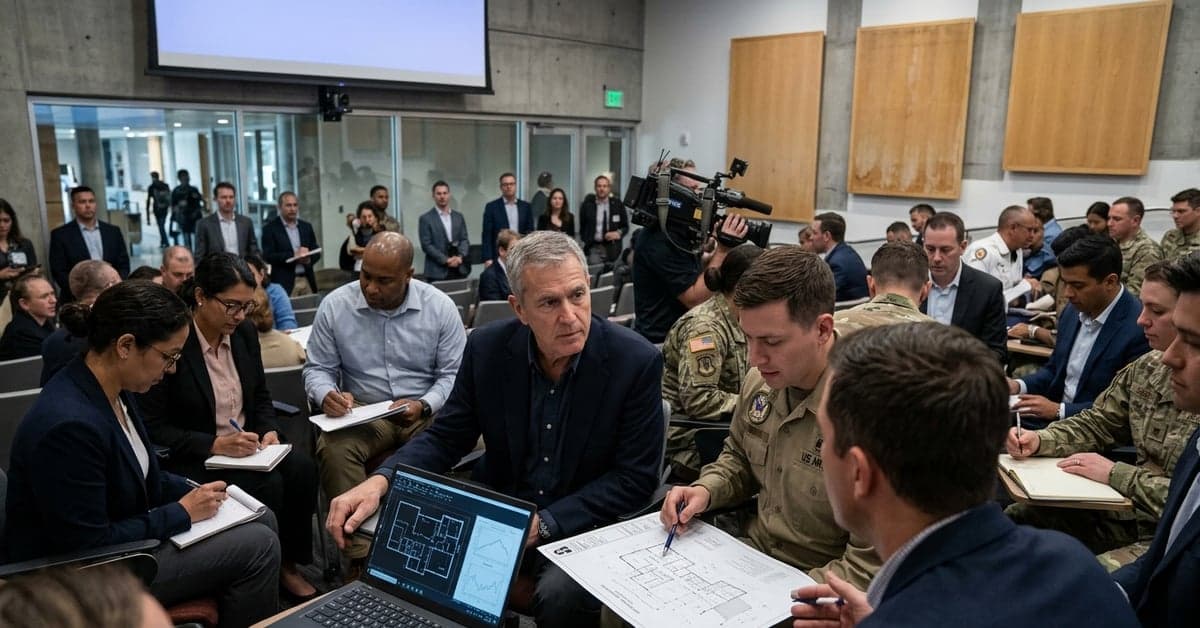
On September 9-10, 2026, federal officials, military engineers, and A/E/C executives will meet at Stanford University’s Center for Integrated Facility Engineering for the 2026 Federal AI Summit, a new forum focused on responsible adoption of AI in infrastructure, according to the Society of American Military Engineers (SAME). The gathering marks the first public showcase for SAME’s National AI Working Group and its IGE team, and it aims to turn cross-sector debate into near-term procurement guidance.
That timing matters. Public agencies face rising pressure to show where AI can speed design reviews, reduce change orders, and cut life-cycle costs, while proving models are safe and auditable. Convening the Federal AI Summit two weeks before fiscal year close gives program leads and vendors a venue to align on what “responsible” means in contract language, test pilots, and data-sharing terms.
What the Federal AI Summit plans to solve
SAME says the event was built to “widen the aperture” on responsible AI for federal infrastructure by putting government owners, A/E/C firms, researchers, and investors in the same room (SAME). That mix matters because design models, jobsite sensors, and scheduling tools all touch different risk owners, yet they succeed or fail together on a base, bridge, or hospital project.
Expect sessions that move beyond showcase demos. Owners need common language for model evaluation tied to mission objectives: accuracy thresholds for code compliance checks, failure modes in cost estimation, and change-control procedures when a model is retrained mid-project. Data governance is inseparable from that work. Facility drawings, geospatial layers, and as-builts sit on different systems; pulling them into an AI workflow without violating records rules or exposing sensitive sites is the crux of the job.
Stanford’s CIFE has long convened research and practice around these lifecycle handoffs. Its work on model-based coordination and lean construction gives the summit a practical footing for A/E/C scenarios where an AI suggestion can save a night pour—or trigger a costly rework (CIFE).
Open-weight ambitions meet public-sector constraints
On August 11, 2026, The Guardian’s technology desk reported that Mark Zuckerberg is pushing “superintelligent” AI for all as Meta releases an open-weight model, arguing broader access speeds progress (The Guardian). Open weights promise flexibility for integrators and researchers. For agencies, they also introduce a checklist: supply-chain review of pretraining sources, patch posture when weights and optimizations change, and how to prevent fine-tuning drift across contractors.
Another item highlighted by The Guardian on August 9, 2026 warned that the AI push is putting banks at the mercy of tech firms, citing Moody’s concerns about dependency on a handful of platforms (The Guardian). Swap banks for base commanders or hospital directors, and the risk reads the same: concentration risk and hard-to-exit architectures. That’s why baseline requirements—exportable model cards, clear data exit paths, and on-prem options when needed—should surface at the summit as non-negotiables.
The policy heat shaping the summit
On August 10, 2026, Senator Bernie Sanders called for a pause on AI development, adding fuel to a broader political fight over speed versus safety, according to The Guardian. That pressure will follow federal buyers into Palo Alto. The Federal AI Summit gives them a chance to translate high-level caution into concrete guardrails: documented human-in-the-loop checkpoints, incident reporting requirements, and content provenance signals for project artifacts.
There’s also a basic infrastructure question that A/E/C leaders can’t dodge: energy and water. The Guardian’s August 9, 2026 coverage captured a growing public debate about whether communities must choose between new data centers and housing or farms (The Guardian). That conversation will follow federal builds too, from cooling strategies on new campuses to utility interconnect timelines. Procurement language that forces bidders to disclose site power plans and water footprints—backed by third-party verification—would turn rhetoric into something project managers can act on.
What A/E/C vendors should prepare before Palo Alto
If you sell into federal infrastructure, come to the Federal AI Summit with proof, not pitches. Four prep steps will pay off:
- Show your safety case. Map model risks to the NIST AI Risk Management Framework, include failure examples, and document mitigations tied to specific A/E/C tasks.
- Bring procurement-ready language. Draft contract clauses on data ownership, retraining triggers, audit logging, and service-level metrics for inference latency and uptime.
- Quantify site demands. Provide power profiles, water use, and heat rejection plans for on-prem or edge deployments, with alternatives if utilities delay interconnects.
- Prove portability. Demonstrate how project data and fine-tuned weights can exit your stack without breaking chain-of-custody or provenance labeling.
Federal teams will reward specifics. If you claim an LLM can reduce RFIs during construction, bring baseline numbers, sample prompts, and the review workflow that kept a human in charge of field decisions.
What to watch after September 10
After the Federal AI Summit wraps, a few outcomes would signal real movement. A shared position on model evaluation that spans design reviews, schedule risk analysis, and cost estimation would cut months of agency-by-agency reinvention. Guidance on data residency and content credentials for drawings and change orders would help owners demand the same proofs from every bidder.
Watch for pilot project criteria tied to measurable goals on schedule certainty or change-order reduction, not broad “innovation” banners. If SAME and Stanford CIFE can help agencies publish that playbook, 2027 solicitations will read very different. Vendors that did the homework will be ready on day one; those still chasing slogans will be playing catch-up.
The stakes are simple. Agencies need systems that make projects safer, faster, and cheaper without surrendering control of data or mission. The September meeting is set up to turn that from talking point to contract clause—and that’s why this year’s Federal AI Summit could matter far beyond Palo Alto. For more on this, see ai.meta.com and bloomberg.com.
Related reading: NVIDIA • Meta AI • AI & Big Tech