
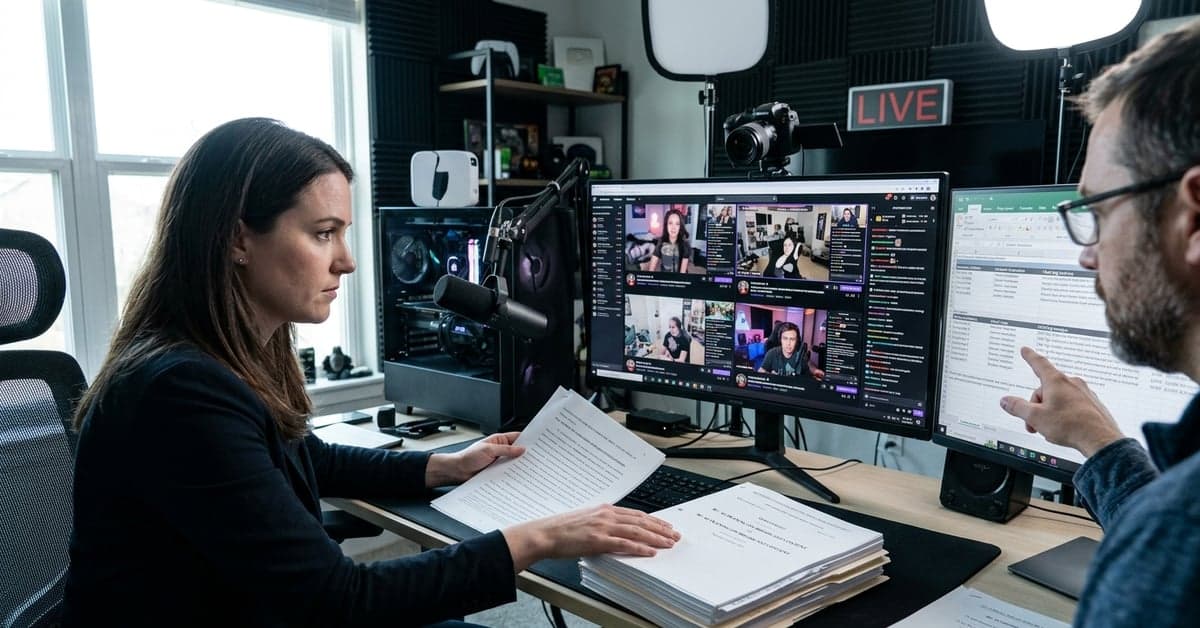
On August 24, 2026, BBC Technology reported that Twitch and parent company Amazon face legal action over claims they used livestreams to train AI systems without permission (BBC Technology). The filing, still emerging, puts a live-video twist on a familiar fight: who gets to decide when creative work becomes training data.
What the Twitch AI lawsuit says about training on live video
The Twitch AI lawsuit appears to challenge whether broadcasters’ streams, chat logs, and associated assets were repurposed to develop automated tools or models. According to the BBC’s technology desk summary, the case targets the practice of ingesting creator content at scale to improve AI features or products. Details will turn on the contract trail: Twitch’s terms, any creator program addenda, how data was stored, and what internal teams used it for. Those specifics determine whether the use aligns with user agreements or strays into unlicensed training.
Context from outside this complaint shows why the issue is heating up. The Guardian has documented growing pushback from creatives who say their work is being fed into AI systems that may one day replace them (The Guardian, AI section). Livestreaming raises the stakes because it blends video, audio, music snippets, and audience chat in real time, creating a dense bundle of rights and privacy expectations that are harder to unwind after the fact.
Live content creates messy consent and privacy edges
Static posts are one thing; live broadcasts are another. Streamers don’t just publish a finished clip. They capture faces, voices, and locations in the moment. They sometimes feature guests or bystanders who never accepted platform terms. They play games and licensed music. Their chatrooms generate text that can contain personal data, and moderation tools recycle it into logs. If any of that material feeds a model, the consent story may splinter across multiple parties.
That’s the nub the case forces into view. Even if a platform’s terms reserve broad rights, live streams create mixed rights and mixed expectations. Viewers may believe they’re part of a fleeting interaction, not a dataset. Guests may assume a limited audience, not perpetual inclusion in an AI corpus. And developers working inside a large platform often don’t see those edges; they see a repository labeled “internal use,” which can be read as a green light until a lawsuit says otherwise.
Privacy regulators have long treated faces and voices as sensitive signals. In the UK, biometrics guidance flags the heightened risks when systems record or infer identity traits from media (ICO guidance). If training pulls signal from streamers’ faces or vocal patterns, questions stretch beyond copyright to data protection and right-of-publicity law—areas where consent and purpose limits are central.
Amazon’s model ambitions meet creator rights
Amazon has been racing to ship model tooling and features across its stack. That’s the backdrop that makes the complaint consequential. If plaintiffs can plausibly tie Twitch data to any Amazon AI workflow, discovery could probe how content flowed between business units and whether internal safeguards separated product development from user uploads. The case also arrives as studios and media firms test new licensing models for training data, a trend The Guardian’s reporting on creative labor tensions has tracked through August 2026 (The Guardian).
For developers, the lesson is practical. Keep a paper trail of dataset provenance. Segment experimental corpora from anything that touches user uploads unless you have documented permission. Audit retention policies for chat logs and VOD archives. If your team relies on platform-provided datasets, demand documentation on acquisition method, legal basis, and opt-out channels. The Twitch AI lawsuit is a reminder that “internal use” is not a magic phrase; courts will look at the purpose and the pathway.
The livestream AI case and what courts might weigh
US courts have treated some intermediate copying for search and analysis as potentially lawful, a view that surfaced in the Google Books litigation, where scanning enabled new functionality without substituting for the originals (Authors Guild v. Google). Whether that logic extends to training on full-fidelity live video is far from settled. A tool that reproduces a streamer’s voice or style looks less like analysis and more like a market substitute.
Expect arguments on at least three fronts: contract (what Twitch’s terms allowed), copyright (did training copy protected expression in a way that harms the market), and publicity/privacy (were faces, voices, or names used in a way that requires consent). Civil procedure matters too. If the complaint survives early dismissal, discovery could surface internal emails and technical docs that define where the legal lines were drawn inside the company.
Advocacy groups have warned that expansive scraping and training claims can chill innovation but also stress that creators need meaningful control and bargaining power. The Electronic Frontier Foundation has called for clearer rules that support research and interoperability while respecting rights (EFF). Live-stream disputes could be the forcing function that moves platforms toward explicit, opt-in licensing with revenue sharing rather than relying on blanket terms users gloss over.
What’s next—and what it means for builders
BBC Technology’s report puts Amazon and Twitch in the legal spotlight. Even if this case settles, the discovery map it draws could guide future complaints across streaming, social, and short-form video. For teams building recommendation, moderation, or generative tools, the signal is clear: treat live content as high-friction data. Tag it. Gate it. Prove consent before it enters a training pipeline.
The Twitch AI lawsuit will also influence how platforms talk to creators. Clear toggles for dataset inclusion, audit trails that creators can request, and transparent model cards that disclose data sources are becoming table stakes. Those steps won’t resolve every conflict, but they lower the chance that a feature demo turns into an exhibit in court.
There’s a bigger cultural shift too, captured by The Guardian’s August coverage of creative workers wrestling with AI’s advance. When live moments become raw material for machines, the social contract of streaming changes. Viewers and guests move from audience to data subjects. Creators move from broadcasters to licensors. That shift won’t wait on a final judgment, and product teams should design as if the consent question will be asked—on the record. For more on this, see reuters.com and bloomberg.com and nytimes.com.