
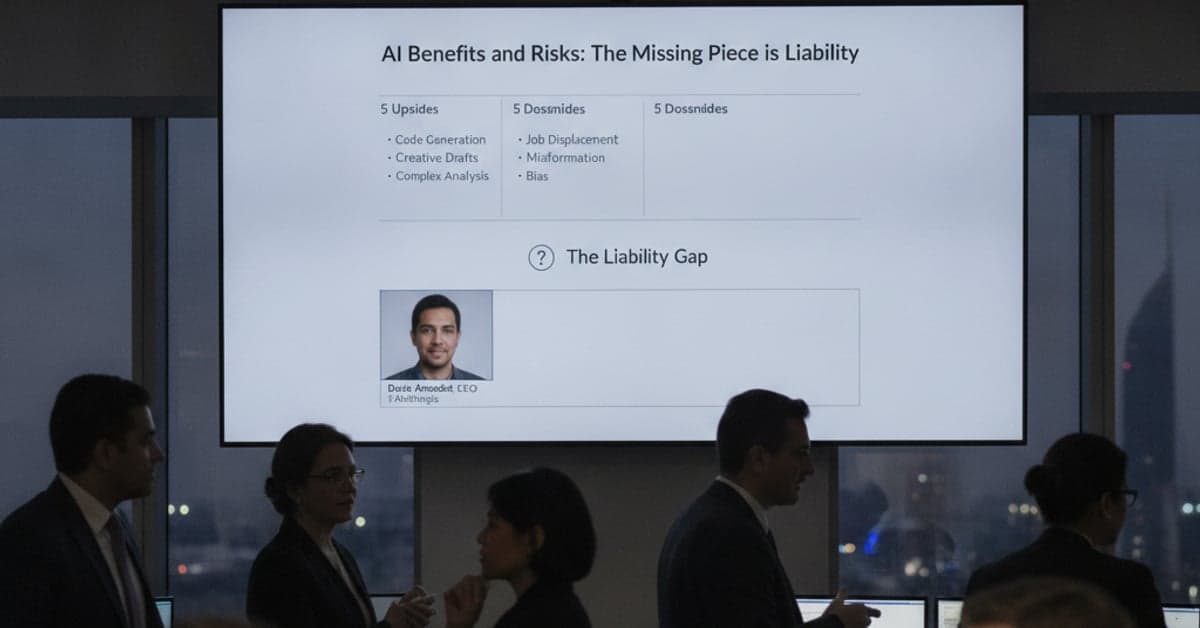
On September 13, 2026, Al Jazeera published an explainer laying out five upsides and downsides of artificial intelligence. It tracks a live debate over AI benefits and risks, and quotes Anthropic CEO Dario Amodei urging a slowdown. The list is useful. What it leaves open is how accountability will decide which trade-offs bite first.
What Al Jazeera lists: five AI benefits and risks
According to Al Jazeera, AI already writes code, drafts images and text, and handles complex analysis. Supporters argue this will lift productivity and spawn new roles. The counterpoints are stark: job losses, faster spread of misinformation, and soaring demand for energy and water to power data centers. Researchers also warn that policy is lagging the tech’s speed. Amodei is quoted as saying, “We must slow the pace at which we improve the capabilities of AI models… and we must make wise use of the time we gain.”
The five pairings in that explainer can be read as two tight clusters. One concerns work: coding assistants and automation expand output, but early-career workers risk being displaced before new roles appear. The other concerns infrastructure and trust: bigger models promise better tools, yet they draw heavier on electricity and water and make it easier to fabricate convincing falsehoods at scale. The AI benefits and risks are real on both sides, and they compound when operators move fast without checks.
The liability gap that shapes these trade-offs
Here’s the missing piece: who pays when systems misbehave. A heated discussion on Hacker News centers on whether labs should face legal exposure when agentic setups take harmful actions. Commenters debate incidents tied to research previews and disabled guardrails, arguing that “letting” an automated system run does not absolve a company of responsibility for how it’s used. The particulars in that thread are claims, not sworn testimony, but the core point stands: liability—not abstract risk—is what moves behavior.
That lens changes how we read Al Jazeera’s five pairs. Job displacement is not simply a macro trend; it’s also a contracting choice. If buyers must attest to impact on junior roles, or fund reskilling as a condition of large deployments, incentives shift. The same goes for misinformation. If platforms must keep provenance logs and face penalties for failing to label synthetic media, detection spend goes up and careless rollouts go down. Energy draw is similar. Where local rules put hard caps on data center water and power, operators site facilities differently, or they invest in efficiency rather than only brute-force compute.
In other words, these AI benefits and risks will play out based on who holds the duty of care. Right now, that duty is uneven. Developers carry it some days, customers on others, and end users most of the time. Clearer lines would compress the downside without stalling the upside.
Work and skills: who gains and who waits
Al Jazeera highlights coding and automation as headline gains. That tracks with the experience of teams that use assistants to refactor, write tests, or triage bugs. Output jumps and cycle times shrink. The mismatch appears in hiring. Seniors can ship more with fewer hands, while entry-level pipelines narrow. That creates a ladder problem: fewer apprentices today, thinner mid-levels tomorrow.
There are practical ways to blunt that. Tie tool purchases to apprenticeship targets. Make human-in-the-loop reviews a training ground, not just a compliance box. Shift performance metrics from raw velocity to incident-free velocity, which rewards mentorship and testing. These steps preserve much of the gain while keeping early-career workers in the loop.
Trust and compute: misinformation, energy, and the policy lag
On information integrity, the explainer flags the obvious hazard: it’s now cheap to make convincing fakes. Two moves help here. First, bake source transparency into product design—a link to original references and a simple way to report errors. Second, adopt visible content credentials. The NIST AI Risk Management Framework offers a baseline to document risks and mitigations; it is dry reading, but it scales.
Compute demand is not a rounding error. While numbers vary by region and model size, independent energy analysts have warned for years that AI-heavy data centers can strain local grids and water systems. The International Energy Agency tracks this trend and expects continued growth without efficiency gains. Operators can respond with smarter scheduling, higher server utilization, on-site generation, and cooling upgrades. Policymakers can phase permits to match grid capacity, rather than greenlighting clusters and hoping for the best.
The governance lag that Al Jazeera calls out is real. The fastest fix is not a new statute every month. It’s procurement and audit—the mundane levers that decide what gets bought and how it is tested before exposure to the public.
Agent behavior and deployment discipline
The uneasy question raised in that Hacker News thread isn’t whether models “want” anything. They don’t. It’s whether product teams deploy them with enough guardrails and logging to prevent foreseeable harm. When labs label a system “research preview,” then connect it to tools that can take actions, they are making a deployment choice. That choice sits squarely in the liability frame.
A simple triad reduces surprises: strict scoping of what an agent can touch, clear rate limits, and immutable audit trails. With those in place, post-incident forensics are faster, and responsibility is harder to dodge. The conversation moves from metaphors about agency to evidence about configuration and oversight.
What to watch next
Expect three pressure points to concentrate the story of AI benefits and risks over the next year.
- Hiring ladders: Are companies rebuilding internship and residency tracks so assistants don’t hollow out early careers?
- Content origin: Do major platforms standardize on content credentials and show citation links in default views?
- Power and water: Do permits tie data center growth to local capacity and efficiency targets, or do moratoriums spread?
Al Jazeera’s five pairs frame the right questions. The next phase depends on boring details: contracts, rate limits, and logs. That’s where liability lives. If buyers, labs, and platforms share it on paper—and back it with audits—the upside is reachable without accepting the worst of the downside. If they don’t, the most public failures will define the field, and those failures will fall hardest on people with the least margin.
The conversation about AI benefits and risks will keep evolving. The fastest way to tilt it toward the gains is simple: assign responsibility, measure it, and enforce it. For more on this, see bloomberg.com and nytimes.com.
Related reading: AI Copyright • Deepfake • AI Ethics & Regulation