
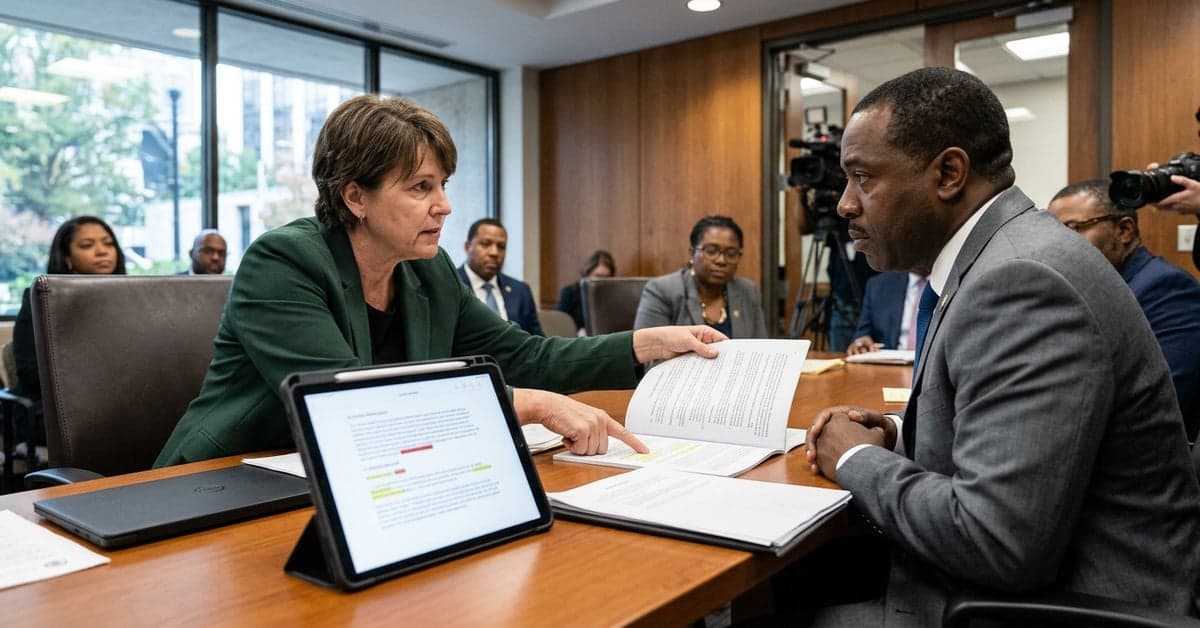
On September 19, 2026, a Fulton County commissioner said AI likely authored four pending measures — two touching ethics — reigniting debate over how local rules are written. According to Rough Draft Atlanta, Commissioner Dana Barrett used GPTZero to analyze proposals from colleagues Marvin Arrington Jr. and Bob Ellis. The tool scored three measures at 100% likely AI‑generated and another at 90%.
Barrett worried that using AI to frame ethics policy crosses a line. “The idea that we’re going to have machines write what humans should be doing ethically … it opens a can of worms for me,” she said, per Rough Draft Atlanta. Ellis responded that he used “technology tools” to research and refine ideas and asked the county attorney to review his work. He did not say whether drafting was outsourced to a model.
What set off Fulton County’s AI fight
The immediate flashpoint is authorship: who wrote the words that will become law? The GPTZero review flagged language traits such as “robotic formality,” impersonal tone, and mechanical precision, Rough Draft Atlanta reported. Those judgments fed headlines and sharpened worries that Fulton County AI ordinances might be shaped, in part, by a chatbot rather than an elected official and staff.
Barrett’s deeper concern isn’t just who typed the first draft. It’s whether using generative tools at all can introduce hidden errors or legal quirks into county code, especially in the sensitive area of ethics policies and procedures. She argued that AI often goes overboard on details, which can create loopholes or unintended burdens once a policy is enforced.
Can AI detectors decide authorship?
There’s a hitch: AI authorship detectors have a track record of being unreliable, which complicates claims about any AI-drafted ordinances. OpenAI shut down its own AI text classifier in July 2023, citing “low rate of accuracy” and false positives — a public acknowledgment that detection is shaky even for the company behind popular models. The notice is preserved on OpenAI’s blog.
Academic work has raised more flags. A Stanford-affiliated analysis in 2023 found AI detectors tended to falsely label polished, formulaic, or non‑native English writing as machine‑generated, reinforcing why binary “AI or human” stamps can mislead. That critique, summarized by Stanford HAI, applies to the broad class of detectors that score style and predictability.
GPTZero itself discloses little detail about its methods beyond pattern analysis, per its website. The company says it finds similarities across raw data and draws a line between human- and AI‑generated text. Those choices can be useful signals, but they aren’t forensic proof. A “100%” label may look definitive to the public; it isn’t, on the science. That’s why experts urge caution before using detector outputs to question legitimacy or motives.
Where policy beats provenance: guardrails that matter
Even if authorship is murky, the policy risks are concrete. Generative tools can hallucinate citations, embed ambiguous definitions, or draft clauses that conflict with existing code. The right test for Fulton County AI ordinances is whether they survive legal review, align with precedent, and are debated in public — not whether a detector finds “mechanical precision.”
That points to a clearer standard: disclosure and review. The federal government’s push on AI risk management emphasizes transparency, documentation, and human oversight for consequential uses. The NIST AI Risk Management Framework lays out those principles plainly. While it targets systems more than documents, the same logic applies to legislative drafting.
- Require a simple disclosure note when commissioners or staff use generative tools to draft or edit ordinance text.
- Mandate line‑by‑line legal review for any measure shaped by AI, with a short memo of issues found and resolved.
- Preserve human accountability by naming a responsible sponsor and staff lead for every section introduced.
- Publish machine‑generated references or prompts, if any, so the public can audit the research trail.
These steps don’t ban tools; they protect process integrity. They also separate a measurable goal — better transparency — from an unstable claim about “who wrote” a paragraph.
What the Fulton debate says about transparency
Ellis said he used technology tools to refine ideas and sent drafts to the county attorney. That aligns with a sensible baseline for any AI in policymaking: let machines brainstorm, then require human lawyers to harden the text. If Fulton wants public confidence, it can formalize that practice and make the review trail public.
Relying on detectors alone risks a chilling effect. If officials fear being “outed” by a tool with a history of false positives, they might avoid even low‑risk uses like summarizing public comments. A better approach is to draw clear lines: disclose use, document review, and ban models from generating citations or legal interpretations without verification. That focuses scrutiny where it belongs — on the quality and enforceability of the words presented for a vote.
There’s also a public‑records angle. If prompts, model outputs, and edits shaped a draft, those artifacts become part of the legislative history. Counties can treat them like staff memos: retain them and release on request, with clear redactions for any protected data. That preserves accountability without turning every style choice into an authorship dispute.
A practical way forward for Fulton County AI ordinances
This controversy is a chance to write rules that meet voters where they are: curious, skeptical, and focused on outcomes. Fulton can adopt a short resolution that does three things for Fulton County AI ordinances going forward. First, disclose AI assistance on the cover page of any measure. Second, require documented legal review before introduction, with a public summary. Third, publish a one‑page “model use log” listing any tools used, similar to a source note in a report.
Those moves would make detector debates beside the point. The county would tell residents what was used, show how humans verified it, and invite scrutiny where it counts — the text on the page. That’s how you keep trust while letting modern tools do clerical work.
The Fulton story won’t be the last. As more councils experiment with drafting aids, communities will need norms that reward disclosure over guesswork. You can read GPTZero’s own pitch and limits on its website. Pair that with NIST’s guidance and OpenAI’s warning about the state of detectors, and the lesson is clear: process beats provenance. The county’s job is to make the process transparent, then hold elected sponsors accountable for every word — machine‑assisted or not. For more on this, see reuters.com and bloomberg.com.