
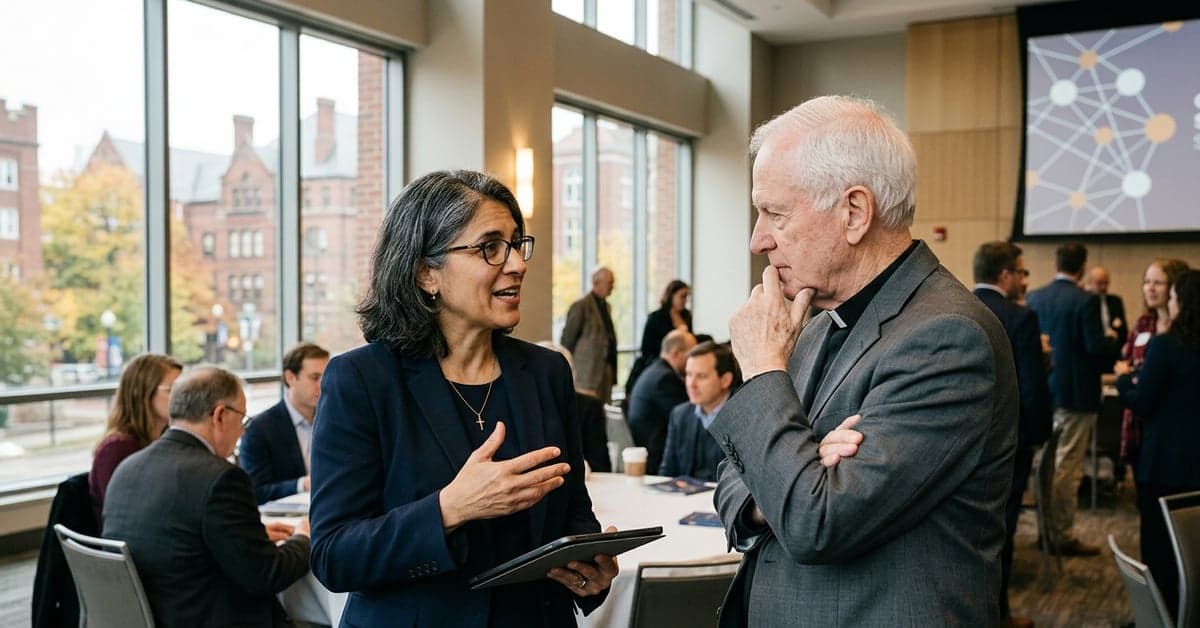
November 5-6, 2026, Duquesne University will host the Grefenstette Symposium 2026, the seventh annual Tech Ethics Symposium themed “Constructing Community, Deconstructing AI: Storytelling, Solidarity, and Faith.” The event is scheduled for the Dougherty Ballroom in the Power Center and will stream online, according to Duquesne’s Grefenstette Center. Co-sponsor: the Patricia Doherty Yoder Institute for Ethics and Integrity in Journalism and Media. The program, speakers, and registration details are forthcoming, but the university confirms expert talks, panels, a student research poster competition, and a new community storytelling event.
What the Grefenstette Symposium 2026 is setting up
On paper it reads like a standard campus conference. The theme points in a different direction. By centering storytelling, solidarity, and faith, organizers are signaling that AI ethics debates in 2026 can’t be resolved by technical safeguards alone. The Duquesne page highlights a special storytelling event and the perennial student poster competition, suggesting a design that invites lived experience alongside academic work. That emphasis pushes the conversation from abstract risk toward accountability and trust inside real communities.
That matters for journalism and civic life. Duquesne’s co-sponsor sits in journalism and media ethics, a field wrestling with synthetic media, source transparency, and newsroom AI adoption. The Reuters Institute has tracked how newsrooms test generative tools while trying to protect editorial standards. A symposium grounded in community narratives and faith traditions could arm working reporters and students with practical ways to earn public trust when algorithms touch reporting, editing, and audience work.
Why the Duquesne Tech Ethics Symposium puts storytelling first
Stories do what benchmarks can’t: they show consequences. A parent’s experience with an opaque school algorithm. A pastor counseling a congregant after a deepfake smear. A student confronting biased moderation in a campus group. These are the kinds of concrete cases that move ethics from ideals to operations. The Grefenstette Center’s framing points to that shift. It invites attendees to weigh not just whether AI works, but whom it serves, who bears the cost when it fails, and how institutions make amends.
Faith communities bring another layer. They surface duties that outlast product cycles—dignity, care, and the moral weight of intent. Those threads already shape global AI guidance. UNESCO’s Recommendation on the Ethics of AI centers human rights and the public good. Interfaith efforts like the Rome Call for AI Ethics appeal to responsibility across sectors. Placing faith in the title signals Duquesne’s intent to connect such principles to concrete practice, not just citation.
Faith, journalism and AI: who this agenda serves
Journalists, product managers, public officials, and students will read the same theme differently. For reporters, the co-sponsorship is a cue to bring real cases: disclosure policies for AI-assisted drafts, image provenance workflows, and newsroom rules for synthetic voices. Standards bodies are moving here. The C2PA specification for content credentials is gaining adoption across cameras and creative tools. Pairing those mechanics with community storytelling can surface where provenance helps—and where it falls short in the real world.
For campus leaders and city agencies, “solidarity” points to shared governance. When AI sorts benefits, grades, or safety alerts, the people subject to those systems should co-create the rules. That’s where a public-facing symposium can do unusual work: it can put designers, decision-makers, and affected communities in the same room before a policy ships. Done well, that changes incentives. It rewards teams that test with, not on, the public.
Students have a clearer on-ramp. Duquesne confirms the Student Research Poster competition will return. Posters let early-career researchers mix qualitative fieldwork with audits and small experiments. A strong entry this year could pair a user story—a local newsroom, a parish, a neighborhood clinic—with a concrete intervention and a simple metric that a non-technical audience understands.
How to get value from the Grefenstette Symposium 2026
The program is “coming soon,” says Duquesne’s event page. Preparation can start now. If you work in media, gather two case studies where AI touched your workflow and one place where you stopped an experiment. Bring artifacts: a redacted prompt, a screenshot of a policy, a reader email. Those specifics make panels useful.
Faith leaders and community organizers can map harms to remedies. Pick one system that shapes daily life—school placement, rental screening, or translation—and list the questions your community asks that vendors can’t yet answer. That list becomes your discussion agenda. It also becomes a request for evidence to any supplier in the room.
Students aiming at the poster competition should keep the audience in mind. A clean one-page method beats a dense literature review. If you’re studying misinformation, design a small test that a local newsroom or parish could run next month. If you’re focused on accessibility, talk to the campus disability office before you draft. Show how your idea changes one decision someone will make the week after the event.
What we know—and what to watch
Per Duquesne University, the symposium will run November 5-6, 2026, in the Power Center with an online option; the theme, co-sponsor, student poster competition, and a new community storytelling event are confirmed. The university also points readers to livestreams from prior years on its News and Events page, a useful primer for first-time attendees. Details to watch next: speaker lineup, panel formats, and any guidance for poster submissions or the storytelling program.
The bet behind this theme is clear. Technical safety work remains vital, and it will show up on stage. But a year marked by synthetic media scares and newsroom experiments also needs moral clarity and practical trust-building. The Grefenstette Symposium 2026 plants its flag there. If organizers match the theme with formats that give the mic to affected communities—and space for pushback—the conversations in Pittsburgh could set patterns other ethics events copy in 2027.
For now, the signal is strong enough to plan around. Book the dates, skim prior livestreams, and arrive ready to trade specifics. If the curation follows the title, the Grefenstette Symposium 2026 will be a place to test whether stories and solidarity can move AI ethics from aspiration to action. For more on this, see bloomberg.com and nytimes.com.