
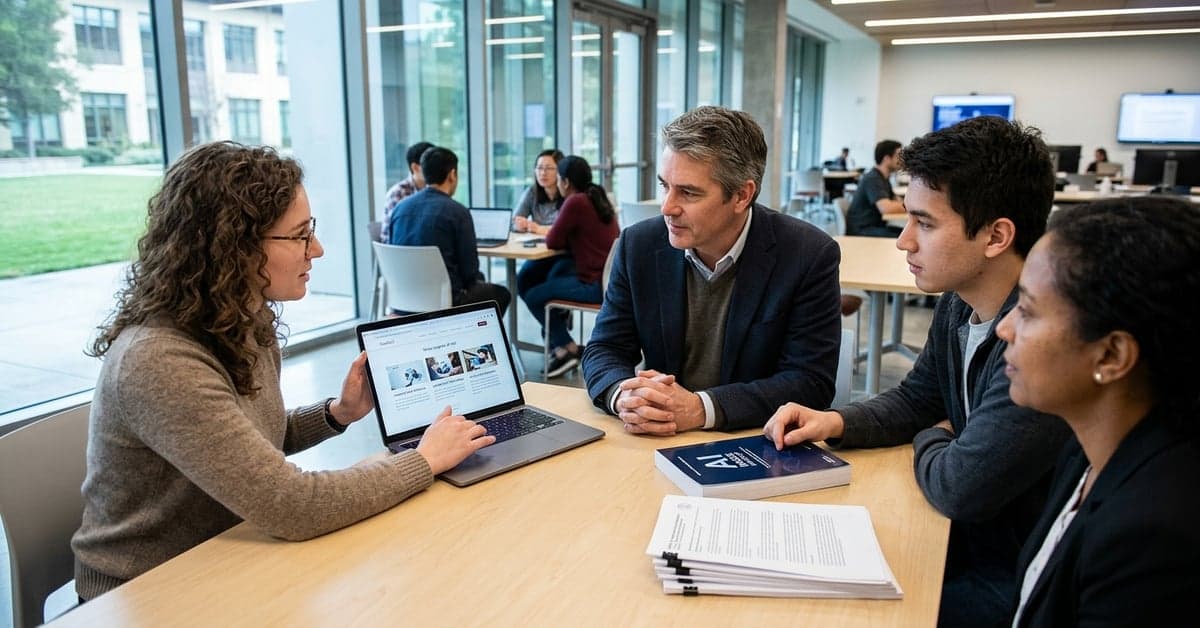
Fellowship programs, policymaker classrooms, and the AI Index sit side by side on the Stanford HAI homepage. The arrangement reads like a thesis: build AI that improves the human condition by moving evidence, people, and policy in lockstep. That is the Stanford HAI mission in practice, and it signals a deliberate attempt to connect laboratories with lawmakers—and the companies deploying systems at scale.
What the Stanford HAI mission prioritizes
Stanford HAI puts three engines on its front page: research, education, and policy. According to the site, the institute funds fellowship programs and grants, runs centers and labs, and publishes research. On education, it spans executive and professional training, offerings for government and policymakers, K–12 materials, and courses for Stanford students. Its policy pillar features policy publications and learning tracks for officials, backed by the AI Index and tools tracking global activity. Each lane feeds the others: evidence from research informs courses and briefings, while policy questions shape new studies.
The homepage layout also emphasizes public accountability. Policy reports sit next to the AI Index, which publishes trend data and benchmarks that anyone can query. That combination—open data and open debate—suggests HAI wants arguments about AI’s risks and benefits to rest on numbers, not only narratives.
From principles to practice: how HAI maps to UNESCO’s ethics playbook
In November 2021, UNESCO’s 193 Member States adopted the first global standard on AI ethics, the Recommendation on the Ethics of Artificial Intelligence. It centers human rights and human dignity, and it lists principles such as transparency, fairness, human oversight, and environmental sustainability. The Stanford HAI mission lines up with those pillars in pragmatic ways.
Transparency is visible in the AI Index, which makes methods and datasets public so outsiders can challenge assumptions. Fairness and human oversight are reflected in the policymaker education track; training regulators and civil servants creates the capacity to audit systems and set guardrails before harms scale. Environmental sustainability, a growing concern in AI compute, can be measured and debated using open indicators; placing metrics alongside policy analysis makes those trade-offs harder to ignore.
UNESCO’s document also moves beyond values to concrete policy action across areas like data governance, inclusion, and international cooperation. That is where HAI’s structure matters. Grants and fellowships seed new methods and social-science research on bias. Executive education helps firms translate ethics into practice. Policy publications provide templates and frameworks that local agencies can adapt. No single element delivers ethics; the portfolio only works if these pieces stay interlocked.
Where the Stanford HAI mission meets enterprise guardrails
Companies want trusted systems, not just working systems. KPMG frames this as a Trusted AI framework spanning the lifecycle: from design and data to deployment, monitoring, and assurance. It emphasizes values-driven decisions, human-centric outcomes, and operational transparency. HAI’s mix of programs can plug into each stage.
Design and data: grant-funded research can generate new evaluation methods, bias checks, and robust datasets for testing. Deployment: executive courses equip product leaders with patterns for consent, documentation, and fallback modes when models fail. Monitoring and assurance: the AI Index provides comparative baselines, while policy reports translate expectations into audit-ready practices. Firms still need their own controls, but HAI’s public goods reduce guesswork and shorten the path from principle to checklist.
That is also why the institute’s cross-sector model matters. Enterprises read the same policy publications as regulators and students. Shared references lower friction in rulemaking and compliance. When an engineer, a GC, and a state official point to the same definition of “high-risk system,” a review moves faster and with less contention.
Why this approach matters for AI builders and rulemakers
For developers, a steady pipeline of research and fellowships means fewer blind spots. Methods move into practice faster when curriculum and code live near each other. For educators, K–12 and university offerings lay foundations for AI literacy before products reshape classrooms. For policymakers, classes designed for government staff, coupled with public policy papers, speed up the learning curve that often delays effective oversight.
There is a second-order effect. When institutions publish shared data and language—like the AI Index and glossaries—public debate gains a common floor. Disagreements still happen, but they become about trade-offs that can be measured. That is the difference between hunch-driven regulation and evidence-led rulemaking.
What to watch next from HAI’s public-facing model
Keep an eye on three signals. First, how the AI Index expands its coverage, especially around compute intensity, emissions, and real-world incident tracking. Those areas tie directly to UNESCO’s sustainability and human-rights lens. Second, the depth of policymaker education. If more city and state agencies send staff through HAI’s programs, we may see faster, more consistent procurement and auditing practices. Third, the cadence of executive education. Demand there will hint at how quickly enterprises plan to embed assurance into product roadmaps.
The Stanford HAI mission is ambitious, but the mechanics are concrete: build knowledge, teach the people who will use it, and publish the rules of the road where everyone can see them. That alignment—labs, classrooms, and policy desks sharing the same source material—may prove more durable than any single model or product cycle. For more on this, see bloomberg.com and nytimes.com.