
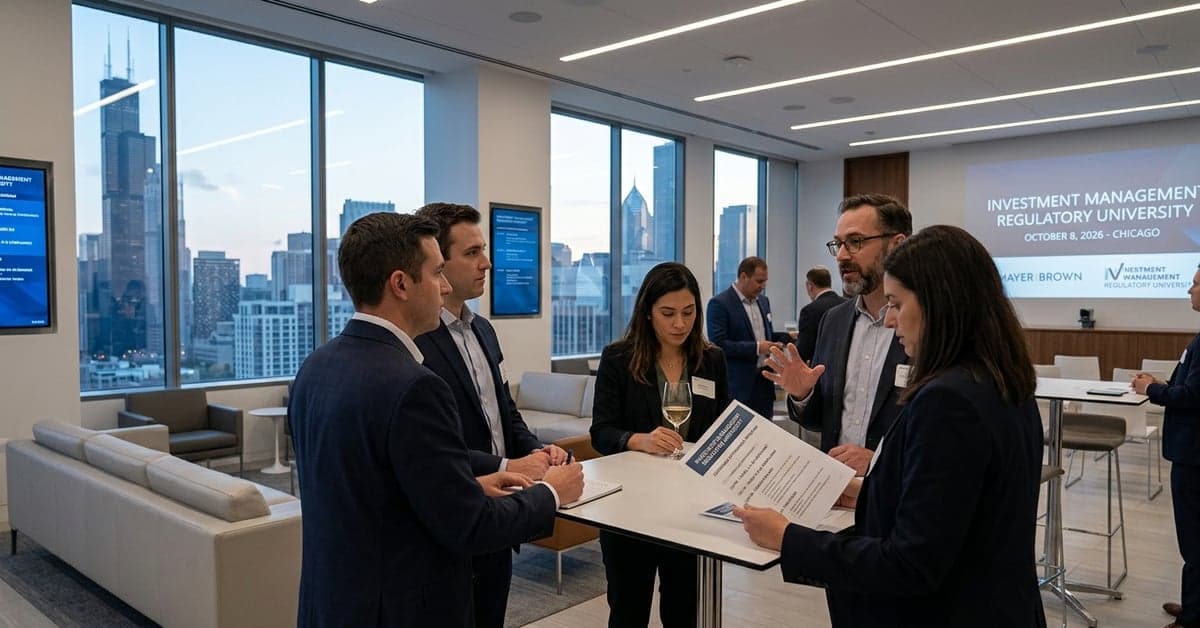
On October 8, 2026, Mayer Brown will run its Investment Management Regulatory University in Chicago as a condensed afternoon program, swapping the old full-day marathon for two concentrated panels and a reception. According to Mayer Brown’s event page, the agenda starts with a 2:00 p.m. welcome, moves into a “Regulatory Hot Topics” session, and closes with an Ethics CLE on “Artificial Intelligence and the Future of Legal Privilege,” before networking at the firm’s 71 S. Wacker Drive office.
What the Investment Management Regulatory University changed for 2026
The firm has rethought the format around attention and time. Registration opens at 1:30 p.m., programming runs from 2:00 p.m. to 5:00 p.m., and credit is pending, with ethics credit anticipated for the AI/legal privilege panel, per Mayer Brown. The promise is “maximum insight in minimum time,” a pitch that lands with compliance teams who face heavy rule churn and year-end reviews.
The timing matters. Advisory firms are juggling marketing rule controls, vendor diligence, data governance, and a surge of AI experiments. A half-day that prioritizes what changed, what examiners ask for, and what to fix next is more actionable than a broad survey. The Investment Management Regulatory University has positioned itself as a sprint: fewer sessions, more signal.
Why AI legal privilege is the new front line
The headline shift isn’t the shorter schedule. It’s the choice to anchor the day with an ethics CLE on artificial intelligence and attorney–client privilege. As generative tools move into document review, research, and client communications, firms risk waiving privilege or mishandling confidential data if they don’t set guardrails. The focus of the session—where legal ethics meets model behavior—hits a pressure point many GCs now feel.
Regulators are also drawing a bead on AI’s role in advisory conflicts and client interactions. The U.S. Securities and Exchange Commission has proposed a rule addressing conflicts tied to predictive data analytics and similar technologies used by advisers and broker-dealers, aimed at preventing tools from placing firm interests ahead of investors. The proposal outlines new obligations to identify, eliminate, or neutralize those conflicts. That backdrop ensures the ethics discussion won’t be academic. See the SEC’s predictive data analytics proposal for the thrust of the policy debate.
Risk frameworks are catching up too. The U.S. National Institute of Standards and Technology’s AI Risk Management Framework gives firms a shared language for documenting context, controls, and monitoring. For investment managers, that map has to intersect with privilege, confidentiality, vendor oversight, and recordkeeping. Expect panelists to probe that overlap: what belongs in engagement letters, how to scope vendor NDAs, and when to wall off AI systems from client facts.
What investment managers should watch in 2026
The agenda headline reads “Regulatory Hot Topics,” but the real value is triage. Based on recent rulemaking and exam focus areas, attendees should be ready for pointed conversation on:
- How AI-based tools intersect with marketing content review, including substantiation and books-and-records duties under the SEC’s Marketing Rule.
- Conflicts questions raised by recommendation engines and personalization, with the SEC’s predictive analytics proposal as policy context.
- Privilege risks when staff paste client facts into external models, and what policies, disclosures, and access controls actually work.
- Vendor diligence for AI services—data retention, training on client data, and the right to audit or delete.
Each of these items blends legal risk with operational muscle memory. A policy by itself won’t save an adviser if logs, approvals, and training don’t line up. That’s why a short-format, panel-heavy afternoon can work: it forces prioritization. The Investment Management Regulatory University is leaning into that trade.
Who should join the Chicago compliance event—and how to prep
This program is built for chief compliance officers, in-house counsel, and operations leaders who need a straight answer to “What do we fix before year-end?” The location—Mayer Brown’s Chicago office at 71 S. Wacker Drive—makes it a regional draw, but the topics travel. According to the firm, the day includes a networking break and a reception, giving attendees time to compare notes on practical controls and team workflows.
Preparation will pay off. Bring a current inventory of AI-related use cases inside your firm, the vendor list behind them, and any exceptions you’ve granted to the normal review process. Cross-check those notes against your privilege guidance and incident response steps. If your team is testing retrieval-augmented generation or document summarization, line up examples and the safeguards in place. That will make the ethics CLE on AI legal privilege far more concrete, and it will surface gaps you can address as soon as you’re back at your desk.
For broader context on how financial regulators view AI, it’s worth scanning SEC Chair Gary Gensler’s public remarks on model-driven conflicts and financial stability, which outline why the agency sees AI as both useful and risky. The themes in those speeches—and the pending analytics rule—are likely to echo in the room. A recent example sits on the SEC’s website alongside the proposal materials.
What happens after the conference
Events only matter if they change work on Monday. The panel on regulatory hot topics should give compliance teams a shortlist to execute in Q4. The ethics session should firm up boundaries for model use and set a plan for training and attestations. If the Investment Management Regulatory University delivers on its promise, attendees should leave with two things: a refreshed read on enforcement risk, and a checklist for AI-era privilege that your outside counsel can stand behind.
Registration details, times, and CLE status are available on Mayer Brown’s event page. The firm lists October 8, 2026, a 2:00 p.m.–5:00 p.m. program window, and a post-panel reception at its Chicago office. Seats for a compact format tend to go fast. If you work in investment management, this is a timely stop. For more on this, see nytimes.com.