
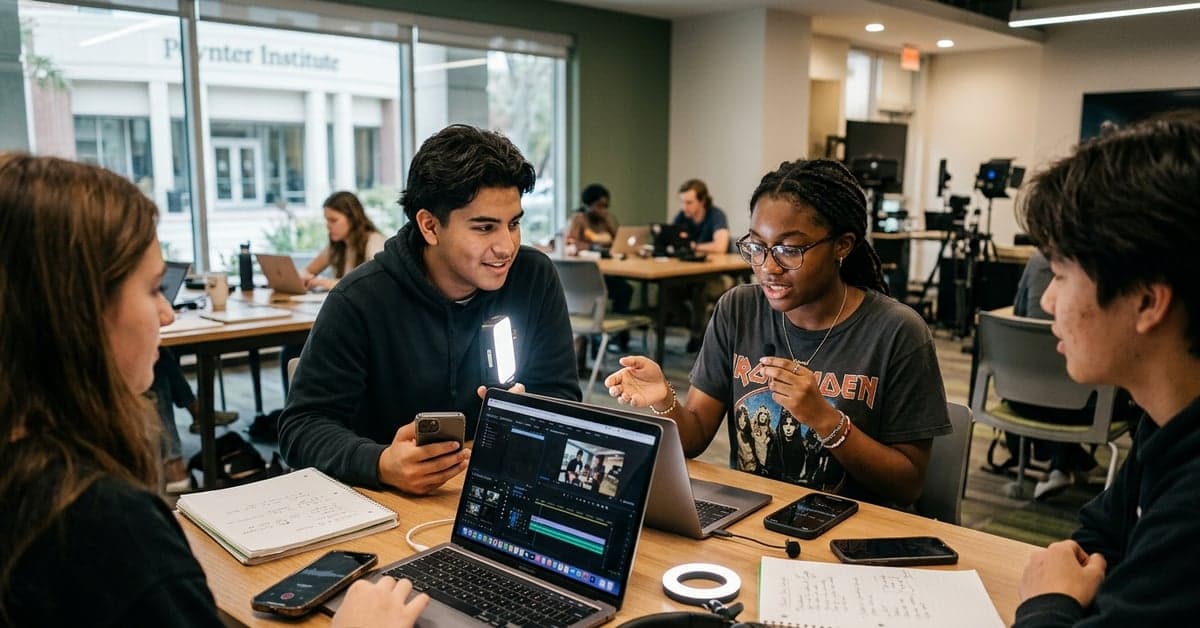
On March 23, 2026, Poynter said it would launch the MediaWise Teen Creator Network with a $300,000 grant from the Patrick J. McGovern Foundation and a partnership with Local News International, aiming to help teens make credible content for their peers (Poynter). The bet is simple: if trust is scarce, borrow it from classmates who speak the same language on the same platforms.
Why the MediaWise Teen Creator Network targets peers, not press releases
Teenagers don’t adopt new information because an organization says it’s true. They share what their friends share, and they watch who they already follow. Research shows younger audiences increasingly encounter news via influencers and creators rather than front pages. The Reuters Institute has tracked this shift, noting the rise of TikTok and creator-led formats among under-25s in its Digital News Reports (Reuters Institute). Pew Research Center likewise finds teens heavily clustered on platforms like TikTok, YouTube, and Instagram, where social context amplifies what gets seen (Pew Research Center).
In that environment, a top-down media literacy lecture rarely cuts through. A teen-led format might. By design, the MediaWise Teen Creator Network shifts distribution to the feeds where teens already spend time and places the messenger inside their peer group. That increases the odds of watch time, completion, and shares—signals platforms reward. It also makes space for relatable framing, which matters as much as facts when attention is scarce.
What Poynter is promising—and what’s still unknown
According to Poynter, the program pairs the grant from the Patrick J. McGovern Foundation with a Local News International partnership to help teens publish engaging, trustworthy content their peers can use (Poynter). That framing suggests an editorial backbone anchored in local reporting, which could give young creators access to sourcing and verification support that most influencer programs skip.
Two key questions remain. First, platform mix: will the project focus on TikTok and YouTube Shorts, or spread thin across everything? Second, guardrails: what review steps ensure accuracy without sanding off the voice that makes creator content work? Poynter has explored creator collaborations before—its MediaWise team outlined lessons from partnering with streamers to address rage bait and toxicity, including clear briefs, rapid feedback loops, and audience input on tone (Poynter). Those lessons will likely shape the playbook here.
How a teen creator network should measure success
Awareness alone won’t justify a grant. The right scorecard blends reach with learning. A practical set of metrics for the MediaWise Teen Creator Network could include:
- Audience and engagement: impressions, average watch time, saves, and shares among 13–17-year-olds on each platform.
- Learning outcomes: pre- and post-exposure quizzes on verification skills in participating classrooms or clubs.
- Behavioral signals: the rate at which viewers use reverse image search, follow fact-checking accounts, or flag dubious posts after viewing.
- Local impact: partner newsroom citations, community reposts, or school adoption of creator-made explainers in lessons.
Tying creator output to classroom use matters. Teachers have limited time, and short, platform-native explainers can slot into existing media literacy modules. Organizations such as Common Sense Media already provide lesson scaffolds educators can adapt (Common Sense Media). If MediaWise aligns creator content to those scaffolds, it reduces friction for schools and increases repeated use.
Trust, disclosures, and the difference between influence and accuracy
A peer messenger is persuasive, yet persuasion can drift into performance. The risk is obvious: creators tune for clicks, not care. That’s where editorial standards and transparent labeling help. Clear disclosures about funding, sourcing, and corrections establish a baseline viewers can recognize. Technical signals—such as attaching content credentials via the C2PA standard—can document edits and sources across platforms, even as posts are remixed (C2PA).
There’s also a tone problem to solve. Poynter’s own guidance on working with streamers points to avoiding baiting tactics that prime outrage. Trust grows when creators show their work—demonstrating a reverse image search on camera, citing a local reporter by name, or testing a rumor step by step. The MediaWise Teen Creator Network can normalize these habits so they feel native, not tacked on.
What to watch as the program scales
Three execution details will signal whether this model can last. First, selection: choose teens who already collaborate well and can take edits without losing their voice. Second, feedback: treat comments as an assignment desk, mining recurring questions for the next video. Third, safety: set escalation paths for harassment and brigading, with rapid support from partner newsrooms and platforms.
If those pieces hold, the MediaWise Teen Creator Network could become a template that other schools and local outlets copy: partner locally for facts, produce natively for teens, measure both reach and retention of skills, and publish fast enough to meet the moment without sacrificing verification. That balance is hard. It’s also where the gains are.
The premise behind the MediaWise Teen Creator Network is easy to test and, if it works, easy to replicate. Meet teens where they are, let trusted peers carry the message, and make accuracy part of the performance. That’s a strategy built for today’s feeds—and one with a better shot at sticking in tomorrow’s. For more on this, see bloomberg.com.
Related reading: AI Copyright • Deepfake • AI Ethics & Regulation