
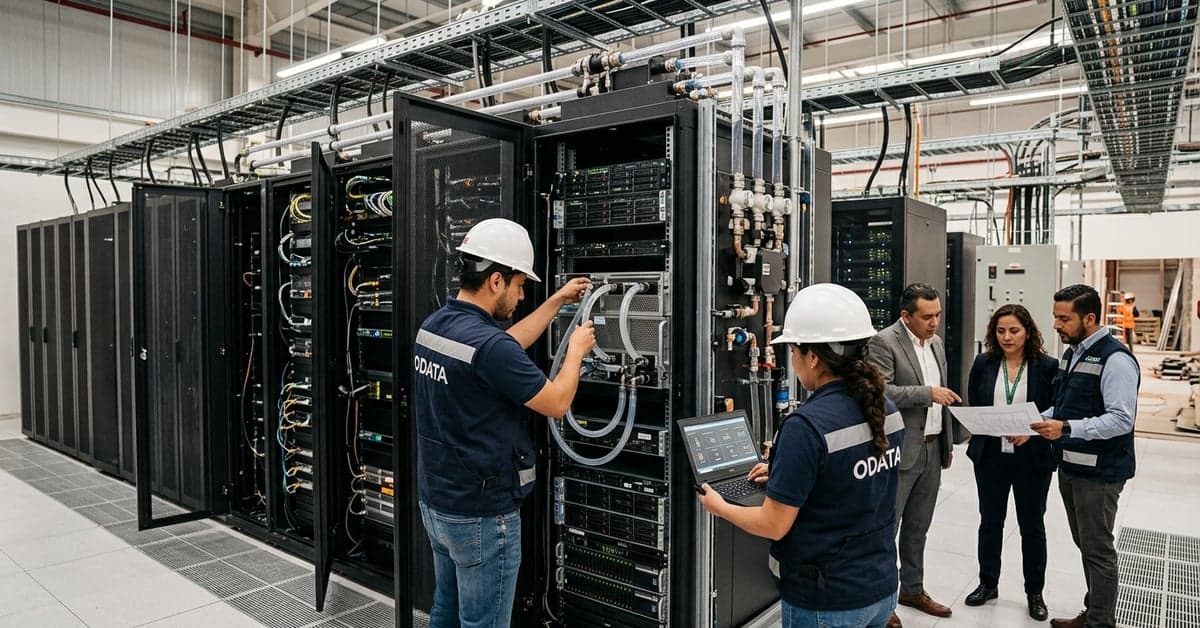
ODATA is rolling out DeltaFlow liquid cooling in Mexico, while the national utility CFE and the Mexico Data Center Association (MEXDC) are coordinating grid capacity for new campuses. Those headlines — carried by Mexico Business News’ Cloud & Data section — and parallel coverage of Mexico–China talks on AI and supercomputing point to the same reality: Mexico data centers are entering a power-and-cooling inflection.
Power planning will decide which Mexico data centers scale
According to Mexico Business News, CFE and MEXDC have set up a framework to plan power for future data center growth. The goal is simple, but hard in practice: line up megawatts years before the first rack lands. Without clear interconnection queues and transmission visibility, even shovel-ready sites can stall. The CFE’s role is pivotal here; enterprise and colocation operators will need durable contracts and a line of sight to substation buildouts. For a sense of the stakes, the International Energy Agency estimated in March 2024 that global data center electricity demand could roughly double from 2022 to 2026, amplified by AI workloads (IEA analysis). Mexico will feel that pull as campuses concentrate near fiber backbones and power.
This coordination should help Mexico data centers avoid piecemeal approvals and stranded capacity. It also signals to investors that grid planning is moving from case-by-case negotiations to a more predictable path. Consistency lowers country risk and can shift hyperscale interest south of the border, especially for latency-tolerant services targeting North America.
Liquid cooling arrives: what ODATA’s move signals
Mexico Business News reports that ODATA is deploying DeltaFlow liquid cooling in-country, a clear tell that AI training and dense inference clusters are shaping build specs. Traditional air-cooled halls struggle once rack power climbs past the mid-teens of kilowatts; many AI racks run far higher. Industry surveys have tracked the tension between rising densities and legacy cooling plants, with a gradual move toward direct-to-chip and immersion options (Uptime Institute research). ASHRAE’s thermal guidelines have also expanded to cover liquid-cooled equipment classes, reflecting a mainstreaming of these designs (ASHRAE resources).
For operators, ODATA’s step is a local proof point that procurement, maintenance, and safety playbooks for liquid cooling must be in place before AI clusters arrive. Supply chains for manifolds, cold plates, dielectric fluids, and leak detection matter as much as transformers and chillers. The upside: higher density per square meter and better PUE at scale. The trade-offs include integration complexity and new failure modes. Mexico data centers that invest early in liquid-ready halls can land AI tenants that would otherwise bypass sites capped at air-cooled limits.
China ties and the hunt for AI compute in Mexico
Mexico Business News highlights that Mexico and China plan to expand cooperation in AI and supercomputing. That could take several forms: joint research, training access for universities, or supply chain links for components. The shape of any cooperation will depend on export controls and vendor policies, but the intent alone is notable. It hints at more routes to bring compute and know-how into the market, which could raise the bar for local capability. Any public-private coordination should be weighed against compliance risks and long-term maintainability, especially where firmware and support lifecycles dictate uptime.
The subtext for buyers is straightforward. If more compute pathways open, capacity pricing and queue times could ease. If they don’t, expect fierce competition for GPUs and HBM memory, tightened SLAs, and stricter onboarding gates for power-thirsty tenants. Either way, Mexican data centers that present clear power roadmaps and liquid-cooling readiness will have an edge in winning AI-heavy workloads.
What operators and buyers should watch next
The threads flagged by Mexico Business News — CFE–MEXDC power planning, ODATA’s liquid cooling rollout, and China cooperation talks — amount to a market signal. AI demand won’t wait for retrofit cycles. To stay investable, Mexico data centers and their customers should move on three fronts:
- Lock power early. Pursue staged PPAs or capacity reservations with CFE and document interconnection milestones. Tie lease terms to those dates.
- Design for liquids, even if day-one is air. Specify heat rejection, floor loading, and safety systems so halls can pivot to direct-to-chip or immersion without gutting the room.
- Measure water and heat reuse. AI clusters can lift site WUE; plan for non-potable sources or heat recovery to blunt local constraints and permitting risk.
- Diversify the supply chain. Secure spares and service coverage for pumps, plates, and fluids, and maintain second-source options where possible.
- Align fiber with power. New megawatts need matching long-haul and metro routes; phase builds around both, not one at a time.
None of this guarantees smooth growth. Interconnection queues can stretch, substations slip, and liquid-cooling projects hit commissioning snags. Yet the direction is clear. Mexico data centers that treat power and thermals as first-class program risks — with executive ownership and capital attached — will be better positioned to capture AI and HPC demand as it lands.
Why this shift matters for Mexico’s cloud ambitions
Seen together, these developments push the market past pilot talk. Power planning at the utility level, commercial liquid cooling deployments, and international AI links suggest a step-change in readiness. For enterprises weighing regional expansion, that means shorter paths to multi-tenant AI hosting and, over time, a broader ecosystem of specialists — from heat-reuse engineers to liquid-service technicians. For policymakers, it’s a nudge to align incentives with grid upgrades and skills training, so the benefits of AI-driven investment spread beyond a few industrial parks.
Mexico data centers are not starting from scratch; they’re building on cross-border connectivity, maturing construction partners, and a growing pool of cloud talent. The competitive question for the next two years is whether power and cooling keep pace with demand. If they do, expect larger AI footprints to anchor in-country. If they lag, tenants will chase megawatts elsewhere. Either way, the winners will be the campuses that planned for heat and electrons first — and talked about everything else second. For more on this, see bloomberg.com and nytimes.com.
Related reading: AI Copyright • Deepfake • AI Ethics & Regulation