
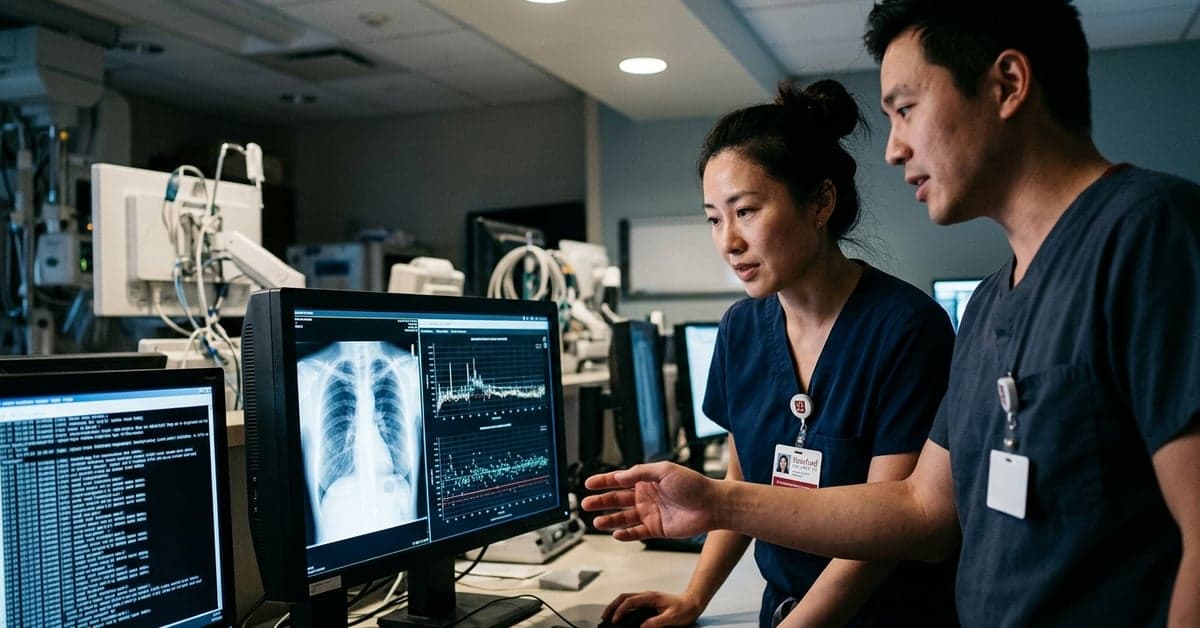
Stanford’s Institute for Human-Centered Artificial Intelligence is putting deployment under the microscope. On its homepage, Stanford HAI spotlights a policy brief titled “Operationalizing Real-Time Monitoring of Clinical AI,” focused on radiology safety and authored by Zhongnan Fang, Lina Cheuy, Hye Sun Na, Akshay Chaudhari, and David B. Larson. The signal is clear: hospitals need clinical AI monitoring in production, not just validation before go-live (Stanford HAI).
What Stanford HAI just put forward on clinical AI monitoring
The brief, featured by Stanford HAI on its home page, argues that real-time monitoring can close oversight gaps for radiology tools once they are deployed to clinicians. According to the summary shown by Stanford HAI, the work demonstrates how ongoing checks can address weaknesses in traditional, one-time evaluations of imaging algorithms (Stanford HAI). While the full text is not linked from the landing page, the emphasis on radiology reflects a field where model performance can slide as scanners, protocols, and patient populations shift.
This is where hospitals often struggle. Metrics look strong in retrospective tests, then drift in day-to-day care. A monitoring program typically tracks slice-level performance, flags outliers, and routes alerts to a human reviewer, which aligns with broader safety guidance from U.S. regulators. The U.S. Food and Drug Administration has outlined a total-product-lifecycle approach for AI/ML-enabled software, including expectations for postmarket surveillance, change control, and periodic revalidation (FDA). In short, the lab is no substitute for the ward. That’s the gap clinical AI monitoring aims to fill.
Why radiology needs continuous monitoring
Imaging AI is sensitive to context. A change in scanner vendor, a new reconstruction algorithm, or a different contrast protocol can shift the data distribution. When that happens, a detector’s positive predictive value can fall while sensitivity holds, or the reverse. If no one is watching, clinicians get surprise errors.
Professional groups have warned about this dynamic for years. The American College of Radiology’s Data Science Institute describes production workflows that include performance dashboards, error triage, and governance that links technical signals to clinical review (ACR DSI). These are the building blocks of continuous oversight. Stanford HAI’s focus on radiology underscores that such guardrails should be standard, not optional, once AI touches patient care.
There’s a human side too. When an algorithm changes behavior, trust erodes quickly. Transparent logs, clear “hand-off to human” steps, and documented remediation plans help clinicians see that clinical AI monitoring isn’t policing—it’s safety engineering.
Policy context: ethics, regulators, and hospital reality
Stanford HAI’s spotlight lands in a policy environment moving the same direction. UNESCO’s Recommendation on the Ethics of Artificial Intelligence, adopted by 193 Member States, calls out human rights, transparency, and human oversight as core pillars. It stresses concrete actions across the lifecycle, not just values on paper (UNESCO). Continuous oversight in hospitals maps cleanly to that mandate.
In the United States, the FDA’s total-lifecycle posture has matured as more AI/ML devices reach the market. While specific requirements vary by product, the agency’s public materials make clear that sponsors should plan for real-world performance monitoring and controlled updates. Hospitals, in turn, need operational processes to receive telemetry, validate behavior, and escalate anomalies. The NIST AI Risk Management Framework also emphasizes ongoing measurement and monitoring as part of risk treatment, which supports the same operational model inside health systems (NIST).
The alignment matters. Ethics frameworks and regulatory signals give hospital leaders leverage to require monitoring hooks in vendor contracts. They also justify the budget and staffing required to run a safety program. Without that foundation, clinical AI monitoring risks becoming a side project that fades after the first incident review.
What hospitals can do next to prepare for monitoring
Most health systems already collect more data than they can use. Turning that into a meaningful AI safety signal takes a few concrete steps.
- Inventory algorithms in clinical use, with owners, intended use, and clinical pathways.
- Define a compact set of metrics per model: sensitivity, PPV, calibration, and time-to-alert in radiology workflows.
- Establish drift checks tied to known failure modes: site, scanner, protocol, or demographic shifts.
- Route alerts to accountable humans, with documented escalation to clinical governance and, if needed, to vendors.
- Negotiate vendor agreements for telemetry export, version transparency, and update notices before rollouts.
- Protect privacy by monitoring on de-identified or minimally necessary data, and log access to production signals.
These steps are vendor-agnostic and mirror best practices in safety-critical software. They also reduce firefighting. When a metric blips, the team knows where to look, who to call, and how to decide. That is the practical value of real-time oversight, and it’s the kind of operational detail Stanford HAI is elevating by highlighting radiology-focused work on its front page (Stanford HAI).
Why this HAI signal matters now
Hospitals are deploying more AI, often faster than their safety processes evolve. By bringing a radiology-specific brief on deployment oversight to the top of its site, Stanford HAI is nudging the conversation from model accuracy to clinical reliability. The message lines up with global ethics guidance from UNESCO and lifecycle thinking at the FDA, but it also meets clinicians where they work—inside workflows that must perform under pressure.
Expect procurement teams to start asking sharper questions about monitoring features and vendor transparency. Expect quality leaders to link AI surveillance to existing incident reporting. And expect IT to prioritize dashboards that clinicians will actually use. The winners will be the hospitals that treat clinical AI monitoring as routine infrastructure, not a research add-on, and the patients whose care gets both smarter and safer. For more on this, see reuters.com and bloomberg.com.