
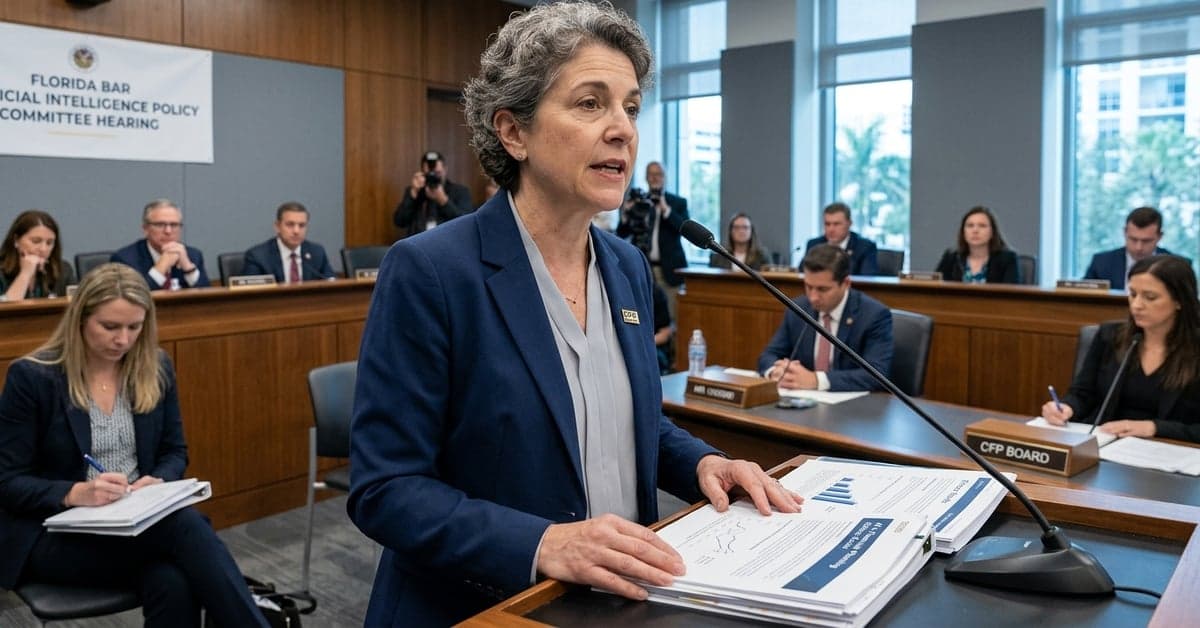
On August 14, 2026, the CFP Board told lawmakers that artificial intelligence should strengthen—not supplant—the trusted bond between planners and clients. The group’s submission leaned on its 2025 AI reports and ethics guide, and it mapped out governance, privacy, model risk, and workforce needs. For ongoing Florida Bar AI debates, the cross‑profession message points to a practical compass: keep human judgment at the center, and build oversight that earns client trust.
CFP Board’s message on AI: trust, judgment, and client duty
In its new comments to policymakers, the CFP Board said AI belongs inside a framework that protects consumers and respects professional standards. The group cited themes from its AI Working Group and Generative AI Ethics Guide: risk-based oversight, clear governance, data privacy, and model accountability—paired with a workforce that can interrogate machine output (CFP Board). It argued that human advisors should remain responsible for judgment calls, from suitability to conflicts checks, even when software drafts the first answer.
That framing matters to lawyers advising clients who are rushing into robo-planning tools, AI-driven tax optimizers, and automated retirement projections. It also rhymes with how financial regulators and standards bodies are steering the conversation. The NIST AI Risk Management Framework promotes measurable controls across the AI lifecycle, from data curation to monitoring. In securities, FINRA’s ongoing AI work highlights suitability, supervision, and transparency as vendors push predictive tools into broker-dealer workflows.
What this means for Florida Bar AI obligations
Florida already expects lawyers to understand the benefits and risks of the technology they use. That duty of competence, widely recognized in the profession, includes staying current on tech that touches client matters. The principle appears in the comment to Model Rule 1.1, which Florida’s approach mirrors in spirit; it urges lawyers to keep abreast of changes in law and practice “including the benefits and risks associated with relevant technology” (ABA Model Rule 1.1). Florida’s Rules Regulating The Florida Bar also make clear that lawyers must protect confidentiality, supervise nonlawyer assistance, and communicate with clients about material risks—duties that apply directly when AI tools enter the picture.
Translated to practice, the CFP Board’s emphasis on human judgment tracks three Florida ethics pillars:
- Competence and diligence: Know how a tool reaches its output, where it can err, and when manual review is mandatory.
- Confidentiality: Treat any upload to an AI service as a disclosure. Scrub identifying details or use enterprise tools with binding privacy terms.
- Supervision: Vet vendors like any nonlawyer assistant. Set instructions, test output quality, and monitor drift over time.
Trust-and-judgment is not just a planning maxim—it is a legal ethics throughline. When a client’s wealth plan or tax posture hinges on a black-box forecast, the lawyer’s role is to probe the assumptions, explain limits in plain language, and document the advice. For Florida Bar AI compliance, that scrutiny is the difference between informed guidance and delegation to a tool that may be biased, stale, or trained on data that do not match the client’s reality.
Florida lawyers and AI: a practical checklist
Clients are already using AI to analyze portfolios, model cash flows, and summarize complex trusts. The risk is not theory; it shows up when a chatbot suggests an aggressive strategy that conflicts with a client’s risk tolerance or creates a tax cliff next year. Borrowing the CFP Board’s priorities—and aligning them with Florida ethics duties—here’s a tight checklist for matters that touch finance tech:
- Map the decision. Identify which legal conclusion depends on an AI output (e.g., a projected basis, a return expectation, or a portfolio rebalancing rule).
- Ask about data. Who supplied the training data? What period does it cover? How are outliers, regime changes, and missing data handled?
- Interrogate the method. Is the tool a rules engine, a statistical forecaster, or a large language model producing text explanations? Each fails differently.
- Check conflicts. Does the provider get paid more if the client chooses a higher‑fee product? That matters for independence and disclosure.
- Stress test the output. Change key assumptions and see if the recommendation flips. Document where it breaks.
- Protect client data. Use encrypted channels and enterprise terms that bar providers from training on confidential matter content.
- Explain and consent. Tell the client what the tool does, its limits, and how you will validate results. Get informed consent when appropriate.
- Monitor drift. Calendar reviews of models and vendor policies. An acceptable tool today can degrade tomorrow after a silent update.
This is the same arc now animating national policy discussions. The CFP Board’s filing stressed risk-based regulation and governance, urging lawmakers to set standards without stripping professionals of judgment (CFP Board). The SEC, for its part, has spotlighted AI issues in markets, from conflicts in predictive analytics to supervision of automated recommendations (SEC AI spotlight). The signals converge: machines are welcome, but the human remains answerable for the call.
What to watch next for Florida Bar AI policy
Expect clients to keep bringing AI outputs into the conference room. Expect vendors to pitch “advisor copilot” features into practice platforms. And expect courts and regulators to scrutinize who is on the hook when an algorithmic nudge causes harm.
Inside the profession, several near-term moves would bring clarity. Bar committees could publish scenario-based guidance on AI in client intake, discovery, and financial planning–adjacent work. CLE providers can expand courses that teach lawyers how to audit vendor claims and translate model caveats into client-ready explanations. Firms should update engagement letters to describe if and how AI tools are used, and what that means for confidentiality and review.
The CFP Board’s stance gives Florida practitioners a helpful lodestar: center human judgment, document your oversight, and keep clients’ trust front and center. That same trio—judgment, governance, trust—can shape Florida Bar AI discussions without waiting for a formal rule change. For more on this, see bloomberg.com and nytimes.com.