
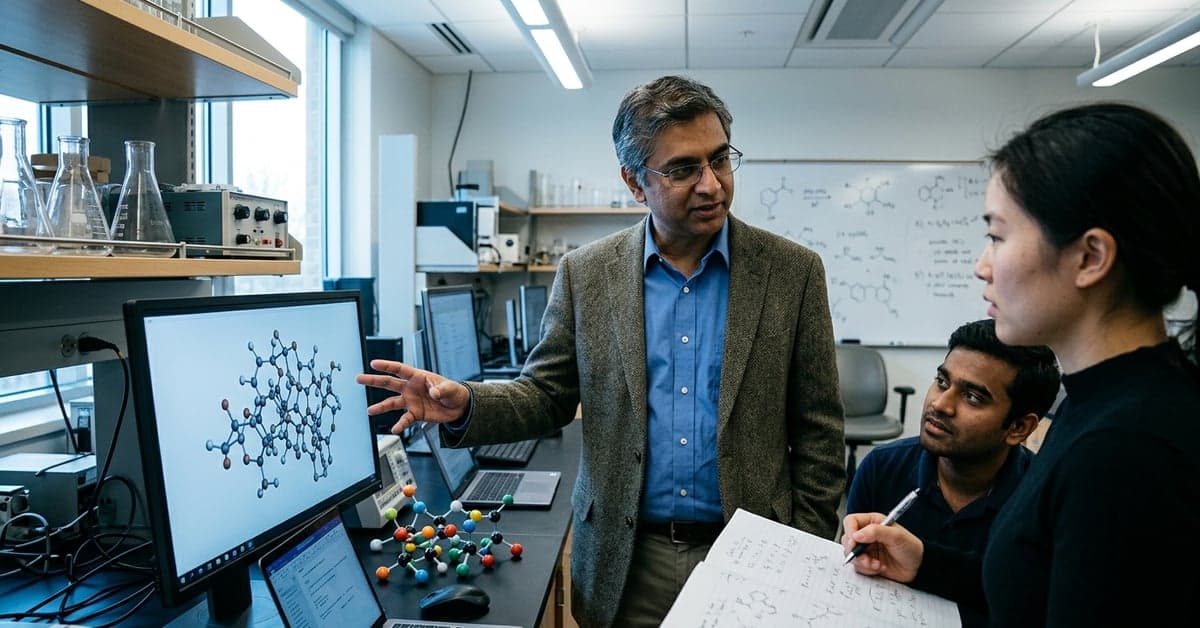
On September 3, 2026, the University of Notre Dame spotlighted a claim that flips the usual script: it’s chemistry shaping AI, not just AI reshaping chemistry. In a review published in Chemical Reviews, Notre Dame’s Nitesh Chawla and collaborators argue that the hardest problems in organic chemistry have pushed AI to get better at structure, causality, and uncertainty — the design features today’s models often still lack outside the lab, according to Notre Dame’s news post.
What the Notre Dame team says chemistry demands
The review, as summarized by Notre Dame on September 3, 2026, highlights what makes chemistry unusually tough for machines: three-dimensional structures, multiple interacting components, changing conditions, and more than one plausible outcome. Chemists do not only want an answer; they want the “why,” the mechanism, the conditions that matter, and a measure of confidence. That wish list has teeth. It forces models to juggle geometry, causality, and probabilistic reasoning at once (Notre Dame; Chemical Reviews).
This framing matches what the field has already seen. Protein structure breakthroughs like AlphaFold succeeded by honoring molecular geometry and physics. Reaction prediction systems in synthesis planning advanced once models stopped treating molecules as text strings and learned over atoms and bonds. In other words, chemistry’s constraints kept modelers honest — and made their tools stronger.
How chemistry shaping AI raised the bar on representation
Start with representation. In molecules, rotations and translations should not change what a model “sees.” That requirement seeded a wave of geometry-aware approaches — graph neural networks for molecules and equivariant neural networks that respect 3D symmetries. Those ideas did not stay in the lab. They are now informing robotics, materials science, and computer vision, where spatial structure matters just as much.
Chemical problems also punish shallow pattern matching. A catalyst’s activity may hinge on subtle conformations, long-range interactions, or solvent effects. Models had to capture relationships across scales and conditions. That drove deeper message passing, attention over atomic neighborhoods, and hybrid approaches that mix learned features with physical priors. The lesson is simple and durable: if the world has structure, bake it into the model.
Uncertainty and mechanism: the demands that changed training goals
Chawla’s team stresses confidence, not just accuracy. In chemistry, a high-probability guess without a calibrated uncertainty can waste weeks of bench time or derail a trial. The field responded by pushing for better calibration, conformal prediction, and Bayesian ideas in deep learning — tools that report risk along with a result. That shift makes models more useful and safer in any domain where decisions have real costs.
Mechanism is the other push. Chemists care about how a reaction proceeds, not only what the yield might be. That emphasis spurred work that pairs prediction with pathway insight, encourages causal checks under perturbations, and conditions outputs on temperature, solvent, and time explicitly. It also favored active learning loops that ask, “What experiment would reduce my uncertainty fastest?” — a strategy already key to materials discovery and, by extension, to any data-scarce enterprise.
The stakes explain the pressure. Getting a mechanism wrong in drug design can send teams down expensive dead ends. U.S. health agencies outline a long, costly path from target to therapy; each misstep compounds risk and spend, as NIH overviews of drug discovery make clear. It’s no surprise that chemistry forced AI to become more transparent about what it knows — and what it doesn’t.
Four chemistry-driven AI lessons developers can copy
Notre Dame’s case boils down to practical design shifts that travel well beyond the bench. For teams building models in manufacturing, energy, logistics, or finance, the chemistry playbook is a shortcut to sturdier systems:
- Use structure-aware models. Favor molecular-style graphs, spatial features, or equivariant layers when the problem lives in 3D, on networks, or under known symmetries.
- Ship uncertainty, not just scores. Add calibrated probabilities, confidence intervals, or conformal prediction so users see risk alongside recommendations.
- Make mechanisms testable. Tie predictions to interpretable factors, run counterfactual checks, and condition on the parameters that truly change outcomes.
- Close the loop with data. Build active learning into your workflow to target the next sample, simulation, or user study that cuts uncertainty fastest.
Put differently, chemistry shaping AI is a reminder that the best model is the one people can interrogate under real constraints. That mindset scales.
What to watch next as the thesis spreads
Notre Dame’s summary of the Chemical Reviews article argues that chemistry’s bar has already raised AI’s game. The likely next step is broader adoption of geometry-aware, uncertainty-aware, and mechanism-aware practices in general-purpose models. Expect stronger demands for evidence beyond top-line accuracy, especially in safety-critical tools that touch patients, infrastructure, or capital.
The claim that it’s chemistry shaping AI is more than a slogan. It is a blueprint: design for structure, expose confidence, and connect predictions to mechanisms. If developers follow that lead, fewer models will look smart on a benchmark and fail when conditions change. More will earn trust where it counts — in the lab, and far beyond it.
According to Notre Dame’s report on September 3, 2026, the work led by Nitesh Chawla points to a durable path forward: let the hardest science problems set the standard for AI. On present evidence — from molecular modeling to protein folding — that standard lifts the whole field.
Related reading: AI Copyright • Deepfake • AI Ethics & Regulation