
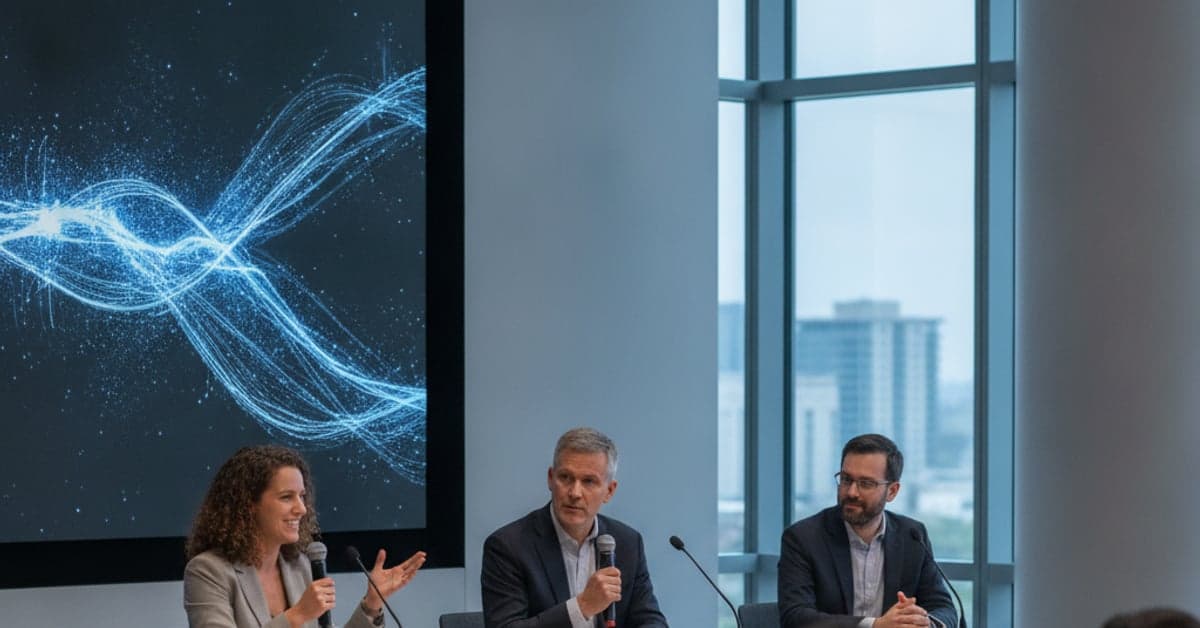
On August 19, 2026, Northwestern’s Network for Collaborative Intelligence hosted Meta’s Madeline Hinkamp and Technion’s Yossi Keshet to spotlight how open‑source AI gets applied to real problems, according to the NNCI site. The event underscored the network’s simple promise: put researchers, students, and industry in the same room, then move ideas into working tools. That’s the kind of follow‑through the Northwestern NNCI says it exists to deliver.
“Where Collaboration Leads to AI‑Driven Breakthroughs.” — Northwestern NNCI
What the Northwestern NNCI is building
The university describes the Network for Collaborative Intelligence as a community focused on responsible, high‑impact work in AI and data science that spans schools and disciplines. It aims to advance “world‑class research and education” while growing partnerships across and beyond campus, the network explains on its homepage. In plain terms, the model is a campus‑wide connective tissue, not a single lab or isolated institute.
That scope matters. By inviting faculty, educators, students, and industry leaders to participate, the Northwestern NNCI can convene experts who rarely share workflows: model builders, domain scientists, policy thinkers, and product engineers. The network’s framing around “responsible” work also tracks with outside guidance, such as the U.S. standards body NIST’s AI Risk Management Framework, which emphasizes measurable practices for trustworthy AI. A broad tent makes those practices easier to test in the open.
From talks to tools: open‑source AI in practice
The August speaker lineup brought that tent to life. Hinkamp, from Meta AI, and Keshet, from the Technion–Israel Institute of Technology, discussed how open‑source models and methods get pushed into field contexts, the NNCI write‑up says. That pairing—an industry practitioner and an academic researcher—signals a deliberate choice: use the room to test assumptions from both sides, then leave with a shorter path to replication and deployment.
Open‑source tooling also answers a practical campus need: students and collaborators can audit, run, and adapt code without licensing delays. That improves reproducibility and speeds iteration. It aligns with long‑standing open‑source norms—see the Open Source Initiative’s definition of shareable, inspectable code—as documented by the Open Source Initiative. When a network turns guest talks into working examples that anyone on campus can try, the learning loop tightens.
The deeper story is operational, not ceremonial. A speaker series can be a funnel for pilots: identify a problem during the session, connect a grad student and a product engineer the next day, merge a patch the week after. A network designed for follow‑through is more likely to close that loop. That is the bet the Northwestern NNCI appears to be making.
Inside the materials study the network is amplifying
The NNCI isn’t only staging conversations. On July 31, 2026, it highlighted a materials discovery result from Northwestern’s McCormick School of Engineering: an AI‑powered approach from Professor Chris Wolverton that combines machine learning, advanced structure searches, and quantum‑mechanical calculations to reveal material interfaces and guide the design of more efficient, durable, and reliable electronic technologies, the network’s site reports. For background on the school’s research portfolio, see the McCormick School of Engineering.
Why it matters: interface behavior often dictates how batteries, chips, and sensors actually perform. If algorithms can map those boundaries with higher confidence, engineers can prune dead‑end experiments and reach manufacturable materials faster. The Wolverton work, as described by NNCI, is a clear example of what a campus AI network can surface and share: a technique that fuses statistical learning with physics‑informed search to answer a materials problem that industry cares about.
There’s another link back to the events program. Talks about open‑source pipelines and data stewardship are not abstract when the next lab over needs to publish code for a new interface‑finding method or validate results on a shared dataset. By elevating both the discussion and the deliverable, the network makes it easier for the broader community to reuse the science.
Why Northwestern’s AI network matters to partners
For companies, the pitch is straightforward: plug into a campus node where ideas move quickly from seminar to sandbox. Partners see early signals on what’s technically viable, and students gain experience shipping code that others can run. For researchers, the benefit is leverage on compute, data access, and collaborators who bring a different lens to the same problem.
There’s also a governance upside. A public network that talks about responsible practice, then links to projects that others can inspect, gives funders and regulators something concrete to evaluate. It reduces the gap between policy statements and working examples, which the NIST framework encourages.
The story the Northwestern NNCI is writing, through its speaker series and research highlights, is that breadth can produce depth. Bring outside voices to campus, keep the code open when you can, and aim the tools where a domain payoff is obvious—like materials interfaces. That’s how a university network avoids becoming just another calendar of talks.
What to watch next for the Northwestern NNCI
Two markers will show whether the model keeps compounding: first, more pairings where an event spins into a reproducible demo or dataset within weeks; second, research spotlights that cross departments and ship artifacts others can run. If those show up, expect stronger ties with industry labs and faster student pathways into applied roles.
The promise is simple and testable. If the Northwestern NNCI continues to connect open‑source know‑how with lab‑grade science, the network can turn more campus conversations into shared methods—and move the needle where it counts, in classrooms, codebases, and hardware. For more on this, see reuters.com.
Related reading: AI Copyright • Deepfake • AI Ethics & Regulation