
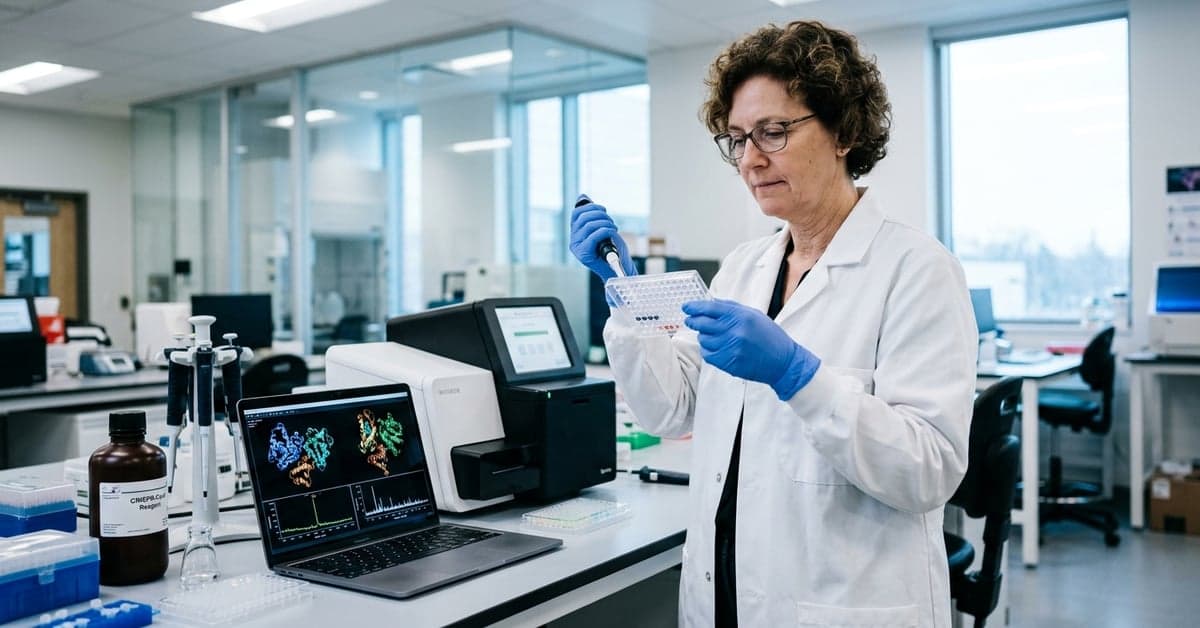
On July 16, 2026, Nature reported that researchers had created functional CRISPR enzymes with the aid of artificial intelligence — molecular scissors not found in nature. The team designed new proteins that cut DNA, then showed they work in the lab. If the results hold up, AI-designed CRISPR could mark a sharp turn in how genome editors are invented and deployed.
What the AI-designed CRISPR study shows
According to Nature, scientists used machine-learning tools to design enzymes that behave like CRISPR nucleases, but with sequences that do not exist in any known organism. That matters because most gene-editing work today relies on natural proteins such as Cas9 and Cas12, adapted from bacteria and archaea. The new work suggests a second path: editors invented first in silico, then proven at the bench.
CRISPR acts like a guided scalpel. A protein follows an RNA guide to a matching DNA address, then cuts. Specificity depends on both the guide and the protein’s built-in rules — including its recognition of short DNA motifs called PAMs. As background, the Broad Institute has a clear explainer of how these parts fit together and why PAMs constrain where edits can happen (Broad Institute overview). The new study implies those rules are no longer fixed. If designers can set the cutting behavior up front, AI-designed CRISPR could target sequences natural enzymes ignore.
Why synthetic nucleases shift the IP and safety debate
Nature’s report frames a technical feat, but the ripple effects land in policy and business. A de novo editor could thread the CRISPR patent thicket that has entangled Cas9 for years. Tools invented by algorithms and trained on public data might sit outside older claims, at least in part. That could reshape licensing costs and who can bring therapies forward.
Safety is the other lever. Off-target edit risk has dogged gene editing since its first human trials. Editors cut where they should — and sometimes where they shouldn’t. Tighter control over PAM site specificity and cutting kinetics could reduce those misses. Reviews in the methods literature catalog how off-targets arise and how they’re measured; they also show progress is incremental, not automatic. Regulators will still expect hard evidence. The FDA’s gene therapy guidance makes clear that sponsors must characterize the editor, its off-target profile, and its delivery system before human dosing (FDA cellular & gene therapy guidances).
There’s a third safety angle: immunity. Several studies have reported pre-existing human antibodies and T cells against bacterial Cas proteins, a by-product of prior exposure to microbes. Editors invented from scratch might dodge that, because there is no natural pathogen match. It’s a hypothesis, not a guarantee, but it’s testable with standard immunology assays and could matter for repeat dosing.
Where AI-built CRISPR could matter first
Near term, the biggest gains may come from fit-to-purpose tools. Many programs stall because a natural nuclease can’t reach the exact site a disease demands, or it’s too large for a chosen delivery vector. In principle, de novo genome editors can be sized for packaging limits and tuned for the right PAM. That opens options in tissues where today’s editors fall short.
Basic research could feel the change earlier than the clinic. If labs can pick from a rack of designers with different PAM preferences and cut profiles, they can probe regions that were off-limits. That variety could speed functional genomics, crop improvement, and microbial engineering. It would also spread risk: if one editor proves finicky in cells, another with similar goals could step in.
The path from design to data has shortened thanks to better protein prediction. Tools like AlphaFold helped make reliable structure models a routine step (DeepMind’s AlphaFold). Newer diffusion-based methods for de novo protein design have further raised the floor for inventing stable, functional proteins (UW Institute for Protein Design). That context helps explain why AI-designed CRISPR is arriving now, not five years ago.
Guardrails and the questions that still need answers
The Nature report is a strong signal, but it is one paper. Independent labs need to reproduce the activity, map off-targets in different cell types, and benchmark against Cas9 and Cas12 on the same targets. Standards matter here: transparent release of sequences, guides, and validated assays would make it easier to compare results across groups.
There are governance knots to untangle. If models can spin up artificial CRISPR nucleases quickly, access policies become important. Preprints and code speed science, yet they also raise dual-use concerns. Expect editors, funders, and journals to ask for risk reviews before full release. Those are familiar debates in synthetic biology and will likely migrate here.
Compute cost is another practical question. Designing an editor once is not the same as letting many labs do it on demand. If only a few centers can afford the pipelines, the field centralizes. Shared resources — or cloud-hosted design services with clear audit trails — could widen access while keeping logs regulators will want to inspect.
What this means if the results hold
If independent teams confirm the findings, AI-designed CRISPR would expand the gene-editing toolkit and alter incentives across research and biotech. The ability to dial in PAM recognition and size could unclog programs stuck on delivery or specificity. A cleaner IP path would lower barriers for startups and academic spinouts. And if immunogenicity really drops, repeat dosing moves from hope to plan.
The catch is the same as always: performance in organisms, not just cells. Animal studies will need to show precise edits, durable effects, and safe biodistribution. Regulators will watch the off-target maps and the manufacturing details. But the direction is clear. In a field built on borrowing from bacteria, human-designed editors are stepping onto the stage — and AI-designed CRISPR may become the new default starting point for the next wave of gene-editing tools.
Related reading: AI in Education • Data Privacy • AI in Society