
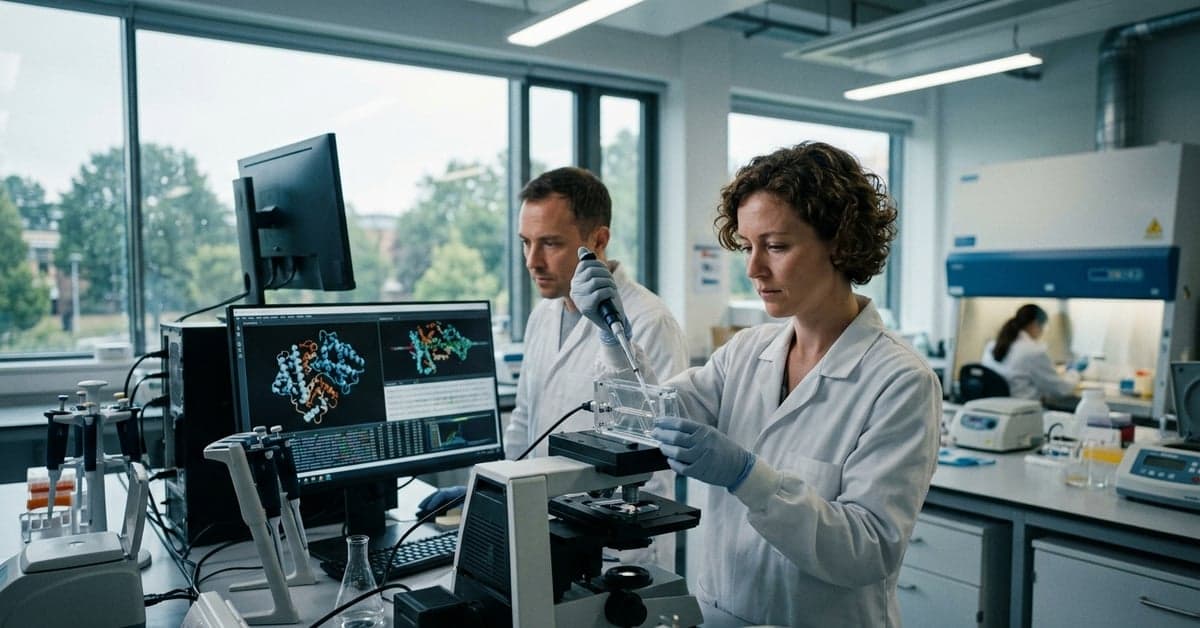
August 6, 2026 marked a line in the sand: scientists created the first viruses designed by AI, a step researchers called promising for medicine yet fraught with risk. The Guardian reported the breakthrough and the urgent biosecurity concerns it raised, pushing a once-hypothetical debate into immediate policy territory (The Guardian).
What The Guardian’s report on AI-designed viruses changes
The claim isn’t that labs have discovered a new class of pathogen. It’s that design work once gated by slow trial-and-error can now be accelerated by code. That shift matters more than any one result. According to Stanford HAI’s 2026 AI Index overview, the field has hit new capabilities while raising hard questions about transparency and who benefits. The Guardian’s report shows those questions colliding with biology in real time.
For health, speed can be a blessing. AI-aided design might cut years off vaccine platforms or oncolytic virus therapies. For safety, speed narrows the window to catch errors, perverse designs, or misuse. That’s the trade-off policymakers, labs, and model vendors now face with AI-designed viruses.
AI biosecurity is no longer theoretical
Biology has spent a decade building guardrails. DNA synthesis firms screen customer orders against known harmful sequences, following the International Gene Synthesis Consortium protocol. Universities run dual-use reviews. Regulators publish guidance on high-risk experiments. The World Health Organization’s global framework for responsible life sciences lays out principles and processes.
AI upends the timing. Generative models can propose thousands of candidates fast. That doesn’t erase wet-lab hurdles, but it reshapes where risk concentrates: at the point of design and at the point of ordering DNA. When design is automated, the weakest link moves from the bench to the keyboard and to the gene foundry inbox. That is why AI-designed viruses trigger different alarms than conventional dual-use work.
Where policy lags the lab
Governance has focused on the lab bench. The U.S. policy on dual-use research of concern and institutional reviews, guided by the NSABB-linked framework, screens plans for risky experiments. But if the riskiest step shifts to computational design, reviews that begin when pipettes come out start too late.
AI policy has its own wedge. The NIST AI Risk Management Framework gives a structure for mapping and measuring model risk. It wasn’t written for synthetic virology, yet its language on context, misuse, and monitoring fits the moment. Stanford HAI’s summary of the 2026 Index underscores transparency gaps. In biology, those gaps look like an absence of audit trails between a model’s suggestions and a DNA order, or unclear handoffs between software teams and biosafety officers.
Without that connective tissue—design logs linked to sequence screening results—labs may comply on paper while missing the riskiest paths in practice. That’s the policy lag The Guardian’s reporting makes plain.
What labs and model vendors should do now
This is where the consequences land for developers, PIs, and platform leads. You don’t need new law to change practice next week. Four pragmatic moves close much of the gap created by AI-designed viruses:
- Record and reconcile. Keep signed logs of model prompts, parameters, and candidate outputs. Tie those logs to the exact sequences submitted to synthesis providers and the screening results returned.
- Screen before you screen. Run in-house filters on generated sequences against curated organism and function databases before any external order, then compare outcomes with IGSC returns.
- Split permissions. Treat sequence export as a privilege distinct from model access. Senior biosafety officers, not software admins, should approve export rights for pathogen-adjacent projects.
- Wire the review earlier. Extend institutional biosafety review to cover computational design phases, including model selection and fine-tuning plans, not just wet-lab procedures.
Model providers have parallel duties. Provide a “safe sequencing” mode that blocks export of known hazardous motifs and flags near-misses. Offer enterprise customers a dashboard for sequence screening telemetry and a tamper-evident audit feed they can share with regulators. Close the loop with synthesis providers through opt-in verification tokens tied to each DNA order. None of this solves dual-use risks outright, yet it raises the bar without stalling legitimate work.
Why the debate is really about defaults, not intent
Biosecurity discussions often hinge on user intent. That frame breaks under scale. With AI-designed viruses, a graduate student can generate a large design space in minutes. A tiny fraction could be hazardous, even if nobody is aiming for harm. The risk moves from motive to math: how many unsafe candidates escape filters and make it to an order form.
That’s why “do no harm” statements from labs or AI firms don’t change much. Default-deny export controls, reproducible logs, and independent sequence screening do. Stanford HAI’s focus on who benefits is relevant here too. If the upside accrues to patients and the downside to communities near labs and datacenters, transparency and accountability aren’t ethics slogans. They are operational requirements.
What happens next if we take this seriously
Expect funders to mandate earlier-stage reviews and auditability for AI-assisted biology grants. Expect synthesis firms to ask for more metadata with every order and to standardize cross-checks. Expect enterprise AI contracts in pharma to include specific biosafety KPIs: pre-screen hit rates, export block accuracy, and time-to-audit.
Regulators won’t wait for a test case. They can use existing tools—DURC policies, select agent rules, and the NIST framework—to set expectations for computational design workflows. International bodies can align on screening baselines and exchange formats so alerts move faster than code. The Guardian’s report may read as a lab milestone, but it is also a calendar marker. From August 2026 onward, any organization using generative tools in synthetic biology should assume audits will reach back into the design logs.
Handled well, the same methods that speed a vaccine platform can be made to slow a bad sequence. Handled poorly, they shorten the path from idea to incident. The difference is whether we treat AI in biology as a software feature or as an exposure that needs controls from prompt to pipette. This is the practical takeaway from AI-designed viruses: the lab bench is no longer the first line of defense, and neither is intent.
The Guardian raised the alarm; Stanford HAI supplied the wider frame. The next moves belong to labs and model vendors. Put the controls in now, and the promise of AI in drug discovery won’t be held hostage by its worst-case designs. For more on this, see reuters.com and bloomberg.com and nytimes.com.
Related reading: AI in Education • Data Privacy • AI in Society