
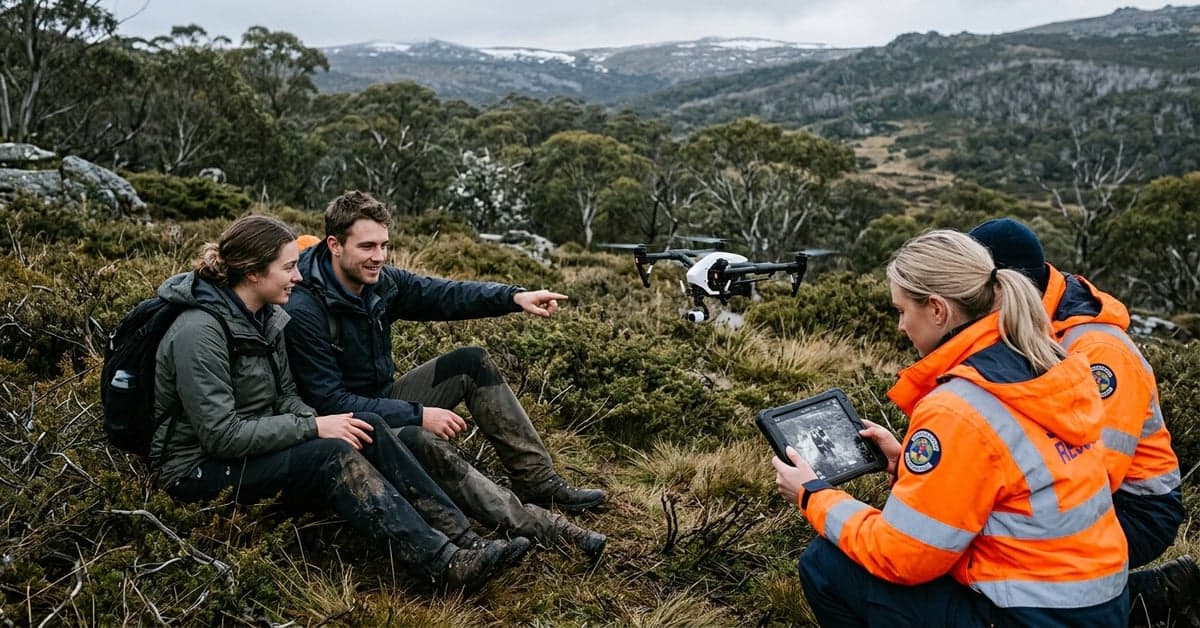
On June 27, 2026, two hikers lost in Kosciuszko National Park, New South Wales, were located in about five hours by an AI‑equipped drone, according to The Guardian. The paper’s report says the pair had strayed roughly half a kilometre from the track before the search team’s system spotted them and guided rescuers in. A companion video from The Guardian shows the operation from takeoff to recovery, underscoring how efficiently the tool slashed the search window.
What happened on June 27, and what the footage shows
The Guardian’s write-up places the incident in Kosciuszko National Park on June 27, 2026, after the hikers veered off a marked trail in difficult country. The article states they were found within five hours using an AI-driven drone, and adds the distance off-trail. In the outlet’s video coverage, the rescue team explains the sequence: launch, search patterns, identification, and coordination for ground recovery. The video helps establish that this wasn’t a lab test or a staged demo. It was an operational save in Australia’s largest national park, at speed, with the aircraft acting as a frontline tool rather than a sidekick.
That difference matters. The short timeline suggests the drone wasn’t just providing a camera on a pole. It was scanning, triaging, and surfacing likely targets, which cut the human workload on a day when minutes were expensive. The Guardian’s account doesn’t specify which model was flown or what sensing stack it used. Even so, the pattern mirrors peer-reviewed work showing aerial systems can narrow search areas faster than ground teams when vision algorithms flag human shapes or colors against terrain. A 2021 review in the International Journal of Disaster Risk Reduction describes that advantage in detail and documents where it holds greatest promise in rough terrain and low-visibility conditions.
Why the AI drone rescue signals a shift for emergency response
Single rescues don’t prove a trend. This one points to it. The short search window and the ease of deployment, as shown in The Guardian’s video, suggest the technology has moved from field trial to playbook. When an incident commander can dispatch an aircraft that scans and ranks likely sightings in real time, the first hour changes. Crews cover more ground. Risk falls for volunteers sent into cold, wet, or steep country. Cost drops when a lightweight drone substitutes for a helicopter pass in marginal weather.
This is the hinge. Many agencies have bought small drones for years, but they’ve flown them as eyes, not decision aids. An AI drone rescue reframes the device as a sensor-and-analysis tool that tees up actions, and that shift carries procurement and training weight. Operations leaders will ask for models that are rugged, weather-tolerant, quick to recharge, and approved for night flying. They will also need workflows that make flagged detections auditable and easy to hand off to ground teams under pressure.
How AI-powered drones change a search, and the rules that shape them
Australia’s aviation regulator, the Civil Aviation Safety Authority (CASA), sets the boundaries for where and how public safety teams can fly. CASA’s drone rules shape altitude, line-of-sight constraints, and approvals for more complex operations such as beyond visual line of sight (BVLOS). Those guardrails matter for scaling the approach used in Kosciuszko. A bigger operational envelope — higher ceilings, BVLOS corridors, night waivers — widens the search area and reduces handoffs between crews.
Training is the next lever. Teams must learn to trust algorithmic hits without over-trusting them. That takes drills where operators deliberately seed false positives and watch how the model behaves across lighting and terrain. It also takes data hygiene. Search logs, detections, and outcomes need to be kept in a simple format so skills transfer across crews, shifts, and neighboring agencies. Without that, one high-profile AI drone rescue can look like luck, and its lessons won’t stick.
Costs, benefits, and what The Guardian’s report doesn’t say
The Guardian’s article and video establish speed and success. They don’t list model specifications, sensor modalities, or the confidence score that triggered the find. That’s normal in a fast-moving rescue. It also highlights why public safety buyers should demand clear detection telemetry when they source systems. If the aircraft shows why it flagged a patch of scrub — a heat signature, a color cluster, a shape match — crews can learn faster, and incidents build a training library rather than a pile of anecdotes.
There’s a budget case to make as well. Many national parks and state agencies can’t afford helicopter hours for every callout. Drones don’t replace manned aircraft, but they can rapidly clear sectors and free crews for complex work. The Guardian’s five-hour timeline is the headline figure. Under it sits a quieter win: fewer people put in harm’s way during a cold search, and less time burned on empty ground. That’s the kind of saving chief officers can carry into grant applications and program renewals.
What comes next for search teams building on this save
Expect more joint exercises, more shared playbooks, and more standardization of alert thresholds. After one visible AI drone rescue, neighboring services tend to ask for the same kit. The smart move is pooling buys, sharing datasets across districts, and agreeing on metrics: time-to-first-sighting, rate of false alerts per hour, battery swaps per sortie. Those numbers let leaders judge systems against terrain and season.
There will be edge cases. Strong winds and dense canopy still limit what small aircraft can do. Privacy rules apply when searches extend near towns or private land. Agencies should set bright lines on data retention and no-fly zones in advance, so crews aren’t guessing in the field. Done well, those rules keep community trust while preserving the speed that made this save possible.
The Guardian’s reporting from June 27 shows the promise in action. A fast find, a safe handoff, and evidence that the tools are ready for regular duty. If more agencies treat this as a template, the next AI drone rescue will look less like a headline and more like good practice. For more on this, see bloomberg.com and nytimes.com.
- The Guardian video of the Kosciuszko search
- The Guardian’s report on the rescue
- CASA: Australia’s rules for drones
- Review of drones in search and rescue (IJDRR)