
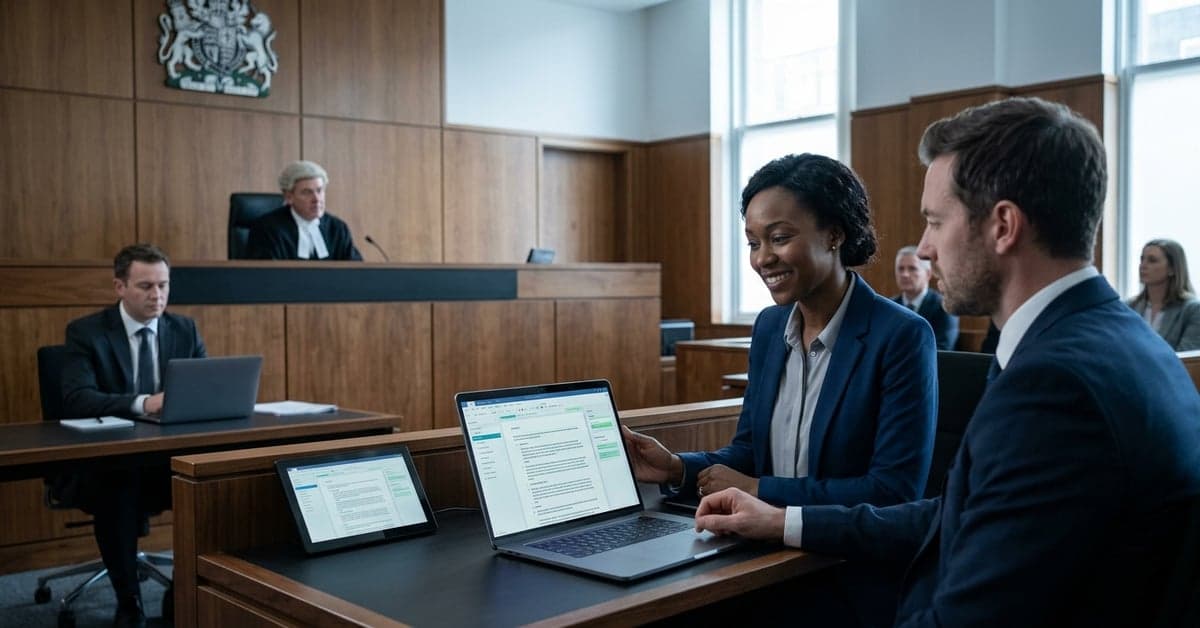
On June 22, 2026, The Guardian reported an AI lawyer court case in England that ended with an HR consultant winning — an apparent legal first (The Guardian). The listing did not name the parties or court, but the framing was clear: software didn’t just draft a memo. It helped deliver a result.
The news hints at a turning point. Consumer-grade legal AI has slipped from demos and chat windows into formal adjudication. That’s new territory for judges, regulators, and clients. It’s also a live test of promises about cost, speed, and fairness in the justice system.
What happened in the AI lawyer court case
According to The Guardian’s AI section, the win came in an English court and involved a non-lawyer relying on an “AI lawyer.” The page describes it as a legal first for England on June 22, 2026. The summary does not detail which model was used, how the tool was deployed in filings or hearings, or what controls were in place. Those specifics matter, because “AI lawyer” can cover anything from drafting prompts to real-time guidance in court.
Even with sparse details, the headline claim carries weight. If a litigant prevailed while leaning on automated analysis or drafting, courts may soon face routine questions about disclosure, admissibility, and reliability of AI-generated work. The first order issue is practical: judges need to know whether facts and citations were verified by a human, and opposing parties deserve to know when an algorithm shaped the argument.
Why this could widen access to justice
Legal help is expensive. Many people go it alone and lose on process rather than merit. The prospect behind the AI lawyer court case is simple: low-cost tools might help more litigants assemble coherent pleadings, meet deadlines, and respond to evidence with fewer errors. If that happens at scale, courts could see better-prepared filings from people who can’t afford representation.
There are hard limits. The Law Society of England and Wales warns that generative systems can fabricate sources and mishandle confidential data, and that solicitors remain responsible for accuracy and supervision (Law Society guidance). Any real gains for access to justice depend on guardrails: clear human review, proper data handling, and honest disclosure about what the machine did.
Governance signals: from courtrooms to the UN
While English courts grapple with use on the ground, international bodies are trying to shape the rules. The United Nations University launched the Global Artificial Intelligence Network to support multi‑stakeholder cooperation on AI for sustainable development, bringing together academia, industry, governments, and civil society (UNU Global AI Network). Its programming in 2025 and 2026, including an April 30, 2026 lecture on AI and the future of work in developing economies, treats governance as a long race, not a sprint.
That framing fits the AI lawyer court case. A single courtroom win can outpace policy development, exposing gaps in disclosure norms, competency standards, and accountability. Global coordination can’t dictate English procedure, but it can inform principles — transparency, safety, equity — that domestic courts translate into rules. Without that bridge, adoption will run ahead of oversight.
What English judges and regulators already advise on AI
The judiciary has started sketching boundaries. Guidance for judges in England and Wales published in December 2023 advises caution with generative AI: don’t input confidential or sensitive material into public tools, check outputs for accuracy, and remember that responsibility rests with the human decision‑maker (Judiciary of England and Wales). That mindset points to how courts may evaluate any filing touched by an algorithm.
Regulators are pressing the profession as well. The Solicitors Regulation Authority has warned firms to assess client confidentiality risks, maintain supervision over AI‑assisted work, and avoid misleading claims about what tools can do (SRA guidance). For litigants outside the profession, comparable duties are thinner. That’s why the AI lawyer court case sharpens the need for simple, public rules on disclosure and verification that apply to everyone in a proceeding.
What to watch next for AI in the courtroom
Expect incremental, local steps rather than a grand directive. Courts can require parties to certify whether they used generative tools, and if so, how human review was performed. They can clarify how to cite AI‑assisted research, and what counts as acceptable verification of quotations and case law. They can also set expectations for digital evidence and ban entering confidential material into public systems, matching the judicial guidance already in place.
The uneven quality of tools is another fault line. If one side uses a vetted, domain‑tuned assistant and the other relies on a brittle chatbot, any efficiency gains could translate into new inequalities. Disclosure won’t solve that, but it will help judges weigh credibility and intent when mistakes surface. Procurement by legal aid providers and consumer‑facing labels on accuracy and data handling would help more.
There’s also a cultural hurdle. Lawyers who refuse to touch AI risk falling behind on productivity. Lawyers who overtrust it risk sanctions and client harm. The sensible middle — human‑led, AI‑assisted — will win only if courts set expectations that reward careful use and punish sloppy shortcuts.
The Guardian’s report plants a flag: the courtroom is no longer a hypothetical space for these tools. Governance work at the UN and in London has to meet that reality. The sooner the rules are simple and public, the faster courts can capture benefits without importing new risks from the AI lawyer court case. For more on this, see bloomberg.com and nytimes.com.