
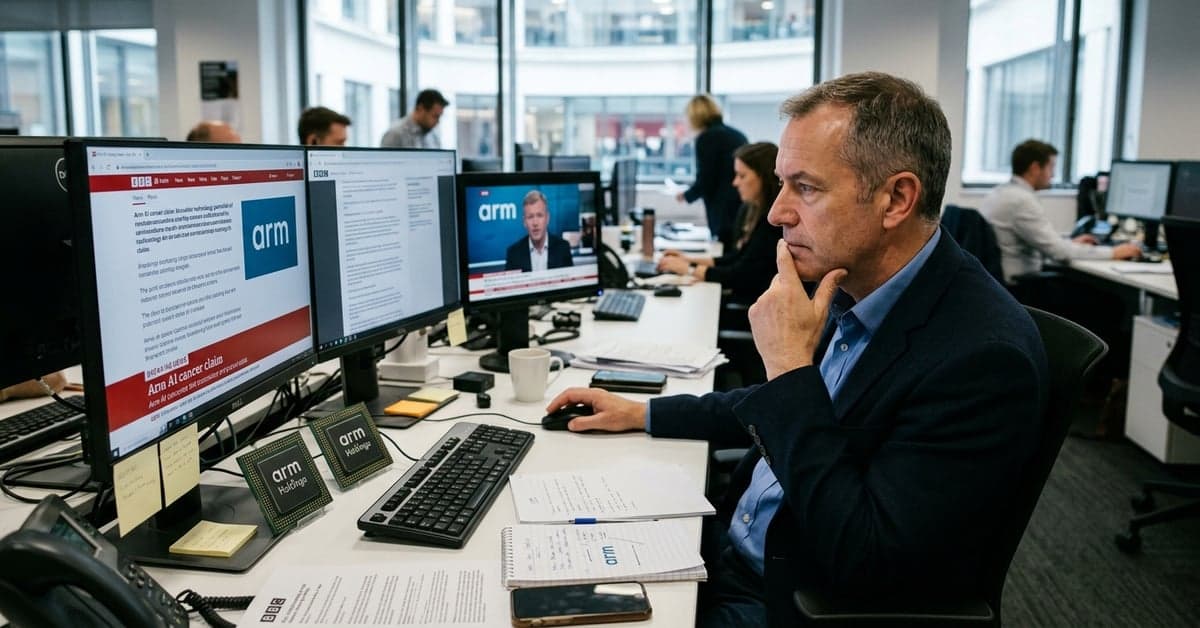
On September 8, 2026, the head of Arm Holdings said artificial intelligence would help find a cure for cancer within our lifetimes. The BBC’s technology desk highlighted the remark the same day, framing it as a bold bet from the UK chip giant, while the Guardian reported the pledge in near-identical terms and timing, quoting the line “within our lifetimes” from Arm’s chief (BBC Technology; the Guardian). The claim travels fast. The reasons it could stall are slower to explain.
What the Arm AI cancer claim really says
The Arm AI cancer claim is less a calendar promise and more a direction-of-travel statement. Coming from a company whose designs underlie most smartphones and an increasing share of data center gear, the message doubles as a pitch: if AI accelerates oncology, demand for efficient compute rises too. That alignment doesn’t make the forecast wrong, but it does color it.
Both outlets focused on the statement itself. Missing was a translation into near-term outcomes patients and clinicians will actually see. AI can compress steps in discovery, triage, and monitoring. But curing a set of hundreds of diseases grouped as “cancer” depends on biology, trials, and public health as much as algorithms and chips.
Where AI is moving the needle in oncology today
Three areas show real traction. First, imaging support. Machine-learning readers for mammography, lung CT, and colorectal screening can flag suspicious regions and help prioritize backlogs. Regulators keep a running public list of AI/ML-enabled medical devices, with radiology the most active category (U.S. FDA device list). These tools do not cure cancer; they aim to find it sooner or reduce missed findings, which improves odds in specific cancers.
Second, pathology and genomics. Models that read whole-slide images or predict tumor subtypes from sequence data are edging into workflows as decision support. Accuracy claims vary by dataset and lab conditions. Independent validation across diverse populations remains the bar to clear before widespread use, a point echoed by global health guidance on AI’s risks and guardrails (WHO guidance on AI for health).
Third, drug discovery. Generative chemistry and structure prediction can cut early-stage search time, winnowing candidates before wet-lab testing. That can save money and open new targets, yet the slow part—demonstrating safety and efficacy in humans—still runs on trial calendars and biology. A Nature Medicine perspective on translating such systems into clinics underscored the gap between promising models and reproducible patient benefit (Nature Medicine analysis).
Chips aren’t the bottleneck; data and trials are
Arm’s view highlights compute efficiency, which matters for cost and energy use. But the limiting factors for curing cancer lie elsewhere. High-quality, longitudinal datasets that capture imaging, pathology, treatments, outcomes, and socioeconomic context are scarce and siloed. Even when hospitals can share, consent frameworks and incentives are misaligned. Models trained on narrow cohorts underperform in the wild; bias creeps in; results drift.
Then comes evidence. To move from promising AUCs to practice, tools must prove they change decisions and improve survival or quality of life. That means prospective trials, embedded studies, and post-market surveillance. Health systems need to measure not just accuracy but false positives, workflow impacts, and equity effects. Those are policy and operations questions as much as engineering ones. Neither the BBC nor the Guardian coverage addressed this bottleneck head-on; it’s the difference between an exciting line and a durable milestone.
Testing the Arm cancer AI prediction: five-year milestones
If readers want a way to judge the Arm AI cancer claim without waiting a lifetime, track these concrete signals over the next five years:
- Screening outcomes: Peer-reviewed trials showing AI-supported screening reduces interval cancers and stage at diagnosis in breast, lung, or colorectal programs, with diverse populations and clear equity analyses.
- Trial velocity: Documented reductions in time from target discovery to first-in-human oncology trials tied to AI-aided candidate selection—and lower attrition in Phase II due to better target quality.
- Adaptive care: Deployment of AI tools that synthesize imaging, labs, pathology, and notes to recommend therapy adjustments in tumor boards, backed by prospective evidence of improved progression-free or overall survival.
- Real-world monitoring: Broad use of AI to detect toxicity or relapse signals from wearables and EHR data, cutting avoidable hospitalizations or catching recurrence earlier, again with published outcomes.
- Regulatory clarity: Stable, internationally aligned guidance for learning systems in medicine, enabling updates without re-litigating safety each time. Watch for harmonized policies from FDA, EMA, and MHRA referencing lifecycle monitoring.
Hit several of these, and the claim’s spirit looks more credible. Miss them, and we’ve improved diagnostics and productivity but not cures.
Why this claim lands now—and who should care
There’s timing here. Arm designs underpin many data-center and edge deployments racing to cut inference costs. Health systems face oncology backlogs, and governments want growth stories from AI that feel socially valuable. Those currents make the message appealing. The BBC’s framing placed the line amid a run of AI headlines, while the Guardian page positioned it alongside editorials warning about overpromising in other AI domains. The juxtaposition tells its own story about expectation management.
For clinicians, the near-term move is pragmatic: demand external validation before adopting tools, and insist on monitoring their impact on patient outcomes, not just workflow speed. For hospital leaders, fund data partnerships that link imaging, pathology, genomics, and outcomes under strong privacy controls. For policymakers, invest in registries and audit capacity so claims can be verified across demographics and sites. For chipmakers and cloud providers, show how your platforms cut cost per validated patient benefit, not just tokens per second.
Bold predictions have a place. They galvanize teams and budgets. But healthcare moves on evidence. The Arm AI cancer claim will earn its keep if AI systems help catch more cancers early, make treatments more precise, and keep survivors healthy longer—with numbers that hold up outside the lab. Patients will not judge the era by compute efficiency charts; they’ll judge it by years added and fear removed. That’s a bar chips alone can’t clear. For more on this, see reuters.com and bloomberg.com and nytimes.com.