
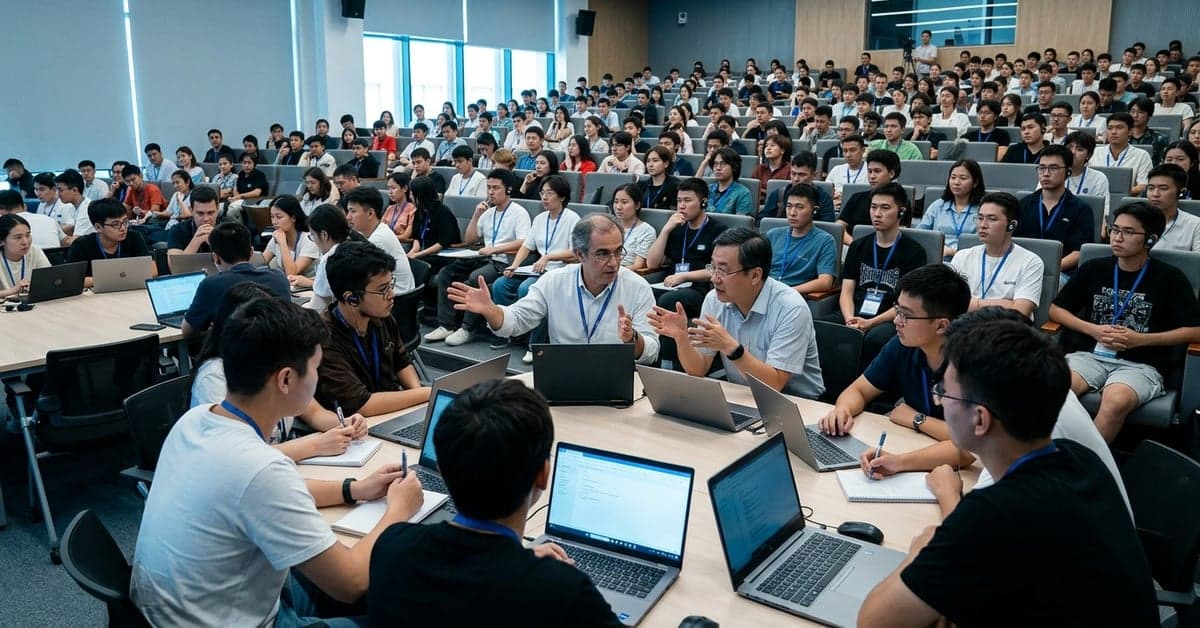
On August 5, 2026, two UNESCO–Uzbekistan laureates turned a student competition into a live ethics lab. At Astana’s International Olympiad in Artificial Intelligence, Professors Virgílio Almeida and Liang Zheng led lectures and debates on accountability, human oversight, and governance for more than 300 competitors, according to UNESCO’s report published September 18, 2026. It was a rare moment where the Beruniy Prize AI ethics agenda met the people who will build tomorrow’s systems—before they ship code.
Why the Beruniy Prize AI ethics push landed in Astana
UNESCO says Almeida, a 2025 awardee, addressed the practical pillars of responsible development: who is accountable when models fail, how humans stay in the loop, and what institutional scaffolding keeps systems in check. Those talking points echo priorities in the UNESCO Recommendation on the Ethics of AI, adopted in 2021. Liang Zheng, a laureate representing the Institute for AI International Governance (I‑AIIG) at Tsinghua University, brought practices and policy approaches from China, giving competitors a view of how norms travel across borders in real programs and rules.
On August 6, the two scholars joined Xiao Qian of I‑AIIG on a high‑level panel that gathered more than 200 experts and researchers. The discussion ranged across public sector transformation, education, science, and international cooperation, UNESCO reported. The setting mattered: ethics wasn’t parked in a closed workshop. It sat inside a talent pipeline, where norms can shape habits early.
“Through the UNESCO–Uzbekistan Beruniy Prize, we recognize outstanding scientific contributions to the ethics of AI. But beyond recognition, the Prize also serves as a platform for continued engagement, connecting research, policy, and society.” — Dr. Dafna Feinholz, Chief of Section of Bioethics and Ethics of Science and Technology, UNESCO
What the laureates told 300 competitors about accountability
The lectures ran straight through the thorny questions developers face under deployment pressure: traceability of model outputs, escalation paths when systems behave unpredictably, and the governance structures that prevent harm. Those themes align with wider guidance like the NIST AI Risk Management Framework and the OECD AI Principles. The Beruniy Prize AI ethics sessions in Astana didn’t just cite frameworks; they pressed students to interrogate trade‑offs they’ll encounter on real teams.
UNESCO’s account highlights two complementary angles. Almeida focused on accountability and the guardrails that keep humans empowered in high‑stakes contexts. Liang detailed current practices and governance approaches in China, offering a look at how different jurisdictions seek to operationalize similar values. For competitors, that comparison shows the concrete decisions—documentation, auditability, escalation, and role design—that turn ethics from slogans into habits.
UNESCO Beruniy Prize as a bridge from research to policy—and students
The Prize was created to honor outstanding scientific work on AI ethics. This year’s activity shows it also functions as a conduit into classrooms and competitions. That bridge matters. Conferences and summits tend to convene executives and regulators. Olympiads convene implementers at the start of the pipeline. When those groups speak the same language about risk, timelines compress and fewer issues fall through the cracks.
By showing up where code is written, the laureates brought governance questions into the moment of design. A student who learns to define an incident response playbook during a contest is more likely to insist on one in a startup. A team that practices model cards and data provenance in a scoring round can carry that discipline into production. That’s how the Beruniy Prize AI ethics program can move the needle: not by publishing another framework alone, but by shaping muscle memory.
How cross‑border norms gain traction in a student arena
Astana offered a practical case study in norm diffusion. Liang’s perspective from I‑AIIG introduced ethics practices and governance mechanisms used in China, while Almeida surfaced accountability and oversight themes that recur in international guidance. Students saw the overlap—and the differences—side by side. That comparative lens matters for teams that will ship products into multiple jurisdictions.
UNESCO’s framing also points to a wider playbook. Pair policy architects with practitioners; push the conversation into competitive settings where participants must make decisions under constraints; and stress test those choices in the open. Done well, it helps future developers internalize why audit trails, role clarity, and human oversight are not overhead but basic engineering hygiene.
What Astana’s format signals for next‑gen AI governance
Competitions reward speed. Governance rewards restraint. Bringing them together can feel tense, but that tension is the point. If students are asked to explain model behavior, document training data lineage, and map failure modes while racing a clock, they learn to bake those steps into their workflow. That’s a better preparation for production than a separate compliance lecture back on campus.
Organizers elsewhere can lift three simple ideas from UNESCO’s account of the Astana event. First, put ethics and governance experts on the main program, not the sidelines. Second, translate policies into contest tasks—require structured documentation, red‑team rounds, and post‑mortems. Third, invite perspectives from multiple governance traditions so competitors see the shared values and the operational differences up close.
UNESCO positioned the Prize as a platform that connects research, policy, and society. Astana showed what that looks like in practice. When laureates face questions from hundreds of young developers, abstractions give way to design choices. And the Beruniy Prize AI ethics focus moves from declarations to habits, which is where safety lives day to day.
UNESCO reported the event on September 18, 2026, but the meaningful date for the field may be August 5, when the first lecture started. That was the moment ethics entered the code arena at scale. If more Olympiads and hackathons follow suit, the Beruniy Prize AI ethics initiative could help set a new baseline: ship faster, but with accountability, oversight, and governance wired in from line one.