
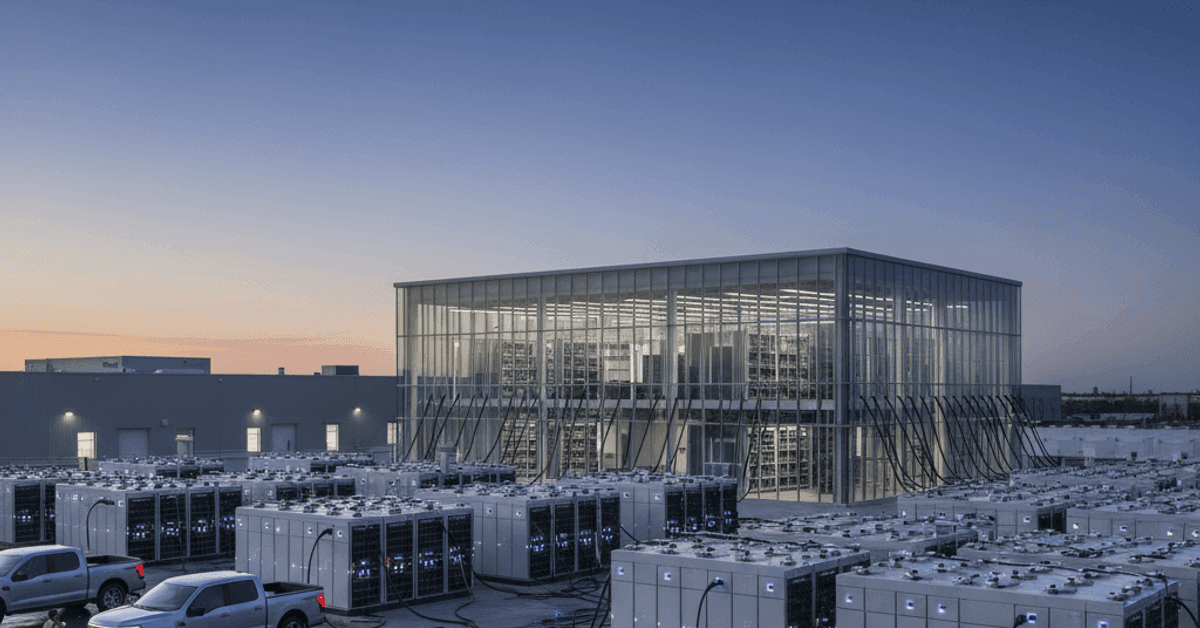
Ford will enter the grid-scale battery business to support AI data centers as it pivots from pure EVs to hybrids and extended-range models. The move adds a new energy business alongside a redesigned truck lineup and marks a clear response to rising electricity needs from artificial intelligence infrastructure.
Ford AI energy storage strategy
Ford outlined plans to build and sell stationary battery storage systems amid a broader restructuring of its vehicle roadmap. According to reporting by The Verge, the company framed the new products as a way to serve growth in AI data center construction while it accelerates hybrid production and readies an extended-range F-150 Lightning variant with up to 700 miles of range. The announcement underscores how AI is shaping industrial strategy beyond software, hardware, and chips.
Ars Technica adds that Ford is ending production of the current F-150 Lightning and will replace it with a series-hybrid EREV that uses a gasoline generator to charge the battery. The report notes the company will emphasize towing capability, long range, and lower costs, while repurposing battery assets and partnerships. Ford’s energy storage products arrive as a parallel bet on electrification that does not depend on consumer EV demand alone.
Why AI data centers need batteries
AI training and inference push data centers to draw more power, raise peak loads, and demand higher grid reliability. Therefore, grid-scale batteries can help smooth demand spikes, reduce curtailment, and provide fast-response services. The International Energy Agency has highlighted the rapid growth in electricity use from data centers, networks, and AI. Its analysis shows steep increases in consumption in major hubs, with more to come as AI workloads spread. Readers can explore the agency’s assessment in its data centres and networks analysis.
Additionally, utilities are turning to battery energy storage systems to balance intermittent renewables and to defer costly grid upgrades. The U.S. Department of Energy outlines how storage supports frequency regulation, peak shaving, and resilience. For more on those functions, see the DOE’s overview of grid energy storage. As AI campuses cluster in regions with constrained transmission, batteries can deliver near-site support and reduce exposure to outages.
From EV ambition to hybrid realism
Ford is dialing back expectations for near-term battery-electric growth. The Verge reports that slowing EV sales and higher material costs have pressured margins and plans. As a result, the company will scale hybrids and introduce a range-extended F-150 Lightning EREV, which blends electric driving with a combustion generator for long trips and heavy towing. Ars Technica quotes Ford’s leadership promising “revolutionary” range and performance in the next iteration, despite the retreat from a fully electric pickup.
Furthermore, the company is reallocating manufacturing lines and rethinking its battery partnerships. Those changes are happening as industrial demand from AI puts new value on stationary batteries. In practice, this allows Ford to keep investing in battery expertise while aligning with a surging customer segment: data center operators, utilities, and developers building power-hungry AI clusters.
AI data center power demand reshapes auto strategy
AI has become a cross-sector force that reshapes capital plans, supply chains, and labor needs. Ford’s energy storage initiative reflects a broader trend in which high-tech demand guides heavy industry. Battery cells and packs can serve cars or containers, and companies now flex those assets based on near-term returns and grid needs. In turn, automakers can hedge against EV adoption cycles while deepening electrification skills.
Moreover, batteries for data centers require robust thermal management, long cycle life, and strong safety measures. Those requirements overlap with automotive standards, which creates room for component reuse and shared engineering. Ford can leverage learnings from vehicle packs, software controls, and manufacturing quality to win energy contracts. This dual-use capability could reduce unit costs and stabilize procurement for both stationary and mobile applications.
F-150 Lightning EREV and the hybrid truck strategy
The F-150 Lightning EREV aims to keep the instant torque and smoothness of electric drive while solving towing and range anxiety for long-haul use. Meanwhile, hybrids can meet customers who want better efficiency without charging dependencies. Together, these steps signal a pragmatic approach to decarbonizing pickups at scale, even as battery supply chains evolve and public charging expands unevenly.
However, the hybrid truck strategy will face scrutiny from climate advocates who prefer full battery electric adoption. It will also face competition from rivals that may hold to BEVs in specific segments. Still, Ford’s leaders appear focused on affordability, uptime, and total cost of ownership. If the EREV succeeds with fleets and rural buyers, it could bridge today’s infrastructure gaps while keeping momentum in vehicle electrification.
What the shift means for jobs and grids
Jobs often follow capital and capability. Because Ford is repurposing battery capacity for both vehicles and stationary systems, manufacturing roles may shift rather than disappear. The Verge notes that Ford will expand hybrid production while it seeds a new storage business. Consequently, communities tied to truck plants could see steadier volumes, while regions with data center growth may attract new energy projects tied to Ford’s offerings.
For grid planners, another OEM entering storage is welcome. Additionally, diversified suppliers can improve pricing, availability, and maintenance support. Utilities and AI operators value proven partners, bankable warranties, and integration expertise. Ford’s brand and scale may help it win contracts where reliability and service matter as much as cost per kilowatt-hour.
Risks, realities, and what to watch
Execution risks remain. Supply chains for cells, power electronics, and thermal systems are tight, and demand from AI can shift quickly with new model architectures. Moreover, permitting and interconnection timelines often delay storage deployments. Policy changes could also alter incentives or prioritize long-duration technologies. Yet, the near-term need for fast-responding capacity favors lithium-based systems, which aligns with Ford’s established competencies.
Regulatory attention on data center impacts is also rising. The IEA and other analysts expect higher electricity consumption in AI-heavy regions, which pressures local grids. In response, operators are testing on-site storage, demand response, and even behind-the-meter generation. If Ford can package batteries with software, service, and financing, it can become a turnkey vendor for AI campuses and utilities alike.
Outlook: vehicles, batteries, and AI demand
Ford’s dual-track approach suggests a new alignment between mobility and infrastructure. As EV demand fluctuates, stationary storage tied to AI may offer steadier growth. Ford AI energy storage products can keep battery lines busy while hybrids and EREVs serve buyers who value range, towing, and cost certainty. Over time, these paths can converge as charging improves and battery chemistries diversify.
In the near term, watch three signals. First, look for confirmed storage contracts with utilities or data center developers, which would validate Ford’s market entry. Second, track performance details and pricing on the F-150 Lightning EREV, since fleet adoption will hinge on total cost and uptime. Third, monitor regional policies on data center power use, because new rules could accelerate storage requirements. For additional context on the sector’s growth pressures, review Ars Technica’s summary of Ford’s restructuring and the IEA’s research on AI-driven electricity demand.
The intersection of AI and heavy industry is tightening. With this pivot, Ford is betting that batteries will power both tomorrow’s trucks and tomorrow’s algorithms. If that bet pays off, the company could become as much an energy supplier as an automaker, while AI’s footprint continues to reshape how society builds, moves, and computes.