
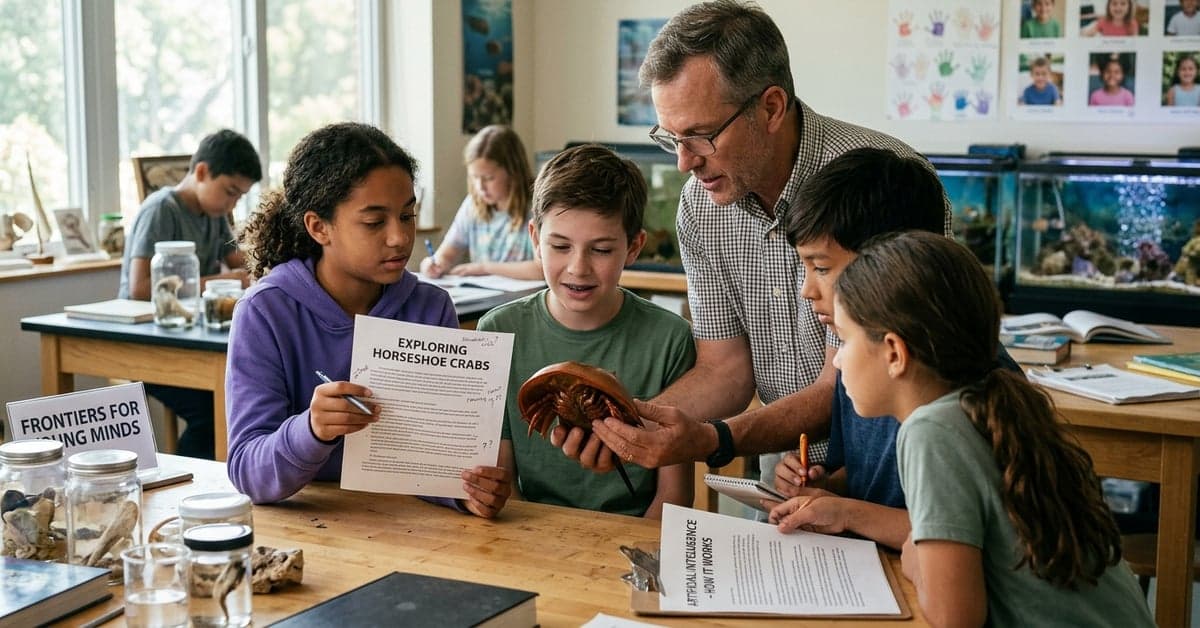
On September 8, 2026, a kid-reviewed explainer on horseshoe crabs by zoologist Winsor H. Watson III appeared at Frontiers for Young Minds, with four named reviewers aged 11–14 weighing in on clarity and accuracy. Four days earlier, on September 4, 2026, an article on how we “cook up” artificial intelligence listed teen reviewers right alongside the authors. The model is the point: scientists write, kids and teens review.
How Frontiers for Young Minds puts kids on the editorial board
According to Frontiers for Young Minds, it is an open-access scientific journal written by researchers and reviewed by a board of young people. The bylines and review credits are public. In the horseshoe crab piece dated September 8, 2026, the young reviewers are named Vibhav (12), Eric (11), Anagha (11), and Sai (14). The AI explainer posted on September 4, 2026, credits reviewers Vivian (15), Shania (14), and Chris (15), alongside authors Mher Safaryan, Eugenia Iofinova, and Dan Alistarh. Seeing reviewers’ first names and ages next to authors’ names makes the process visible, which is rare in science publishing.
For scientists, this is a stress test for communication: could a motivated middle schooler understand your work? For students, it’s an invitation to ask the questions adults skip. The peer review concept itself—ordinarily explained only to graduate students—gets translated into practice for kids. For context on the traditional process, see this neutral overview of what peer review is and why it’s used.
Prizewinners and ‘what’s next’ tech, explained for children
The journal has leaned into curation around major science touchstones. One collection presents “10 field-changing pieces of research that won the world’s largest neuroscience award” and invites readers to explore The Brain Prize through stories pitched at kids. Another gathers articles tied to the World Economic Forum’s Top 10 Emerging Technologies, turning a policy-and-industry list into classroom-ready reading.
This is more than packaging. It signals which topics matter now—frontier neuroscience and near-term tech shifts—while keeping a youth reviewer in the loop. A child can click from a global list of “what’s next” technologies to a piece they helped refine through suggested edits and questions. That feedback loop is the differentiator for Frontiers for Young Minds: prestige topics meet an audience that gets a say in how those topics are explained.
French expansion brings reviews to francophone classrooms
The journal is extending its reach in another way: language. The site highlights a growing set of French-language articles and points to a new official partner, JEFS, making content accessible to francophone young reviewers and readers. For teachers from Montreal to Marseille, it lowers the barrier to assigning primary-source style reading that is still age-appropriate. It also widens the pool of youth reviewers who can comment in their first language.
That matters for scale. If a model depends on thoughtful kid feedback, language coverage is infrastructure. More languages mean more classrooms, more review notes, and better odds that an author will hear the exact question a 13-year-old might ask before the science hits the public.
Why the kid-reviewed model changes the assignment
Most “science for kids” writing is one-way. Here, the review stage is the learning moment. When a teen points out where an analogy breaks, the author must fix the sentence, not the reader. That flips a common classroom problem—students left behind by jargon—into a production constraint on the writer.
In practical terms, teachers can use these articles as living examples of peer review. Start with the credits on a piece like the September 8, 2026 horseshoe crab article, ask students to propose two clarifying questions the listed reviewers might have raised, then compare those to how the article explains blue blood, many eyes, or ancient ancestry. With the September 4, 2026 AI explainer, have students map each step in the “recipe” analogy to an AI training step and identify where the analogy could mislead. The assignment is short, but the habits—question, test, refine—mirror what the young reviewers already did.
For labs and outreach teams, contributing to Frontiers for Young Minds doubles as message testing. If your group studies synapses tied to a Brain Prize theme or works on an item from the WEF emerging tech list, a kid-reviewed piece will reveal which metaphors land and which fail. The edits improve the article, and the exercise improves future talks, press releases, and grant summaries.
What to watch next for Frontiers for Young Minds
Expect more curated collections around marquee topics and more languages beyond French if uptake is strong. The consistent cadence of articles with visible youth reviewers—backed by open access and topic depth—suggests this model is settling in rather than spinning up.
The bet is simple: give kids a real editorial role and scientists will write better explanations. The recent horseshoe crab and AI pieces make that bet easy to see on the page. If that continues, Frontiers for Young Minds could become a default stop for teachers planning a unit, and a routine checkpoint for researchers testing how their work reads outside the lab. For more on this, see bloomberg.com and nytimes.com.
Related reading: AI in Education • Data Privacy • AI in Society