
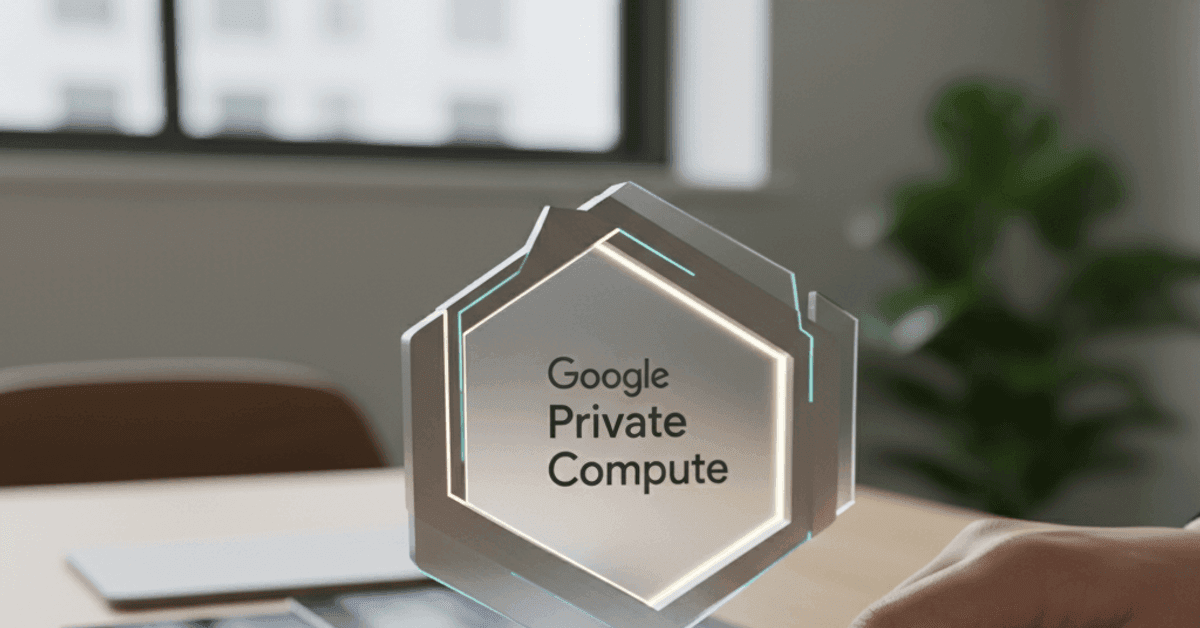
Google says its new Private AI Compute is as secure as processing on your phone, intensifying the debate over where AI should run. Google Private AI Compute promises on-device-level privacy while enabling larger Gemini models in the cloud, according to technical details and early reporting.
Google Private AI Compute explained
The system routes data from a device to a protected enclave in Google’s AI servers over an encrypted link. Those servers run on custom TPUs that integrate secure elements and an AMD-backed Trusted Execution Environment. In theory, the TEE isolates memory from the host so even Google cannot access user data in plaintext.
Google positions this as a path to better AI with fewer privacy trade-offs. Because cloud TPUs offer far more compute than phones, users could access larger models with stronger reasoning and richer context. An Ars Technica report notes that independent analysis by NCC Group assessed the system against stringent privacy guidelines. Google also frames the platform as one seamless stack, reducing handoffs that can introduce risk.
The pitch mirrors a broader industry trend toward confidential computing. Hardware-isolated environments aim to limit who can see code and data, even during processing. AMD’s public documentation on confidential computing outlines how memory encryption and attestation help protect workloads. The approach does not remove every risk, yet it raises the bar for attackers and insiders.
How it compares with Apple Private Cloud Compute
Apple popularized a similar concept with its Private Cloud Compute for generative AI features. Apple emphasizes strict data minimization, hardware attestation, and public verification reports. While implementation details differ, both companies seek to deliver cloud-scale AI with local-like protections. That convergence signals a new baseline for consumer AI privacy.
Transparency will matter as much as architecture. Apple centralizes security materials on its security site, including design overviews and audits. Google will face pressure to publish comparable evidence, such as reproducible builds, detailed attestation flows, and incident reporting. As users compare ecosystems, verifiable controls could influence platform trust, not just features.
Edge versus cloud: the new privacy calculus
Phones with NPUs already run smaller models on-device. That path keeps data local, reduces network exposure, and can cut costs. Conversely, many tasks benefit from larger cloud models that demand massive compute. Private AI Compute attempts to close the privacy gap while preserving those capabilities.
Societal implications hinge on real-world behavior. If the enclave truly prevents operator access to user content, cloud AI could expand into sensitive domains. Healthcare triage, legal drafting, and education assistants might become more acceptable under confidential computing. Moreover, enterprise compliance teams could approve broader deployments when they can verify isolation and logging guarantees.
Performance and sustainability also factor into the balance. Cloud inference can reduce device energy use and enable longer sessions. Yet data transport and data center power draw still carry environmental costs. Therefore, workload placement should consider latency, carbon intensity, and retention policies. Clear defaults and user controls can steer the right tasks to the right place.
Security assurances under the microscope
NCC Group’s involvement adds credibility, but scope matters. Independent audits should test not only cryptographic isolation but also side-channel resistance, supply-chain integrity, and rollback protections. Adversaries exploit the weakest link, so secure elements must integrate with robust software lifecycle controls.
Attestation is pivotal. Devices must verify that the enclave runs approved code on genuine hardware before sending data. The chain of trust should be transparent and routinely exercised. Additionally, red-team exercises and bug bounty programs can surface flaws before they reach attackers. Public technical papers on the Google AI Blog would help researchers review assumptions and limits.
Policy expectations are rising in parallel. Regulators increasingly scrutinize how AI platforms collect, process, and store personal data. Stronger privacy by design could reduce compliance burdens, provided vendors avoid dark patterns and respect consent. Clear deletion timelines and tightly scoped telemetry are essential, even inside secure enclaves.
What Google Private AI Compute could change for users
For everyday users, the pitch is simple: get smarter AI without surrendering control. Larger models may summarize long documents, reason across multimodal inputs, or personalize suggestions more effectively. Meanwhile, isolation aims to keep that sensitive context shielded from operators and third parties. If the system defaults to minimal data retention, the experience could feel safer by default.
Developers may gain new APIs that abstract away the complexity of confidential computing. That could accelerate app features that were previously off-limits due to privacy constraints. However, developers will still need clear guidance about prohibited data flows, attestation handling, and incident escalation. Good documentation and sample code reduce mistakes that lead to privacy incidents.
Enterprises will push for audit artifacts they can cite in risk registers. Reports from independent firms like NCC Group can feed vendor assessments and board-level oversight. Furthermore, procurement teams will want contractual assurances that align with confidentiality claims, including limits on data access and robust breach notification terms.
Limits, risks, and open questions
No enclave eliminates risk. Side channels, configuration drift, and human error can still expose data. Consequently, continuous monitoring and rapid patch pipelines remain mandatory. Attestation must be usable at scale; otherwise, apps will bypass checks or misconfigure them. Usability is a security feature here, not an afterthought.
Another open question involves transparency for end users. People deserve clear, plain-language indicators that show where AI runs, what is retained, and for how long. Labels should distinguish between on-device, private cloud, and standard cloud processing. Additionally, privacy dashboards can surface meaningful choices without coercion.
Competition will pressure vendors to publish more technical detail. Apple set a high communications bar for cloud privacy claims. If Google matches that depth and cadence, researchers can validate assurances and find issues early. Healthy scrutiny will strengthen these systems over time.
The broader societal trajectory
Confidential cloud AI could unlock services that were untenable under conventional architectures. Public institutions might leverage larger models while complying with data protection rules. Small developers could deliver premium experiences without building their own secure infrastructure. As a result, access to capable AI may broaden without amplifying surveillance concerns.
Still, safeguards must extend beyond the compute layer. Fairness, content provenance, and misuse prevention require policy and product controls. Technical privacy guarantees do not address every ethical dilemma. Therefore, vendors should pair confidential computing with model evaluations, rate limits, and robust abuse response.
If the promises hold, Private AI Compute becomes a template others will follow. That could push confidential computing from niche to norm. The outcome would shift the center of gravity from “trust the provider” to “verify the platform,” which is a healthier posture for society.
Conclusion: a cautious step forward
Google’s move signals a new phase for cloud AI, where privacy is engineered, tested, and audited as a first-class feature. The strategy narrows the gap between edge and cloud while preserving the benefits of scale. However, credibility depends on continuous transparency, rigorous third-party scrutiny, and practical user controls.
If Google sustains that discipline, the result could be stronger AI with fewer societal trade-offs. Until then, skepticism remains warranted, and verification remains essential.