
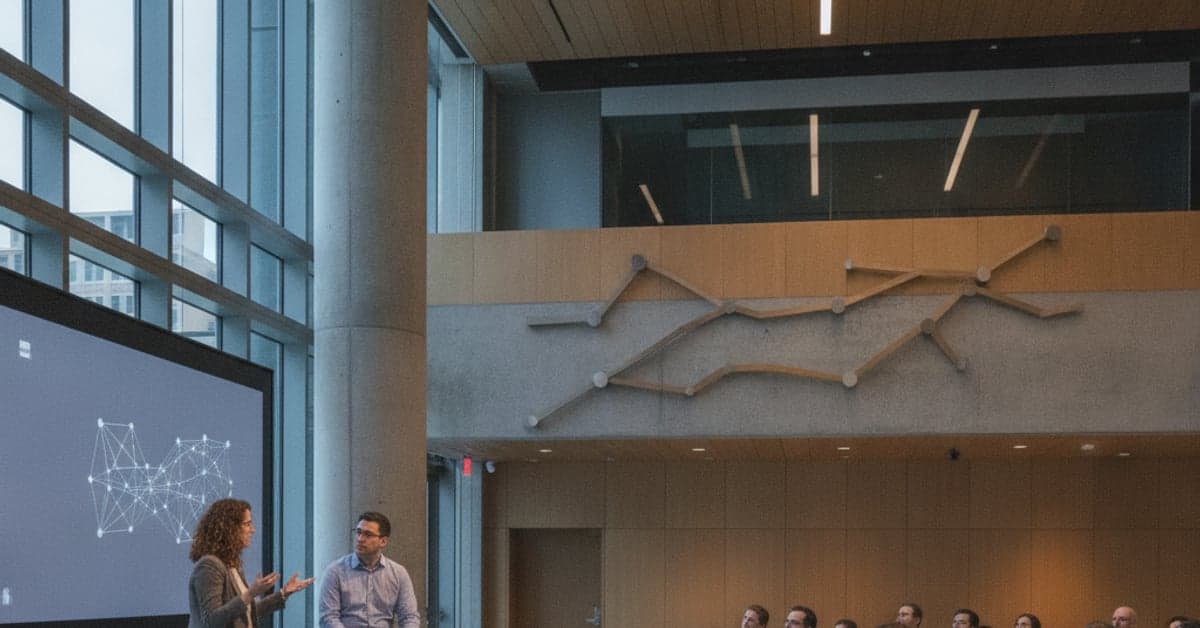
On August 19, 2026, Northwestern University’s Network for Collaborative Intelligence put open-source AI at center stage, hosting Meta’s Madeline Hinkamp and Technion’s Yossi Keshet for summer talks on applying community-built tools to real problems, according to the NNCI site. Two weeks earlier, the network highlighted a July 31, 2026 research update from Northwestern’s engineering school about an AI method from Professor Chris Wolverton that reveals material interfaces. Taken together, those choices sketch a clear early identity: applied, open, and aimed at hard science as much as language models.
What Northwestern’s Network for Collaborative Intelligence is building
The Network for Collaborative Intelligence bills itself as a cross-campus hub linking AI and data science talent with research needs and teaching goals. Its public pitch foregrounds responsible practice, interdisciplinary projects, and partnerships that reach beyond the university. That framing matters. It signals a program designed to move from method to impact, not just to publish models. The site says the network invites faculty, students, and industry to co-develop work that answers social and scientific needs, a position that aligns with how U.S. funders and companies now judge AI projects for merit and use.
Northwestern has the ingredients to make that happen: established engineering and computer science programs, clinical and social science strengths, and a track record in materials and chemistry. A campus network that stitches those pieces together can shorten the path from experiment to deployment. It can also reduce the friction that often stalls cross-department collaborations.
How the Network for Collaborative Intelligence leans into open-source work
Programming choices are a tell. The August 19 speaker series focused on open-source AI in real-world scenarios, per NNCI’s summary. That emphasis dovetails with a broader shift in the field: many labs and companies now ship or adopt open models and tooling to speed translation and build trust. Meta, for instance, has promoted open model families like Llama for research and commercial use, and groups such as the Open Source Initiative push for clearer definitions and responsible practice. By featuring both an industry voice and an academic researcher in one session, NNCI points to a pragmatic stance: use what’s available, share what works, and keep the pipeline visible.
That approach has practical upsides on campus. Open tools lower entry barriers for labs that lack large compute budgets, expand reproducibility, and speed student training. They also make it easier for industry collaborators to evaluate methods without complex licensing. For a university network trying to build durable partnerships, those are not minor advantages.
Why materials-focused AI could define NNCI’s early wins
On July 31, 2026, NNCI’s feed amplified a McCormick School of Engineering post describing Professor Chris Wolverton’s team and an AI-powered computational technique to identify interfaces inside materials. The blurb mentions a blend of machine learning, advanced structure searches, and quantum-mechanical calculations. That’s classic materials informatics: stitching physics-based constraints with data-driven inference to find candidates faster and with fewer lab cycles. The focus is significant for two reasons.
First, it aligns with national priorities. The CHIPS and Science Act encourages research that strengthens semiconductor and advanced materials supply chains. Agencies backing AI—including the National Science Foundation’s AI Institutes—have underscored interdisciplinary work that ties algorithms to scientific discovery and manufacturing. A campus network that elevates materials AI is positioning faculty to compete for those dollars.
Second, it plays to Northwestern’s strengths. Materials and chemistry research is a long-standing asset at the university, with engineering and physical sciences groups accustomed to working across theory, computation, and experiment. NNCI can help those teams adopt new AI methods without discarding domain knowledge. Done well, that blend yields fewer dead ends and clearer pathways to prototypes that industry can test.
For stakeholders outside the lab, the potential impact is concrete. Better modeling of interfaces could improve reliability in batteries, speed screening of compounds for chip manufacturing, or cut waste in coatings and catalysts. Those are problems with measurable outcomes—yield, cycle life, defect rates—that industry partners track closely.
Partnerships, funding, and the risks of staying narrow
There’s a strategic tradeoff in NNCI’s early footprint. An applied, materials-forward agenda can generate near-term wins, attract industry pilots, and anchor proposals around national initiatives. It also risks leaving less oxygen for areas like AI safety, ethics, and governance unless those threads are woven into projects by design. The NNCI site emphasizes responsible practice; to make that real, the network will need social scientists and humanists at the table as tools move from code to classrooms and clinics.
Industry collaboration is the other lever. Companies want channels into campus talent and methods without slow contracting cycles. A network format helps because it creates one front door for partners and one backplane for faculty. The Network for Collaborative Intelligence can use speaker series, shared tooling, and seed grants to align incentives. When the same open-source stack shows up in seminars, research repos, and classrooms, onboarding gets faster and joint projects scale with less friction.
None of this removes the need for governance. Open-source components do not guarantee safety or quality. They do, however, make review and replication easier. That transparency, paired with domain constraints in fields like materials, can help catch failure modes before they surface downstream.
What to watch next from the Network for Collaborative Intelligence
Look for three telltales of momentum. First, the mix of events. If NNCI continues to feature both open-source practitioners and domain scientists, expect broader adoption across labs and faster student upskilling. Second, grant outcomes tied to the materials thread and other applied areas; wins here would validate the network’s early choices. Third, the depth of university–industry collaborations; multi-quarter pilots and shared datasets beat one-off talks.
For Northwestern, the bet seems clear. Use an open, interdisciplinary playbook to pull AI into places where it can change measurements, yields, and designs—not just conversations. If that holds, the Network for Collaborative Intelligence could become a template for campus AI alliances that start with impact and work backward to method.
According to the NNCI homepage, the invitation is open to faculty, students, and industry. The signal behind the invitation is even clearer: bring a problem worth solving, and bring it soon.
Related reading: AI in Education • Data Privacy • AI in Society