
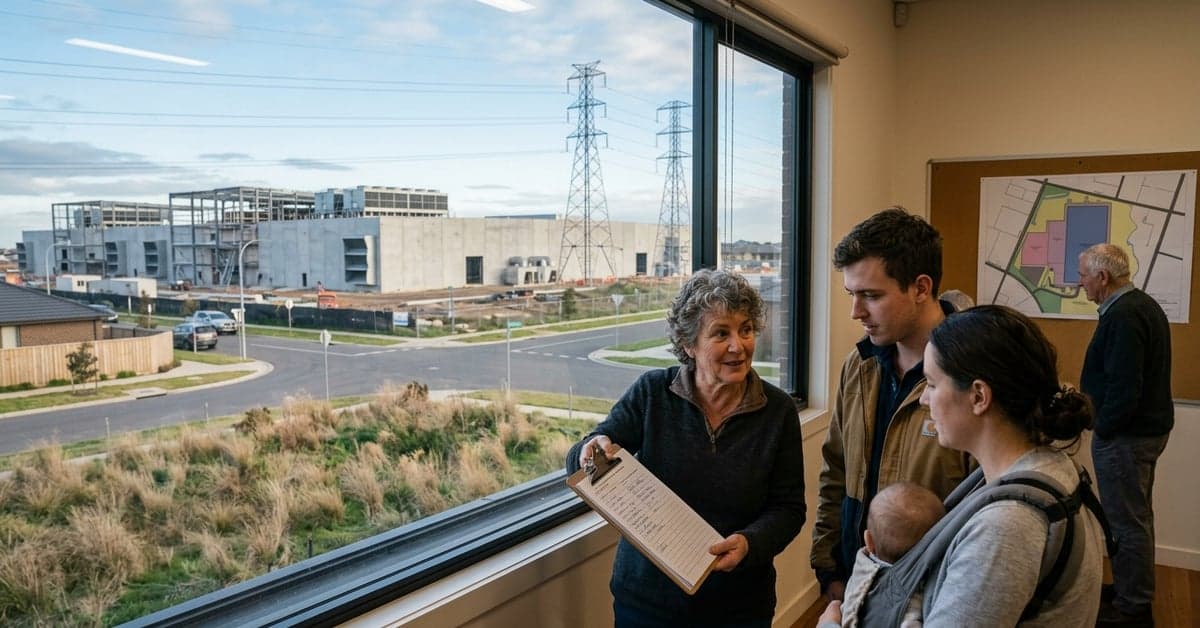
On July 25, 2026, The Guardian reported a proposed mega datacentre on Melbourne’s outskirts, described as six times bigger than a large shopping centre, and now the subject of a 3,600-strong petition calling for a careful assessment (The Guardian). The plan has turned into a national test case for how fast Australia should build AI infrastructure, and on what terms.
What the Melbourne mega datacentre proposal involves
The Guardian’s report detailed a single campus pitched as an AI hub that would anchor new compute capacity in Victoria. While the proponent’s full specifications are not public on the topic page, the framing alone signals a hyperscale footprint: a multi-building site, heavy grid interconnection, and industrial-scale cooling. The petitioners want time for an independent review of energy, water, and traffic impacts before any approvals progress, reflecting mounting community unease about rapid datacentre expansion across Australia (The Guardian).
The Melbourne mega datacentre also arrives as capital markets start to question the breakneck pace of AI infrastructure spending. On July 23, 2026, the BBC reported that heavy AI outlays helped rattle investors, with big tech shares sliding on concerns about spend versus payoff (BBC Technology). That macro mood matters locally: financing costs, grid connection timelines, and political scrutiny tend to tighten at the same time.
Why a hyperscale AI hub worries locals
Residents near planned datacentres often raise two core risks: electricity demand and water use. Both scale with size. The International Energy Agency has warned that global data centre electricity consumption could double by 2026 as AI workloads surge, a trajectory driven by clusters of facilities rather than a single site (IEA). A campus built for AI training and inference would sit at the high end of that load curve.
Water is the other flashpoint. Many operators deploy evaporative cooling or hybrid systems that reduce power draw but use significant water, especially on hot days. Alternatives exist, including air-cooled and liquid-loop designs, but each comes with trade-offs in efficiency, cost, and local climate impacts. Petitioners for the Melbourne mega datacentre are asking planners to weigh those choices openly and to set enforceable limits if the project proceeds.
Traffic, noise, and construction disruption round out local concerns. Hyperscale sites can require years of staged works, frequent heavy-vehicle movements, and 24/7 operations once live. Neighbours want clarity on buffers, night-time lighting, and emergency power testing schedules. None of that is unsolvable, but the details decide whether a facility coexists with nearby suburbs or dominates them.
The grid and water question in Victoria
Victoria’s power system is already in transition, with coal exit dates approaching and new renewables and transmission builds planned. The Australian Energy Market Operator’s 2024 Integrated System Plan maps a tight decade for new load and firming as industry electrifies and data demand grows (AEMO 2024 ISP). A large AI-focused facility would need a credible path to capacity without shifting costs onto households.
That is the crux of the petition’s “careful assessment” demand. Community groups want proof that the Melbourne mega datacentre can add contracted renewable supply, storage, and demand-response capabilities to reduce peak strain. They also want transparent accounting of embodied emissions during construction and a plan for end-of-life upgrades to avoid stranded assets if server power densities change.
Water planning will be equally important. Melbourne’s variable summers and population growth complicate any new industrial draw. Operators increasingly tout on-site recycling, heat reuse, and non-potable sources, but projects succeed on execution, not brochures. The IEA’s guidance on efficiency standards and metering supports tougher, audit-grade monitoring so communities can track real-world performance (IEA).
What happens next for the project
In Victoria, projects with potential significant environmental effects can be referred to the state for a formal Environment Effects Statement. The process, when required, examines alternatives, cumulative impacts, and mitigation options before a minister decides (Victoria EES overview). Petitioners want that level of scrutiny here. Backers are likely to argue that the facility will bring construction work, long-term technical roles, and anchor investment in the area.
Expect tougher conditions if it proceeds. That could include caps on potable water use, minimum renewable energy procurement, grid-flex commitments, biodiversity offsets, and real-time disclosure of electricity and water intensity. Several global operators already publish power usage effectiveness and water usage effectiveness. Communities now want those metrics verified and enforced for an Australian AI campus of this scale.
The wider policy picture is moving too. Australia’s grid planners are racing to connect renewables and storage; councils are updating industrial zoning; and corporate buyers are signing longer-dated power deals tied to new generation. Each of those trends will shape costs and timelines for any Melbourne mega datacentre.
Why this decision will echo beyond Melbourne
This case will set expectations for every proposed AI hub in Australia. If planners insist on measurable grid and water safeguards, future bids will arrive with those features baked in. If they do not, opposition to large-scale compute will harden, and timelines will stretch as communities fight for the same protections one project at a time.
That is why The Guardian’s reporting matters beyond one suburb. The petition is not just a local pushback; it is a referendum on how the country wants to build AI infrastructure. Markets are flashing caution on the cost side, as the BBC’s coverage of July 23, 2026 showed. Communities are asking for proof that benefits outweigh the bills. The decision on the Melbourne mega datacentre will show whether Australia can square those demands. For more on this, see reuters.com and bloomberg.com and nytimes.com.
Related reading: AI in Education • Data Privacy • AI in Society