
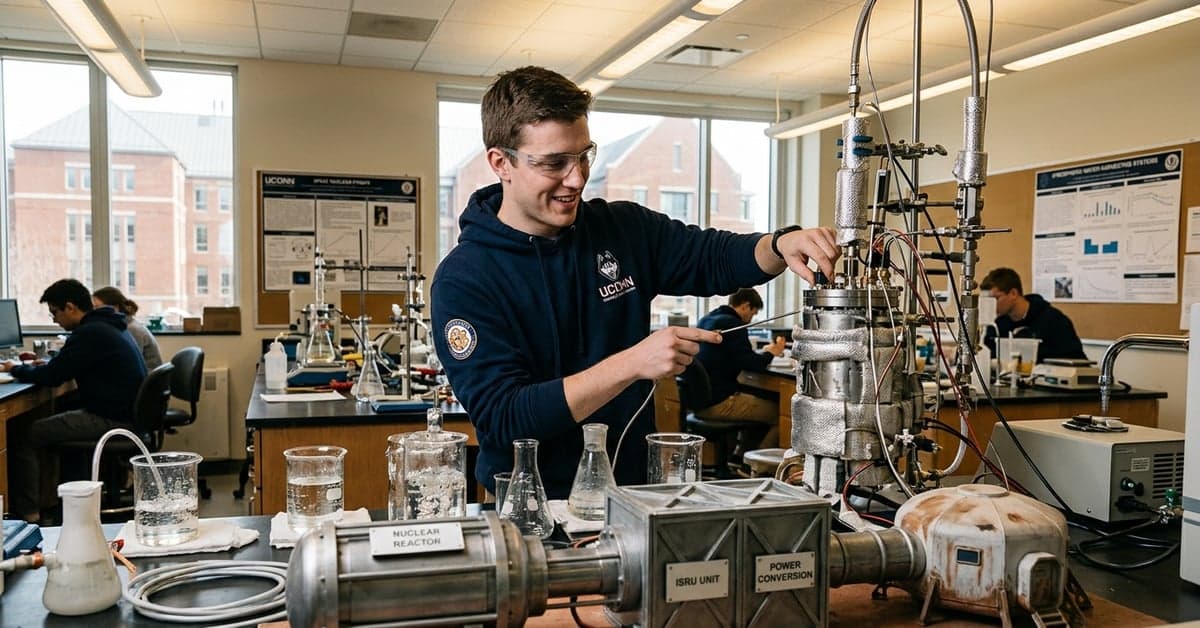
On August 19, 2026, Mirage News reported that UConn chemical engineering student Evan Piotrowski won a NASA CT Space Grant Scholarship, citing his research and ambition to fuse nuclear power with process systems engineering for off-world missions. That scholarship does more than reward a standout student. It signals how NASA’s state Space Grant network is seeding a workforce for space fission and resource-by-design energy systems that can feed back into the grid at home.
Why the NASA CT Space Grant points to space power work
The Space Grant program funds students and universities in all 50 states to build a pipeline for space-aligned research and skills. NASA’s own description of the consortium frames it as a bridge between campus labs and national exploration goals, from propulsion to habitats (NASA). In that context, the NASA CT Space Grant going to a nuclear-minded engineer reads like a bet on fission for space and for Earth.
NASA and the U.S. Department of Energy are advancing a Fission Surface Power program to put a small reactor on the Moon as part of Artemis-era infrastructure. The agencies have already funded early designs to deliver reliable 40-kilowatt-class power in the 2030s (NASA/DOE). In parallel, NASA and DARPA plan to flight-test a nuclear thermal rocket engine under the DRACO effort to shrink travel times in deep space (NASA; DARPA).
Piotrowski’s stated goal — to sit at the intersection of nuclear energy and process systems engineering — maps cleanly to those plans. According to Mirage News, he aims to develop advanced reactor technologies that could one day power missions beyond Earth, and he’s already building that toolkit through research and cross-disciplinary study in materials science and mathematics. The NASA CT Space Grant is the connective tissue between that campus work and the mission profiles NASA is now sketching in hardware.
From water harvesting to geothermal: campus work with off‑world echoes
Mirage News reports that Piotrowski’s projects in assistant professor Burcu Beykal’s lab include atmospheric water harvesting and geothermal power systems. Those are terrestrial problems with a space twist. Water-from-air research can inform in-situ resource use for lunar or Martian habitats where humidity swings and dust complicate capture and storage. Geothermal modeling overlaps with subsurface heat transfer and closed-loop thermal management — skills that translate to compact reactor design and habitat environmental control.
NASA has long emphasized in-situ resource utilization as a way to reduce launch mass and increase resilience for crews (NASA). Process systems engineering brings optimization, controls, and safety analysis to that challenge. It’s the discipline that balances heat exchangers, sorbents, pumps, and storage under tight mass and power budgets. That is exactly where a generation of engineers trained through programs like the NASA CT Space Grant can move the needle.
Piotrowski says the work he’s doing now “has strong applications in the advancement of space technology,” adding, “My goal is to become an engineer who advances both the nuclear power and space technology frontiers,” per Mirage News. The quote is telling: it frames energy not as a siloed specialty but as mission infrastructure.
Why a NASA scholarship matters in Connecticut’s energy backyard
Piotrowski’s first spark came inside Millstone Nuclear Power Station, the plant that keeps much of coastal Connecticut’s lights on, according to Mirage News. That matters for workforce reasons. Connecticut hosts one of New England’s major clean energy anchors in Millstone, and it offers a live training ground for safety culture, operations, and regulatory realities (Dominion Energy).
Pair that with a university lab focused on process modeling and sustainable systems, and a pattern emerges. Scholarships like the NASA CT Space Grant turn local exposure into national mission readiness. A student who understands how a gigawatt-scale reactor stays online can more readily design a 40-kilowatt lunar unit with sparse maintenance. The technical scales differ; the systems thinking rhymes.
For UConn and the state, this is also a retention play. The same skills needed to model a lunar fission plant — thermal cycles, materials under radiation, fault-tolerant controls — are valued in utilities, microgrid developers, and advanced reactor startups. Training for space can boomerang back into the regional energy economy.
The near-term payoff for students and labs
Scholarships buy time to deepen the math and modeling that make energy systems safe. Process systems engineering relies on optimization, estimation, and controls that only come with practice and computation. Mirage News notes that Piotrowski is a UConn Honors Program member with minors in materials science and mathematics. That stack points to the blend of theory and lab work that space fission — and grid modernization — require.
The work in atmospheric water harvesting offers another near-term dividend. Air-to-water systems are gaining attention for drought resilience and off-grid needs. Techniques tested for low-humidity capture under energy constraints could serve emergency response teams and islanded communities first, even as they inform space habitat designs later.
Geothermal projects bring a similar two-track benefit. Models for subsurface heat transport, wellbore integrity, and power conversion sharpen skills that apply to both Earth’s crust and compact surface reactors. As NASA chases reliable lunar surface power, Earth-side geothermal developers aim for more predictable output and lower drilling risk. Students who can navigate both will be hired quickly.
What to watch next
The next milestone won’t be a trophy photo; it will be a project brief. Expect student teams to pitch capstones that mirror NASA’s fission surface power constraints: mass limits, thermal storage trade-offs, and autonomous controls. If the NASA CT Space Grant continues to back cross-disciplinary proposals, more energy-focused students will read themselves into the mission.
Universities should lean into industry ties. A semester embedded with plant operators, grid planners, or geothermal drillers can compress a year of theory into days of lived constraints. For NASA and DOE, the feedback loop is clear: bring student prototypes into field-like testbeds early, even if they start as digital twins. That cadence will pay off when hardware must work the first time on the Moon.
Mirage News framed the scholarship as recognition of academic excellence and undergraduate research on August 19, 2026. The deeper story is pipeline design. Space exploration now depends on reliable, compact, and serviceable power. So does a decarbonizing grid. Awards like the NASA CT Space Grant are aligning those needs — one lab, and one engineer, at a time. For more on this, see nytimes.com.
Related reading: AI in Education • Data Privacy • AI in Society