
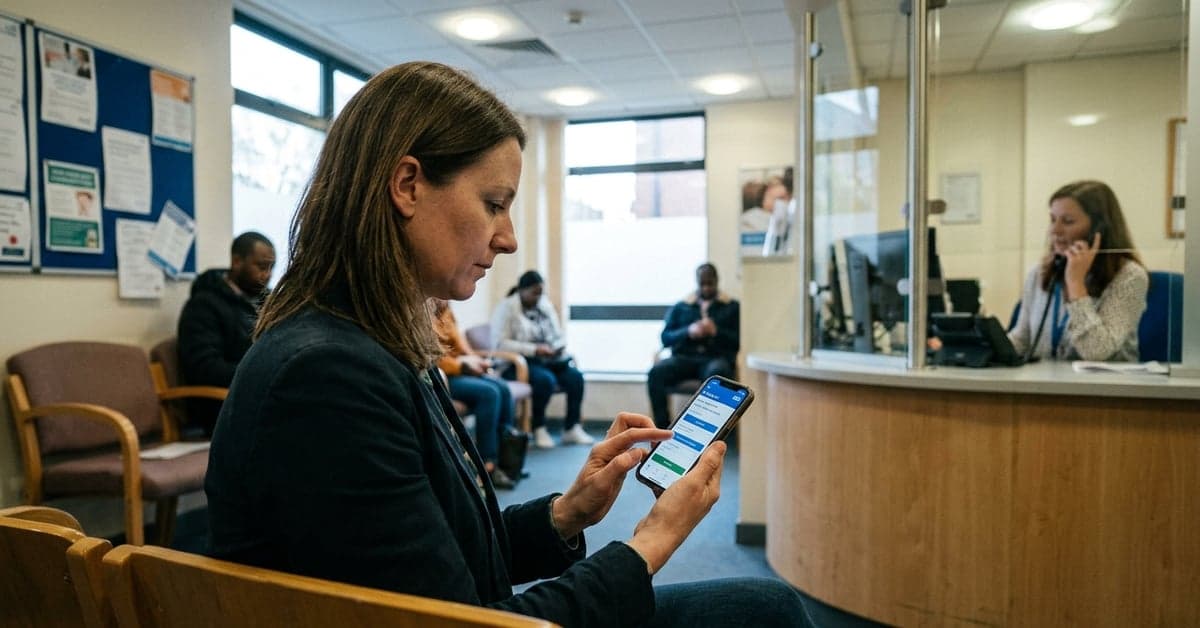
On July 4, 2026, The Guardian reported that the NHS will use AI in its app to direct patients to appropriate services. The move puts triage in people’s pockets and shifts a first decision point from phone lines to a screen. It could cut waiting, or it could misroute care. The difference will come down to transparency, clinical safety, and how quickly the system hands off to humans.
What The Guardian’s report signals about NHS app AI triage
According to The Guardian’s technology desk, the NHS plans to deploy AI within its existing app to guide patients to the right service. The app already covers basics like repeat prescriptions and appointment bookings, as described by the NHS’s own overview. Slotting AI into that front door changes its role from a record-and-booking tool into a decision aid. That’s a bigger responsibility than it sounds.
AI triage systems don’t just surface information. They make a call about urgency and route. If the model nudges more patients toward self-care, clinics may see relief. If it underestimates risk, people could arrive sicker, and trust will fray. The Guardian’s report doesn’t detail the supplier or launch metrics, but it points to a live policy choice: whether to place an algorithm right where demand meets capacity.
Where AI triage helps — and where it can misroute patients
AI triage can shine on clear cases. A sore throat without red flags, a renewal question, travel vaccines. Pattern-matching on structured symptom checklists may match or beat rule-based tools. It can also help after hours, when phone lines are clogged and options are limited. Done well, the NHS app becomes a guide that lowers friction.
The risks cluster around edge cases and ambiguous presentations. Atypical heart attacks. Sepsis in older adults. Children who “just seem off.” Here, model confidence can mask uncertainty. Risk scoring might push too many to self-care, or swing the other way and flood urgent care with false alarms. NHS leaders will need to publish how the system escalates uncertain outcomes to clinicians, and how often it does so.
The Stanford Institute for Human-Centered Artificial Intelligence notes in its April 13, 2026 AI Index that AI’s capabilities are climbing while questions about transparency and who benefits grow sharper (Stanford HAI). That framing fits here. The value of a triage tool should be measured on patient outcomes and equity, not just speed or call volumes.
Standards the NHS app’s AI should meet before scale
The safest way to make NHS app AI triage work is to treat it like any clinical device: test, monitor, report, and iterate. That starts with a public model card that explains training data scope, known limitations, and how the tool performs across age, gender, ethnicity, and deprivation. It continues with real-time guardrails, like an automatic handoff to a clinician when confidence drops or when red-flag symptoms appear in any form.
Privacy is not optional. Health data falls under UK GDPR as special category data, with strict rules for fairness, purpose limitation, and explainability for automated decisions. The UK Information Commissioner’s Office lays out specific expectations for AI systems handling such data, including meaningful human review for high-impact outcomes (ICO guidance on AI and data protection). The NHS will need a clear statement on where patient inputs go, who can see them, how long they’re kept, and how models are updated.
Clinical evidence matters as much as code. The National Institute for Health and Care Excellence has long pushed for clear evidence standards for digital health tools, from clinical effectiveness to usability and economic impact (NICE’s evidence standards framework). An AI-driven triage feature belongs in that lane. Patients should know the tool’s intended use, and clinicians should know its limits.
How to judge if the rollout is working
Announcements land fast. Evidence takes time. A credible plan for NHS app AI triage would ship with a scoreboard and a timeline. The metrics should describe safety first, efficiency second, and equity throughout. Here are four numbers the NHS could publish monthly during the first year:
- Percentage of triage sessions that escalate to a human within the app, broken down by symptom cluster.
- False-negative rate on conditions with time-critical pathways, confirmed against follow-up diagnoses.
- Average time to appropriate care compared with phone triage, with weekend and evening splits.
- Outcome and satisfaction gaps across age, ethnicity, and deprivation quintiles, tied to model updates.
These aren’t vanity measures. They show whether the tool is safe, where it stumbles, and how it treats different groups. They also create the feedback loop needed to improve the model without brushing aside bad news.
Why this move lands now — and what it means for patients
AI capacity has improved, and the NHS is under pressure to manage demand. The Stanford HAI AI Index, published April 13, 2026, captured that tension: rapid capability gains alongside open questions about energy use, transparency, and distribution of benefits. In a public service context, those questions get sharper, because the costs and the gains land on the same population.
For patients, the promise is simple. Faster answers and fewer calls bounced between services. The risk is also simple. Delayed care when an edge case looks routine. The fix is governance you can see, not just assurances you can’t test. That means clear documentation, opt-outs for automated triage, strong privacy guarantees, and a real-time path to a human.
The Guardian’s report signals a turning point for the app: from a portal to a guide. If the NHS treats the feature as clinical infrastructure, the guide could be a help. If it treats it as a convenience widget, trust will erode the first time it misses a serious case. The difference is whether the NHS builds the audit trail now, and shows its work from day one.
Viewed that way, the success of NHS app AI triage won’t be decided by a launch date. It will be decided by whether the NHS proves, with public data and live safeguards, that the tool gets more people to the right care, faster, without leaving the hardest cases behind. For more on this, see bloomberg.com and nytimes.com.