
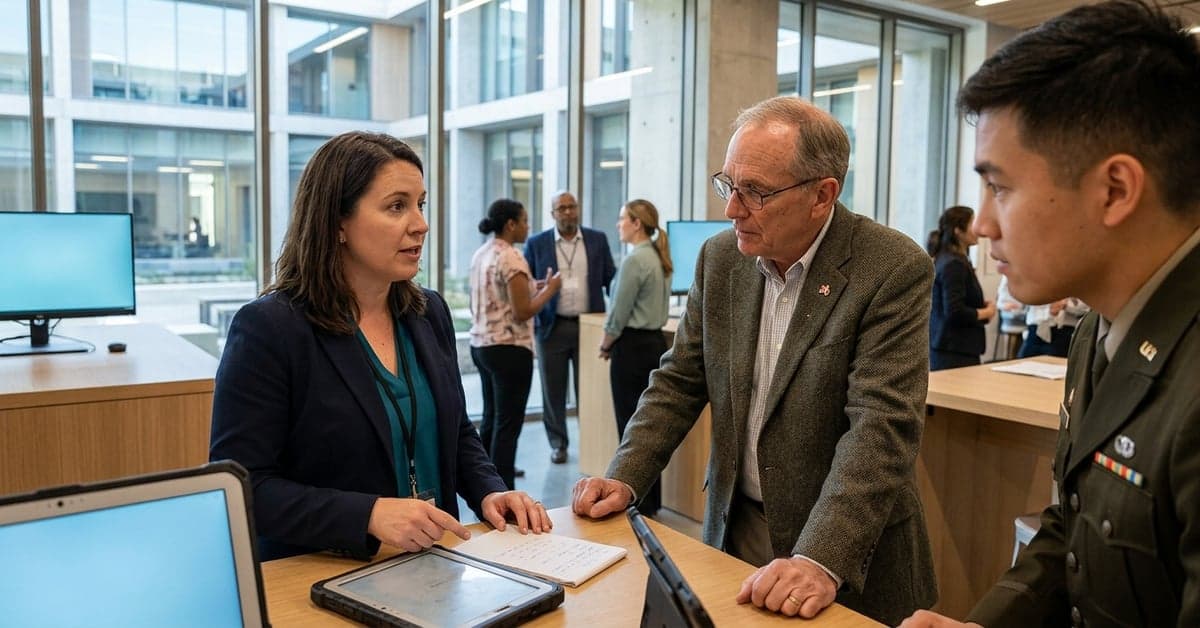
On September 9-10, 2026, leaders from federal agencies, the military, and A/E/C firms will convene at Stanford University’s Center for Integrated Facility Engineering for the SAME Federal AI Summit: AI for A/E/C. According to the Society of American Military Engineers, the gathering aims to widen the conversation on responsible AI in federal infrastructure and catalyze future implementation through cross-sector ties (SAME.org).
Calling it a “summit” undersells the moment. Done right, this meeting can set the near-term playbook for how AI touches military and civilian facilities—from predictive maintenance to safer worksites—and how those tools meet federal risk and procurement rules. The question is less what to discuss and more what to produce by the time everyone flies home: shared data access agreements, pilot criteria, and draft language agencies can drop into contracts.
What the SAME Federal AI Summit aims to solve
Per SAME, the event is a first public showcase for its National AI Working Group and its National AI IGE Project Team, developed with Stanford’s CIFE and the San Francisco Post (SAME.org). That mix matters. A/E/C projects span owners, primes, subs, and technology vendors; even a simple facility upgrade can involve half a dozen data sources and contracting paths. Without a shared baseline for how AI is evaluated, procured, and measured, pilots stall or never scale.
Hosting the dialogue at Stanford’s CIFE also signals a push to connect AI with decades of work on BIM, digital twins, and construction productivity. If the industry’s digital models and sensor data remain siloed, AI will only deliver point wins. The goal in Palo Alto should be agreement on how data from design, build, and operations flows into AI systems, and how those systems flow their outputs back into daily work.
Why AI collaboration in A/E/C is overdue
Construction generates rich data—models, schedules, RFIs, change orders, inspections, and IoT signals—but it’s rarely standardized across portfolios. That makes it tough to benchmark performance and harder to deploy any model at scale. Federal buyers feel this acutely: every base, hospital, and courthouse can look like a “one-off” when the data isn’t normalized.
The summit’s cross-sector format can fix two common blockers. First, procurement friction. Vendors often cannot meet security and record-keeping needs because requirements arrive late in the buying cycle. Second, evaluation drift. Agencies trial a tool on a single project without consistent metrics for schedule risk, cost variance, safety incidents, energy load, or maintenance backlog. A shared scorecard, agreed by owners and suppliers, would travel from pilot to program.
What federal buyers need from AI vendors
Agencies now need AI that aligns with risk guidance as much as it delivers features. The NIST AI Risk Management Framework stresses documentation, data quality, and measurable outcomes, while the White House’s OMB guidance on AI sets governance expectations for federal use. At the SAME Federal AI Summit, buyers and builders can turn those principles into checklists for actual awards. Look for agreements on:
- Model cards and system cards that document training data sources, known limits, and evaluation results relevant to A/E/C tasks.
- Data access terms that cover BIM, schedules, work orders, and sensor feeds, with retention, provenance, and redaction spelled out.
- Security and privacy controls mapped to agency baselines, including role-based access and audit logging for AI-assisted actions.
- Human-in-the-loop steps for safety-critical uses, like change detection on structural drawings or crane risk advisories.
- Outcome metrics tied to project delivery: days saved on submittals, energy reductions, fewer rework orders, or faster backlog burn-down.
These are not paperwork for its own sake. They help agencies compare vendors on apples-to-apples terms, and they help vendors avoid late-stage surprises that kill deals. If a team walks out of Stanford with a one-page “AI annex” template for facility and construction contracts, adoption will accelerate overnight.
What to watch in Palo Alto at the SAME Federal AI Summit
Three threads could turn this gathering from a good meeting into a hinge point for federal infrastructure AI:
First, shared pilots. Cross-agency projects are rare, yet many facilities share similar workloads. A joint pilot on predictive maintenance across two services or bureaus would test portability and speed up approvals. SAME’s network is built for this kind of matchmaking, and the summit can formalize it with a short list of ready-to-run trials.
Second, data standards that fit the work as it is today. Digital twins help when models stay current. Many federal sites mix new and legacy assets. The winning play is pragmatic: decide the minimal fields needed for AI tasks, define how to extract them from existing systems, and publish adapters. That approach lets older buildings join AI pilots without costly retrofits.
Third, evaluation that travels. Agencies can co-author a simple rubric, aligned to NIST risk practices, that any project team can apply. Score how an AI tool affects safety observations processed per week, RFIs resolved per month, or schedule confidence on the critical path. Require vendors to ingest the same anonymized benchmark set and report the same measures. Consistency is the shortest route to trust.
Stanford’s CIFE has long studied how new methods change real projects. Expect sessions to connect research to jobsite and facility realities through examples and, ideally, live demonstrations that show how AI plugs into BIM and operations. If organizers publish recordings and working docs after the event, agencies that could not attend can still run with the outputs.
Why the outcomes matter beyond the event
SAME’s 106-year history includes ushering in CAD, digital engineering, and cybersecurity conversations across agencies and industry (SAME.org). AI is the next turn of that wheel. The summit can put federal buyers and A/E/C leaders on the same page about what is ready now, what needs a pilot, and what should wait.
For vendors, the payoff is clarity on risk, data, and proof. For agencies, it is a path to consistent, measurable gains on cost, schedule, safety, and sustainability. If those gains are captured in shared templates and pilots, the SAME Federal AI Summit will be remembered less as a conference and more as the first mile marker on a common road. For more on this, see nytimes.com.