
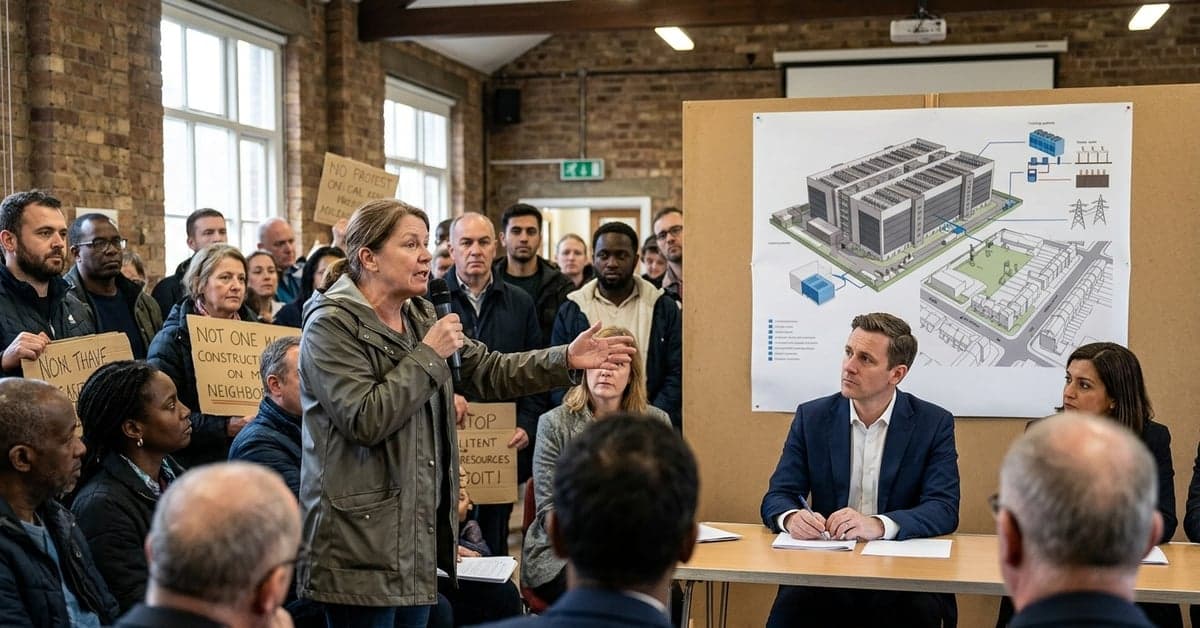
On July 7, 2026, The Guardian reported that Scotland could freeze datacentre projects, a move that would challenge the UK’s national AI strategy. A day earlier, the paper highlighted street-level resistance to a huge Brick Lane build in London. By July 8, 2026, it added a transatlantic twist: Wyoming tightened wastewater rules after a Meta datacenter contractor flushed contaminated water. The pattern is hard to miss.
Why a UK datacentre backlash is taking hold
The Guardian’s coverage points to a simple driver: the industry is colliding with local limits on land, power, water, and public patience. The Brick Lane fight, published on July 7, 2026, captures the tension in one neighborhood famous for food and markets, now confronted with a windowless, power-hungry facility. Scotland’s potential freeze, reported July 7, 2026, takes that sentiment into policy. It would signal that grid capacity, planning rules, and climate targets come before higher compute at any cost.
Concerns are stacking up. A Guardian TechScape newsletter on July 7, 2026 argued that big climate pledges and the electricity appetite of AI don’t line up. Nicki Hutley put it bluntly on July 8, 2026, calling datacentres a “ticking timebomb” unless the benefits exceed the costs. Those aren’t fringe takes. In January 2024, the International Energy Agency projected data centre electricity demand could double by 2026, driven by AI and crypto. That forecast, from the IEA’s Electricity 2024 report, underscored the speed of the shift and the pressure on grids across Europe and the United States. IEA analysis is now the backdrop for every local planning meeting.
This is why a UK datacentre backlash is spreading. Communities see headlines about surging power needs and remember past infrastructure promises that fell short. They hear about water use, backup diesel, and heat. They ask a fair question: what do we get in return, and where does all that burden land?
What a freeze on data center projects would change
Scotland pausing new builds would do more than stop a handful of planning files. It would force companies to adjust buildout timelines, site selection, and, likely, model training roadmaps. According to The Guardian’s July 7, 2026 reporting on stymied projects, delays are already reshaping the industry’s global map. A formal pause would give ministers and grid operators cover to slow the queue and re-prioritize connections toward projects with clearer public value, heat reuse plans, or firmed renewable supply.
Some reforms are already on the table. The UK’s Connections Action Plan aims to unclog grid hookups by removing “zombie” projects and re-sequencing capacity. That helps, but it doesn’t solve siting trade-offs in dense cities or regions with constrained transmission. National Grid ESO’s Future Energy Scenarios sets out pathways for electrification, but those pathways depend on timely upgrades and local consent. A freeze would buy time to align those moving parts, at the cost of short-term AI capacity.
Investors won’t wait forever. If UK approvals remain uncertain, workloads migrate to Ireland, the Nordics, or U.S. states with faster permits and cheap power. The Guardian’s reporting hints at that risk: once a cluster takes shape elsewhere, talent and suppliers follow. Catching up is hard and expensive.
Local fights that foreshadow a bigger realignment
Wyoming’s rule change, reported by The Guardian on July 8, 2026, shows how a single compliance failure can reset statewide policy. After a Meta contractor flushed contaminated water, regulators tightened wastewater rules. The message to operators is clear: community trust is fragile, and mistakes travel fast.
Brick Lane sends a different signal. In a compact, historic area, the jobs case for a massive compute box is a tough sell without clear local benefits. Londoners are asking for heat reuse, public realm improvements, and credible noise and traffic plans. In places like Amsterdam and Dublin, those debates led to stricter overlays and, in some periods, de facto pauses. UK councils are now reaching for similar tools.
Technical fixes exist but must be proven. Site selection in cooler climates and near abundant clean power lowers emissions and water stress. Heat recovery can warm homes or pools, but the engineering must match the local heat load and network. Operators talk about air cooling or recycled water, yet validation and transparency matter. The Uptime Institute’s guidance on water risk makes the case for real disclosure and contingency planning, not just promises. Its public resources outline how operators can cut exposure and report impacts with standard metrics such as WUE. Uptime Institute research is already shaping investor questions.
The Guardian’s July 7, 2026 analysis that “stymied datacentre projects threaten” a broader AI rollout captures the stakes. If permits lag and communities dig in, training and inference schedules slip, and the cost of compute stays high. That is the quiet fear on every product roadmap.
How to ease the pressure without stalling AI
The fastest way to lower the temperature is to treat communities as first-order partners, not last-mile obstacles. Put the power and water math on the table early. Publish independent impact reviews, commit to third-party monitoring, and set out clear penalties for breaches. Wyoming’s rule change is a reminder that regulators will step in if companies don’t manage the basics.
Then rework siting logic. Favor brownfield industrial plots with grid capacity or proximity to new transmission. Co-locate with renewables and storage where possible, and contract for clean power with real-time matching, not annual certificates. Plan for waste heat use upfront, in partnership with local authorities and heat network operators.
Governments can raise the floor without creating a patchwork. Scotland considering a pause creates space to set national baselines for disclosure, noise, backup fuel, and water. Ministers can tie faster approvals to tougher standards and community benefits that scale with load. National Grid ESO, Ofgem, and DESNZ already have the tools to accelerate priority connections; they can use them to favor projects that reduce system stress.
Finally, industry should align product ambition with infrastructure reality. If the UK datacentre backlash slows near-term capacity, stagger model releases, spread training across regions, and invest in efficiency. That means pruning parameters where gains flatten, using better compilers, and scheduling jobs to exploit off-peak clean generation. Efficiency is not a slogan. It buys time and headroom on tight grids.
What this means for the next buildout
The Guardian’s string of reports from July 7-8, 2026 sketches a clear arc: politics, planning, and plumbing are now central to AI. Ignore them and the UK could watch its next wave of compute head elsewhere. Engage early, meet higher standards, and the sector can grow without blowing past power and water limits.
If Scotland does pause projects, operators will adapt. Some will move. Others will redesign. Either way, the signal is sent. The UK datacentre backlash won’t fade on its own, and the firms that reckon with it first will shape where the jobs, spend, and heat go next. For more on this, see ai.meta.com and bloomberg.com.
Related reading: AI in Education • Data Privacy • AI in Society