
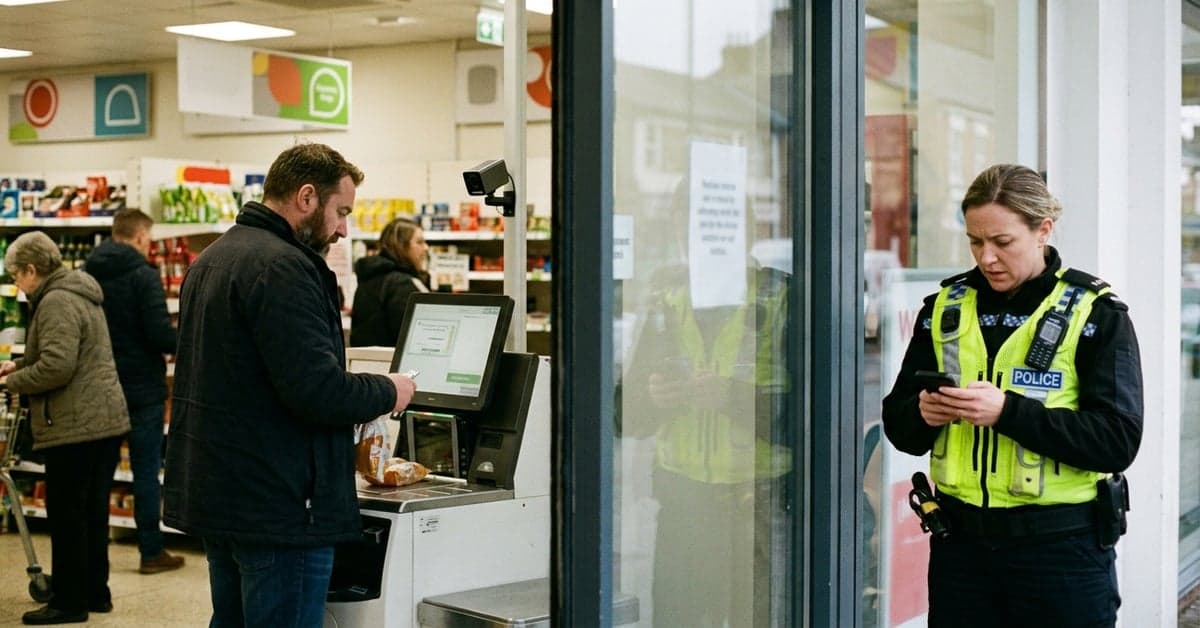
On July 10, 2026, The Guardian reported the launch of facial recognition in UK shops that can instantly alert police. The move pushes biometric surveillance from public streets into private checkout aisles. It also raises immediate questions about consent, accuracy, and who is accountable when the system flags the wrong person.
What The Guardian reports on the UK shop facial recognition rollout
According to The Guardian’s technology desk on July 10, 2026, the deployment has sparked alarm because alerts are sent to law enforcement as soon as a match is made. That design choice is the hinge of the controversy. It shortens the time between a store camera’s decision and a policing response, which can compound the impact of a false hit. The Guardian’s framing makes clear this is not just about loss prevention; it is about the creation of a rapid, private-to-public surveillance pipeline.
The novelty here is the scale and the speed. Retail has used cameras for decades. Machine vision is not new either. But UK shop facial recognition that pings police in real time collapses the traditional wall between store security and public law enforcement. That means familiar data protection duties meet the stricter expectations that come with quasi-policing powers, even inside a supermarket.
Who is responsible when the system misidentifies someone?
The hardest question is accountability. If a store’s model identifies a person on a watchlist and a police unit acts on that alert, who bears legal responsibility for the outcome? Data protection law focuses on roles. A retailer running biometric surveillance is almost certainly a data controller for that processing. When police receive and act on an alert, they bring separate powers and duties under law enforcement processing rules.
That could make the retailer and the force joint controllers for part of the chain, or separate controllers handing data off at a defined point. The split matters. It determines who must minimize bias, who must handle subject access requests, and who answers when the match was wrong. The UK Information Commissioner’s Office (ICO) has warned that biometric identification in public places demands a high bar for necessity and proportionality, including rigorous testing for accuracy and bias. Its 2021 opinion on live facial recognition set out these expectations in detail and remains a touchstone for any deployment that touches public spaces or public powers. Readers can review the ICO’s position in full in the regulator’s published opinion on live facial recognition in public places on the ICO website.
Even if alerts are routed through store staff before contacting police, the risk profile is different from traditional CCTV. Live systems do not just record incidents; they make a prediction about identity in the moment. If that prediction is wrong, people can be stopped, questioned, or embarrassed before any human has checked the match. That is why watchdogs such as the Ada Lovelace Institute have called for strict controls and, in many cases, a pause on live facial recognition in public spaces. Their reports outline the social risks and governance gaps that emerge when private systems shape public policing decisions.
Live facial recognition: the legal fault lines
UK case law already shows how demanding the legal standard can be when real-time face scanning is used in public spaces. In August 2020, the Court of Appeal found South Wales Police’s use of live facial recognition was unlawful on several grounds, including insufficient guidance on where it could be used and who could be on a watchlist. The judgment in Bridges v South Wales Police remains the clearest signal that operational convenience will not excuse weak safeguards.
While that case concerned a police-led system, the principles echo into retail. A shop is a private space, but it is open to the public. If UK shop facial recognition is configured to trigger police action, it looks closer to public-place surveillance in effect, even if the camera sits over a doorway. That increases the likelihood that regulators will expect a formal necessity assessment, evidence of fair processing notices that people actually see, and a serious plan to measure and reduce false matches.
The government’s Surveillance Camera Code of Practice also sets expectations for transparency, clear governance, and the least intrusive means of meeting an aim. Pair that with the ICO’s biometric guidance and you get a practical checklist: prove the need, design for accuracy, publish routes for redress, and keep tight control on watchlists. These are not paper steps. They determine whether a deployment survives regulatory scrutiny.
What store deployments mean for police, shoppers, and staff
The Guardian’s report points to a system that short-circuits the time between detection and action. That changes behavior on both sides of the lens. Staff may feel pressure to trust the alert, even if they doubt it. Shoppers may change routes or habits if they think any misstep could summon officers. Over time, that can have a chilling effect that goes beyond theft deterrence.
Retailers will argue they face rising losses and assaults on staff. Few dispute those pressures. The policy question is whether live, police-linked scanning is the least intrusive answer. Alternatives exist, from better store design to targeted banning orders, without sweeping every customer into an identification dragnet. The Ada Lovelace Institute’s work has cataloged such options and the conditions under which they outperform face scanning.
False matches are not just a technical footnote. They are the core operational risk in UK shop facial recognition. Even a low false positive rate can generate frequent errors at scale. Each one carries real costs: staff time, reputational harm, and exposure to claims. Those costs multiply when law enforcement gets involved because missteps can escalate quickly in a crowded store. Clear human-in-the-loop checks, logged thresholds for alerts, and frequent model audits are the minimum safeguards if retailers hope to justify the approach.
What to watch next as real-time alerts roll out
The Guardian’s reporting sets up a near-term test for UK regulators. Expect questions from the ICO on the legal basis for biometric processing, the contents and governance of any watchlists, and whether data sharing agreements with police meet the law enforcement framework. The ICO’s extensive guidance on biometrics and law enforcement processing is public; organisations should study it before going live. The regulator has signaled repeatedly that biometric deployments that affect the public must pass a strict necessity and proportionality test.
Police forces will also need to clarify their side of the pipeline. If they act on store-generated alerts, what safeguards apply before an officer is dispatched? Do forces require corroboration by a human review, or a higher confidence threshold? How are errors recorded and learned from? Answers to those questions will determine whether this is a narrow tool for serious offenses or a broad funnel that sweeps in everyday disputes.
Lawmakers could step in too. Parliament has already wrestled with live facial recognition in policing. A retail-to-police model may trigger calls for statutory limits, clearer audit powers, or a moratorium until national standards catch up. The broader debate is moving quickly in the UK and abroad, and high-profile retail deployments can set norms by example—good or bad.
For now, the message is simple. If retailers want the deterrence benefits of real-time alerts, they must accept the responsibilities that come with deputising machine judgment. The test is not whether the technology works in the lab. It is whether people can challenge a decision in the aisle, and whether the system can prove it was fair. That is where UK shop facial recognition will either gain public trust or face a hard regulatory stop.
The ICO’s published opinion on live facial recognition and the Court of Appeal’s Bridges ruling are essential reading for anyone building or buying these systems.
Context and guidance: see the ICO’s opinion on live facial recognition in public places (PDF), the Court of Appeal’s decision in Bridges v South Wales Police, the UK’s Surveillance Camera Code of Practice, and analysis from the Ada Lovelace Institute. For more on this, see reuters.com and bloomberg.com and nytimes.com.
Related reading: AI in Education • Data Privacy • AI in Society