
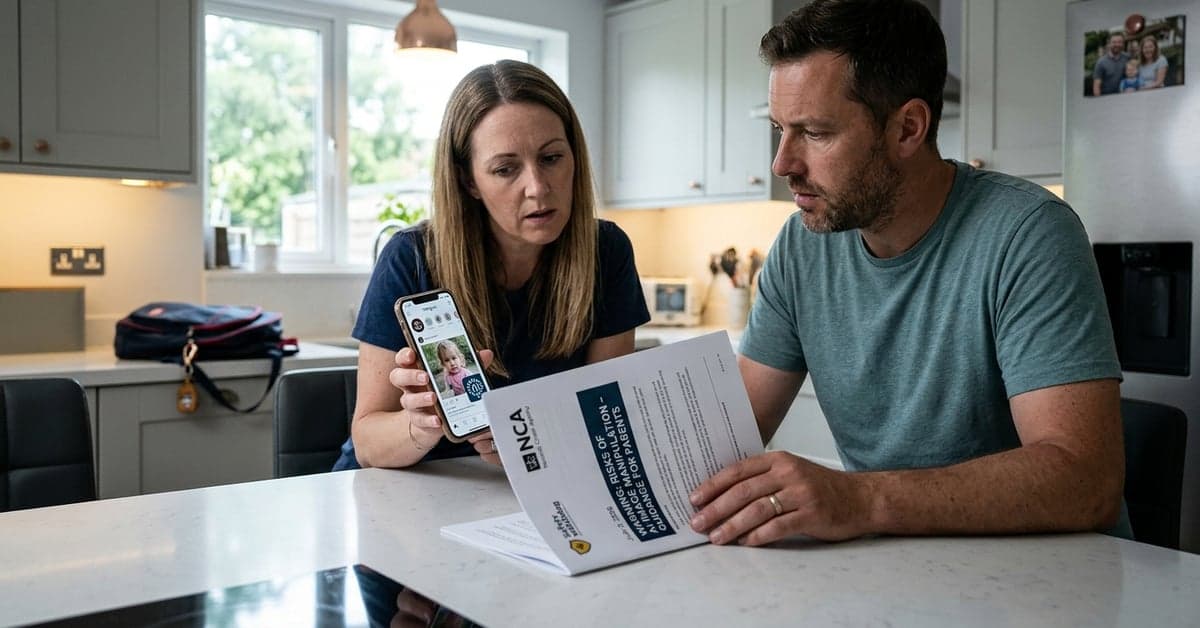
On July 3, 2026, the UK’s National Crime Agency and a safety watchdog warned parents to curb posting children’s images online amid a rise in AI-made explicit material. According to The Guardian, the guidance targets predators’ use of AI nudification apps that can fabricate sexual images from everyday photos.
What triggered the new guidance
The Guardian reports that law enforcement and a safety regulator issued the alert after an uptick in doctored imagery involving minors. The move reflects a shift in policing strategy: focus on reducing the public footprint of children’s photos before bad actors can scrape and weaponize them. That emphasis on prevention, rather than only takedown, matches what child-protection groups have urged for years.
The National Crime Agency has long warned about the industrial scale of online child sexual abuse networks. Its public materials describe how offenders trawl open platforms for images and data points that can be reused or manipulated. The agency’s overview of the threat is available on the NCA site, which outlines how content spreads across forums and file-sharing hubs (National Crime Agency).
How AI nudification apps work and why kids are at risk
As The Guardian’s companion analysis explains, modern imaging tools can strip clothes from a photo and output a fake nude with a few taps. These AI nudification apps often run on standard smartphones and require no technical skill. That accessibility lowers the barrier for abuse. A school photo on a public profile can become raw material for synthetic porn in minutes.
The harm doesn’t end with a fabricated image. Social accounts can be used to identify a child’s name, school, friends, and routines. When combined, those details raise risks of blackmail, doxxing, or repeat targeting. The watchdog’s message, as relayed by The Guardian, is blunt: the safest photo is the one you never upload in the first place.
Outside the UK, hotlines and civil-society groups have flagged the same trend. The Internet Watch Foundation has tracked the spread of AI-generated child sexual abuse material and how fast it migrates across platforms (IWF). Even when platforms remove a file, copies can resurface. That persistence is what makes upstream caution so important.
Deepfake nudes shift the burden to prevention
The Guardian’s reporting points to a hard truth: detection tools and takedown regimes can’t keep pace with cheap generative software. Watermarks and content credentials help, but adoption is uneven and easy to strip from screenshots. In practice, families are being asked to limit exposure as a first line of defense.
The regulator’s stance also dovetails with the UK’s Online Safety framework, which places new duties on major platforms to manage systemic risks. Ofcom’s online safety hub outlines how services should assess harms, tighten access to sensitive tools, and respond faster to user reports (Ofcom). But even strong rules can’t retroactively protect images that have already been scraped.
That’s why the latest warning matters. By naming AI nudification apps directly, authorities are acknowledging that non-consensual deepfakes aren’t a fringe problem. They are a mainstream threat fed by our everyday sharing habits.
What families can do now
Digital safety advocates stress practical steps that reduce exposure without quitting the internet entirely. The goal is to make it harder for offenders to find and reuse a child’s image, and to limit the context that makes targeting easier.
- Lock down social accounts. Limit followers, and review who can see past posts and stories.
- Strip context clues. Avoid school logos, street signs, and location tags in images and captions.
- Share to small circles. Use private albums or messaging groups rather than public feeds.
- Teach kids to report. Show them how to flag abuse on platforms and where to seek help.
Parents can also draw on clear, age-appropriate guidance from charities like the NSPCC, which maintains practical checklists for keeping children safer online and where to get support if things go wrong (NSPCC).
Why this warning resonates beyond the UK
According to The Guardian’s coverage, the UK alert arrives as generative tools continue to outpace guardrails worldwide. That raises a cross-border challenge: a fake made in one country spreads everywhere. The regulatory lines don’t match the speed of sharing.
The message travels, though. Families in any country can adopt low-friction habits that cut risk. Schools can refresh media-literacy lessons to cover deepfake abuse and reporting. Platforms can put friction on tools that are widely misused, while investing in better detection and faster redress when abuse occurs.
The signal from July 3, 2026 is clear. Treat public photos of children as potential inputs for abusers’ toolchains. That means fewer open posts, tighter settings, and quicker reporting. It also means naming the threat—AI nudification apps—so parents and teens know what they’re up against. For more on this, see reuters.com and bloomberg.com and nytimes.com.