
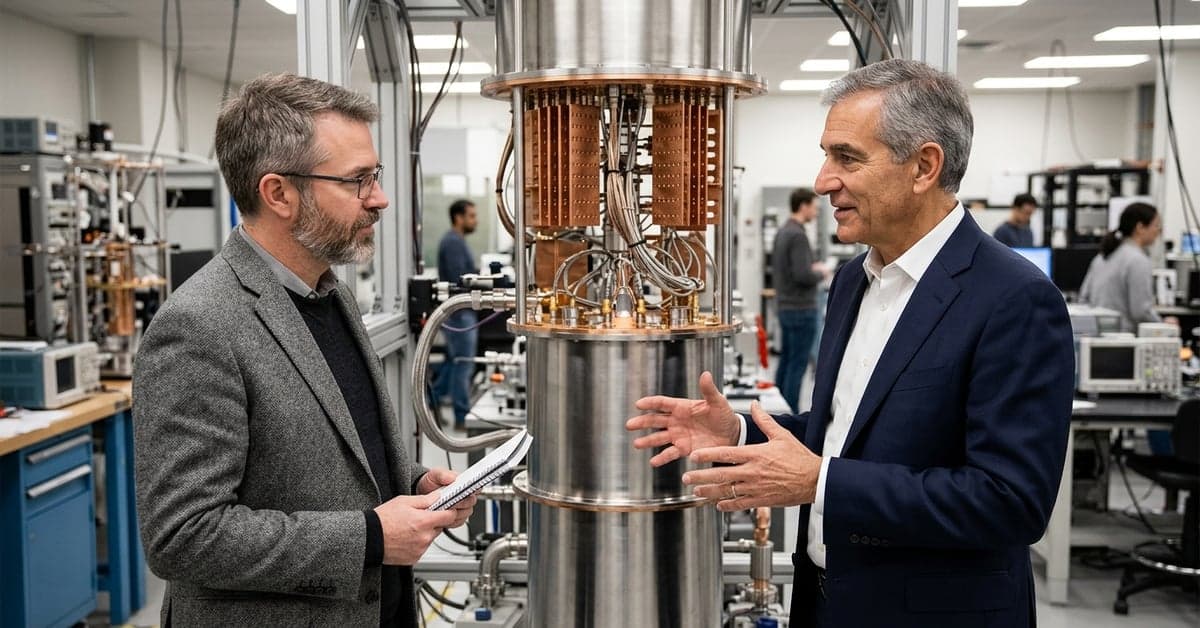
On August 26, 2026, IBM said it had completed the acquisition of HRL Laboratories, positioning the storied R&D house inside IBM’s quantum hardware effort. The news appears on the company’s newsroom as “IBM Completes Acquisition of HRL Laboratories to Accelerate the Future of Quantum” and marks the clearest sign yet that IBM wants tighter control over the materials and device physics layer of its quantum stack (IBM Newsroom).
Why the IBM HRL acquisition matters right now
The timing isn’t random. In the two weeks leading up to the deal, IBM highlighted a modular cryogenic milestone “toward fault-tolerant quantum computing” on August 19 and pointed to prior progress on trusted logical circuits with the University of Chicago on July 30 (IBM Newsroom). These are the plumbing and proof points that come before scale. Folding HRL—a lab known for deep materials science, device fabrication, and silicon qubit research—gives IBM more in-house control over that base layer.
HRL’s public materials describe active work in quantum information science, semiconductors, and advanced materials, including efforts in silicon-based spin qubits and cryogenic device engineering (HRL Laboratories). Those disciplines sit exactly at the chokepoint that separates promising lab demos from manufacturable, error-corrected systems. If IBM can align HRL’s device know-how with its own superconducting roadmap, it gains two things: a bigger bench for materials challenges and a shorter feedback loop between design, fabrication, and system integration.
How the deal fits IBM’s fault-tolerance roadmap
IBM has spent the past several years turning a lab portfolio into a stack: calibrated chips, control electronics, cryogenics, middleware, and cloud access. The company’s public quantum roadmap outlines a march from larger physical qubit counts toward logical qubits and error-corrected modules that can be linked. Error correction is what turns a fragile device into a reliable computer. It demands better materials, tighter fabrication tolerances, and cryogenic stability—areas where HRL’s programs are directly relevant.
Three recent IBM signals line up behind that thesis. First, the modular cryogenic systems connected on August 19 point to the thermal and mechanical infrastructure a scaled machine requires (IBM Newsroom). Second, the July 30 announcement with the University of Chicago focused on demonstrating a quantum advantage with trusted computation on logical circuits, reinforcing that IBM is moving beyond single-device hero numbers toward error-managed workloads. Third, by making the IBM HRL acquisition the capstone in August, IBM shows it’s investing at the very bottom of the stack to reduce upstream risk in the years when logical qubit yields will make or break progress.
There’s another strategic angle: talent and IP. HRL has a track record in materials breakthroughs and device physics. Those capabilities are scarce, slow to build, and hard to rent. Bringing them inside the tent means IBM can run more concurrent experiments, push design-of-experiments cycles faster, and keep learnings proprietary until they convert to platform gains. For a roadmap that hinges on fault-tolerant performance, that control is a feature, not a detail.
What customers and partners should expect next
Short term, little changes for developers writing circuits against IBM’s cloud-accessible systems. The most visible changes will sit behind the scenes: tighter iteration between fabrication, packaging, and cryogenics; expanded materials characterization; and more aggressive reliability testing at the module level. Expect more updates framed around logical qubits, not just physical counts, because that’s where the business value moves from “demo” to “repeatable.”
For research partners, the IBM HRL acquisition could mean richer joint programs that span device physics to application benchmarks. University collaborations that once separated chip R&D from workload design may start to look like end-to-end experiments, with shared targets around error rates, code distances, and run-to-run consistency. IBM’s July 30 work with the University of Chicago hinted at this alignment; adding HRL increases the room to run.
Enterprise buyers should watch for two signals on the public roadmap: 1) language that ties specific materials or fabrication improvements to logical qubit availability dates, and 2) clearer disclosures on module interconnect performance inside those newly connected cryogenic systems. Both determine when a pilot can become a production-style service for optimization, chemistry, or secure computation use cases.
What HRL brings that IBM couldn’t buy off the shelf
Quantum hardware still rides on a mountain of materials quirks: two-level systems in dielectrics, flux noise from amorphous interfaces, packaging-induced loss, and spurious modes that couple where they shouldn’t. Vendor relationships help, but they don’t replace owning the experiments that chase those defects to ground. HRL’s device and materials programs, as described in its open literature and summaries, target exactly these pain points in quantum materials and devices (HRL Laboratories). That complements IBM’s system-level focus and its publicly described qubit control and software layers (IBM Quantum Roadmap).
There’s also a manufacturing-readiness dimension. Moving from a few high-performing dies to repeatable, wafer-level yields requires process discipline, metrology, and feedback cycles that look more like semiconductors than one-off physics. HRL has operated at that interface for decades. If IBM can convert that experience into statistically reliable qubit modules, the runway to fault-tolerant quantum computing gets shorter—and the business case gets clearer.
The open questions around the IBM HRL acquisition
IBM hasn’t disclosed, on its public newsroom listing, deal terms or integration details, leaving several questions for the next quarter. How will IBM align HRL’s research agenda with its superconducting priorities while preserving HRL’s exploratory edge? What portion of HRL’s programs will feed directly into IBM’s production-bound lines versus long-horizon bets? And how will IBM report progress so customers can map procurement and pilot timelines to error-corrected availability?
Watch the next installments on the IBM Newsroom for clues. If August 19’s connected cryogenic systems were about plumbing and July 30’s logical-circuit work was about method, then this purchase is about throughput—how fast IBM can turn raw materials insights into better, steadier qubits. The smart read is that IBM will start anchoring roadmap promises to logical capacity, module interconnect metrics, and reliability distributions, not just to peak device numbers.
The promise of fault-tolerant quantum computing won’t hinge on one acquisition. But the IBM HRL acquisition tightens the loop between theory, fabrication, and deployed systems in a way that could move timelines forward. For enterprises choosing where to place early bets, that’s the metric that matters. For more on this, see reuters.com and bloomberg.com.
Related reading: AI in Education • Data Privacy • AI in Society