
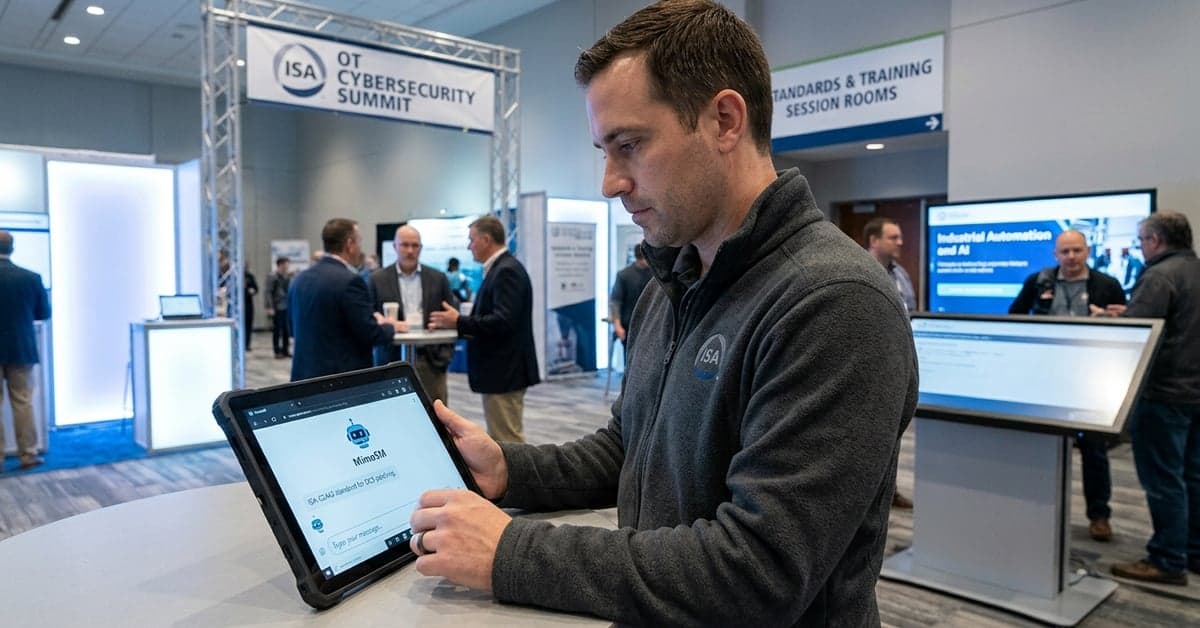
The International Society of Automation has quietly put a new tool on its homepage: an AI assistant named “MimoSM.” Billed as a “large-language model educated on ISA content”—standards, training, reports, articles, and presentations—it invites visitors to “Ask me all of your questions about industrial automation!” The ISA.org listing positions the ISA AI chatbot as a front door to the society’s technical library and services.
That’s more than a cosmetic change. For engineers who live inside standards and training catalogs, a conversational entry point could replace a lot of Ctrl+F scraping and email tag. The assistant sits alongside other updates on ISA’s site—including a recap of the 2026 OT Cybersecurity Summit in Prague and word that ISA was named a Top-Rated Nonprofit for 2026 by GreatNonprofits—signaling a broader push to meet members where they are.
Why the ISA AI chatbot matters for working engineers
Time is the tax on standards work. Finding the right clause, version, or training path often takes longer than solving the control problem itself. If Mimo does what ISA promises, it could compress that search time into a few prompts. According to the ISA homepage text, the assistant draws on ISA’s own materials. That’s the right corpus for everyday questions about course prerequisites, document scope, or chapter program details.
For day-to-day engineering tasks, the gains are obvious. Imagine asking for the difference between two training tracks and getting a side-by-side summary with links to enroll. Or querying which section of a cybersecurity standard addresses remote access, then jumping straight to the citation. The ISA AI chatbot won’t write a safety case, but it could remove a pile of routine friction that slows down compliance work and skills development.
- Standards lookup: point to the clause, revision year, and terminology source without wading through a 200-page PDF.
- Training triage: map a role (controls tech, SIS specialist, OT security lead) to an ordered list of courses and certifications.
- Event decisions: summarize session tracks, speakers, and registration policies for upcoming conferences in one view.
Each of these cases has a cost curve. If the bot shortens a 30-minute hunt to five minutes and does so dozens of times a quarter, it pays for itself in reclaimed engineering hours. The caveat is accuracy, which matters more in standards work than in casual web chat.
How an AI assistant could change access to industrial automation standards
Standards carry legal and safety weight. A model that paraphrases guidance must also anchor it. For control systems security alone, the ISA/IEC 62443 series underpins many supplier requirements and audits. In functional safety, the sister family around SIS practice and lifecycle requirements is just as sensitive. A useful ISA assistant should therefore do three things by default: cite document identifiers and clause numbers; state the revision year; and flag when an answer relies on interpretation rather than direct text.
Those habits are not bells and whistles. They are the difference between a quick hint and an auditable reference. In OT security and safety, engineers routinely need to show their work to customers, regulators, or internal quality teams. Answers that include a trail back to source text keep the assistant from becoming a dead end when scrutiny arrives.
There is also the risk of overconfidence. Large-language models can sound right while being wrong. Guardrails matter, especially when advice could touch process safety, cybersecurity, or contractor requirements. Clear scoping—for example, keeping the assistant focused on ISA materials rather than web search—lowers the chance of hallucinated citations. A visible feedback loop and a correction log would help users judge reliability over time.
For context on the stakes, the U.S. cybersecurity agency CISA maintains guidance for control systems security that many operators reference alongside ISA materials; its overview of control systems risks offers a useful benchmark for the kind of precise, actionable advice engineers expect. See CISA’s control systems security resources for comparison.
Signals from ISA’s 2026 calendar
ISA is pairing the assistant with a busy events slate. The organization says it hosted its fourth annual ISA OT Cybersecurity Summit in Prague in 2026, describing it as the place for OT cybersecurity practitioners to learn, network, and grow. A recap is highlighted on ISA’s site with a link out to Automation.com. This is the audience most likely to pressure-test a conversational assistant on standards and best practice: practitioners who need fast, sourced answers on hard problems.
On the near-term horizon, ISA lists the “ISA Automation Summit & Expo—USA” for September 27–29 at the Walt Disney World Swan and Dolphin in Lake Buena Vista, Florida. That event offers an obvious proving ground. If Mimo can help attendees plan sessions, compare tracks, or surface reading lists tied to talks, it becomes more than a novelty on the homepage.
ISA also highlights a reputational marker: being named a Top-Rated Nonprofit by GreatNonprofits for 2026, the third consecutive year. The claim appears on ISA’s site; readers can review the ratings platform directly at GreatNonprofits. Sustained third-party validation won’t prove the assistant’s quality, but it does suggest ISA is focused on member satisfaction—a sign the tool will get attention and iteration rather than being left to drift.
What to watch next for the ISA AI chatbot
Early chatbots often stumble on three fronts: stale content, unclear scope, and privacy gaps. ISA hasn’t published technical details about Mimo on the homepage beyond its training set. Engineers should watch for a few signals of maturity:
- Source transparency: every non-trivial answer should include document IDs, clause numbers, and links back to the authoritative text where licensing permits.
- Update cadence: a visible changelog that tracks newly ingested standards, course updates, and errata keeps trust high.
- Member vs. public access: clear boundaries on what requires login, and smart fallbacks that point non-members to abstracts or purchase options without dead ends.
- Privacy and retention: straightforward statements about how prompts are stored, who can view them, and whether they train the model.
- Escalation: one-click handoff to a human or to a standards purchase page when the assistant hits uncertainty.
These aren’t wish-list items; they are the plumbing that makes an AI assistant dependable in a compliance-heavy field. A small detail like including the revision year can prevent a costly misread when teams mix editions. A bigger one—like clear data-use policies—can determine whether a firm allows its engineers to ask project-specific questions at all.
There’s an upside here for learning as well. If the assistant can knit together standards references with ISA’s training catalog, it could suggest a personalized study path and flag prerequisites. That reduces the guesswork for early-career professionals and helps managers budget for the right courses. ISA’s own materials emphasize training as a core service; an AI router on top may speed discovery.
For readers who want a baseline on control systems security outside the ISA catalog, NIST’s overview and recommended practices remain a strong complement to ISA material. The agency’s public guidance gives a sense of how precise citations and definitions should look in a reference tool; see the National Institute of Standards and Technology’s SP 800-82 publication on industrial control systems security.
ISA’s site already acts as a hub for standards, training, and events. If the ISA AI chatbot can connect those dots with reliable sourcing and up-to-date content, it will earn a permanent spot in engineers’ workflows. That would turn a homepage mascot into a practical time-saver—and a quiet shift in how the profession reaches for the rules that keep plants safe and networks secure. For more on this, see nytimes.com.