
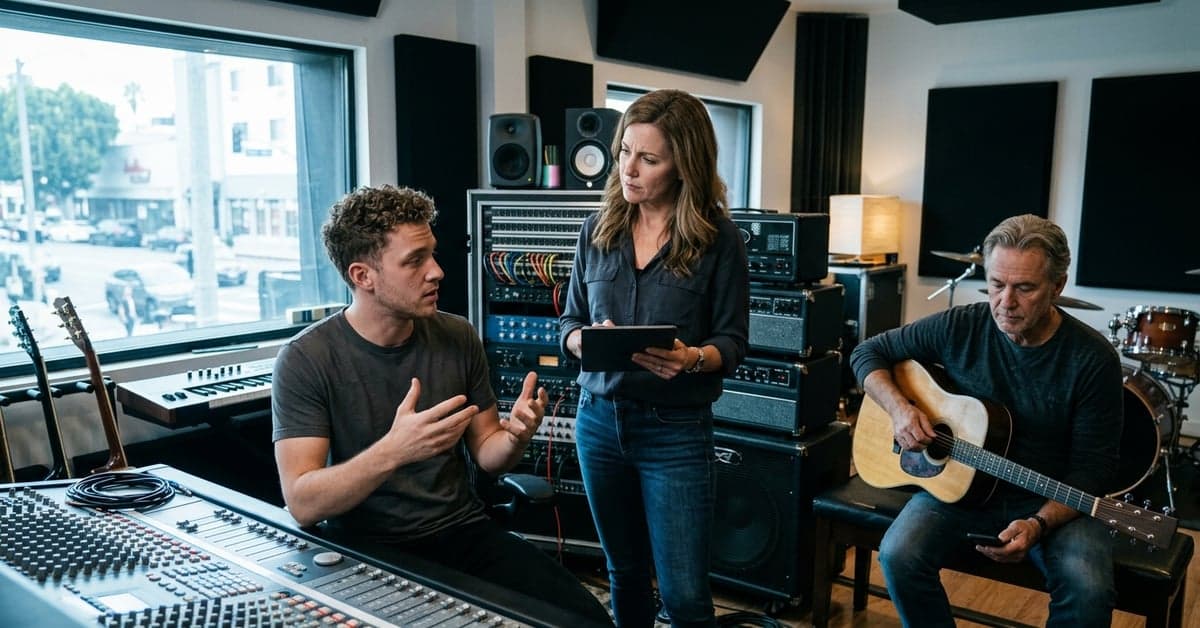
In September 2026, Suno rolled out its first models trained on licensed music from Warner Music Group, BMG, and Believe, marking a hard pivot from the lawsuits that dominated 2024. Rival Udio has also signed with Universal Music Group and Warner. According to the Los Angeles Times, the pitch is simple: AI becomes a new revenue stream for artists, with an opt-in and a cut. The sticking point is everything the labels and startups aren’t saying about these AI music licensing deals — from who can actually consent to what the check might look like.
From court fights to label-AI agreements
Two years ago, major labels sued Suno and Udio for copyright infringement tied to training on their catalogs. Those fights have not fully ended. The Los Angeles Times reports that Sony and Universal are still suing Suno even as other label partnerships launch, and values Suno at $5.4 billion. That whiplash — litigate, then license — is the new playbook.
The legal backdrop remains unsettled. The U.S. Copyright Office has said human authorship still defines copyright protection and is reviewing how training on copyrighted works should be treated. Its ongoing policy study lays out the clash between innovation claims and creator control, without resolving how consent or compensation should work. For a taste of the earlier posture, the Recording Industry Association of America detailed its 2024 lawsuits against AI music generators, arguing wholesale copying and market harm. The same companies now strike deals that promise choice and payment but keep the terms hidden.
Why move now? Labels want a say in how the tech evolves and a slice of new income before norms harden without them. AI firms want legitimacy, cleaner datasets, and a path out of litigation risk. That alignment explains the rush to sign, even as core disputes remain open.
Why many artists bristle at AI music licensing deals
Artists see three red flags: consent, control, and compensation. The LA Times says none of the companies have disclosed what artists will be paid, how many have opted in, or the levers an individual musician can pull to keep their recordings or compositions out. Without transparency, a deal that promises “a cut” is hard to evaluate.
Consent is messy because label contracts already assign key rights. Most masters sit with labels; many publishing rights are split across writers, co-writers, and administrators. Session players and background singers often have no approval rights at all. A label may be able to license a master for “training” while the people who made the sound have no practical veto. That mismatch fuels the pushback from musicians, session players, and songwriter groups cited by the LA Times.
Control goes beyond a yes or no. Musicians worry about outputs that imitate their voice, drum feel, or guitar tone, even if the system never names them. It is one thing to license a track for sampling, which is targeted and track-specific. It is another to grant a corpus license that helps a model generalize style across thousands of songs. Without track-level controls or provenance, creators fear their signature sounds could power a competitor’s “new release.” Industry groups are now pushing for content provenance standards that can help mark what is human-made and how assets are used, a step that could bring more accountability to model training and outputs.
Compensation is the third fault line. If these AI music licensing deals pay like a blanket data license, the upfront fee may never trickle meaningfully to artists. If they pay like a per-output royalty, then the platform must attribute which training data shaped which output to split revenue fairly — a hard technical problem. Either way, the math is hidden, and that makes trust scarce.
The consent gap: an opt-in that isn’t
Labels and AI firms say artists have a choice. The question is whose choice counts. A marquee singer with approval rights can probably keep their recordings out. A mid-tier artist with a standard deal may find their consent already assigned in the boilerplate. A session drummer on a 2012 album likely has no say at all. The LA Times signals this tension, and it mirrors long-running debates over neighboring rights and session pay.
The consent gap also shows up in the split between composition and sound recording. A songwriter might opt out through a publisher, but the label can still license the master for training. Or the opposite. Without clear, synchronized controls, an artist can exit through one door and still get pulled in through another. That is why songwriter groups warn that “opt-in” can be a mirage unless every rights holder, including contributors, gets a binding say.
Audit rights matter too. If a model updates weekly, and a catalog is added or removed in chunks, creators need reporting that shows when their works entered training, what was included, and when it was removed. The Copyright Office has flagged transparency as a core issue in its AI study. Without it, disputes become guesswork, and any promised “opt-out” may arrive after the value has been extracted.
Show us the money: how payouts could actually work
The LA Times notes that payout terms are undisclosed. So what might be on the table? Past digital deals suggest three options:
- Upfront advances for access to catalogs, which labels recoup before sharing with artists.
- Usage-based payments tied to model outputs, which demand granular attribution to be fair.
- Hybrid structures with minimum guarantees plus revenue share over thresholds.
Each path has pitfalls. Advances can vanish in recoupment. Usage-based payouts require technical proof of contribution, which AI firms have struggled to provide. Hybrids still leave creators guessing if they will ever cross the threshold where shares flow.
Artists will also ask how any new money stacks up against potential cannibalization. If AI-generated tracks trained on their catalog take listener time from their own releases, a thin royalty is not compensation. Without independent reporting and audit rights, it is hard to tell if the deal grows the pie or just shuffles slices.
What happens next for artists, labels, and AI firms
Expect three pressure points. First, litigation. The LA Times says Sony and Universal remain in court with Suno. Case law on whether training is fair use, and what counts as infringing output, will shape future deals as much as any NDA. Court filings by the RIAA lay out how labels frame the harm; outcomes there will ripple across every model that learns from music.
Second, policy. The U.S. Copyright Office’s AI inquiry is still active. Its next steps could recommend disclosure duties, consent standards, or model records that make audits workable. Any move toward transparent training logs would raise the bar for platforms and could force labels to offer real track-level controls.
Third, bargaining. Unions and creator coalitions will push for bright-line rules: no training without explicit artist consent, contributor pay for session work used in training, and per-output royalties with verifiable attribution. Labels that adopt those terms early will gain moral and market advantage with talent. Those that hide the ball will face public refusals and catalog carve-outs.
There is a practical path forward. Treat training like sampling: ask first, price clearly, disclose the use, and give contributors a real share. Pair that with provenance and watermarking so artists can track how their work shapes outputs. If the industry gets there, AI music licensing deals could feel less like a bait-and-switch and more like a modern reissue program — new revenue built on clear consent.
The transition from lawsuits to licenses is underway. Whether artists embrace it depends on whether these AI music licensing deals deliver what the sales pitch promises: real choice, real control, and money that shows up on statements they can audit.
Los Angeles Times coverage | RIAA lawsuit overview | U.S. Copyright Office: AI and Copyright | Content provenance standards For more on this, see bloomberg.com and nytimes.com.