
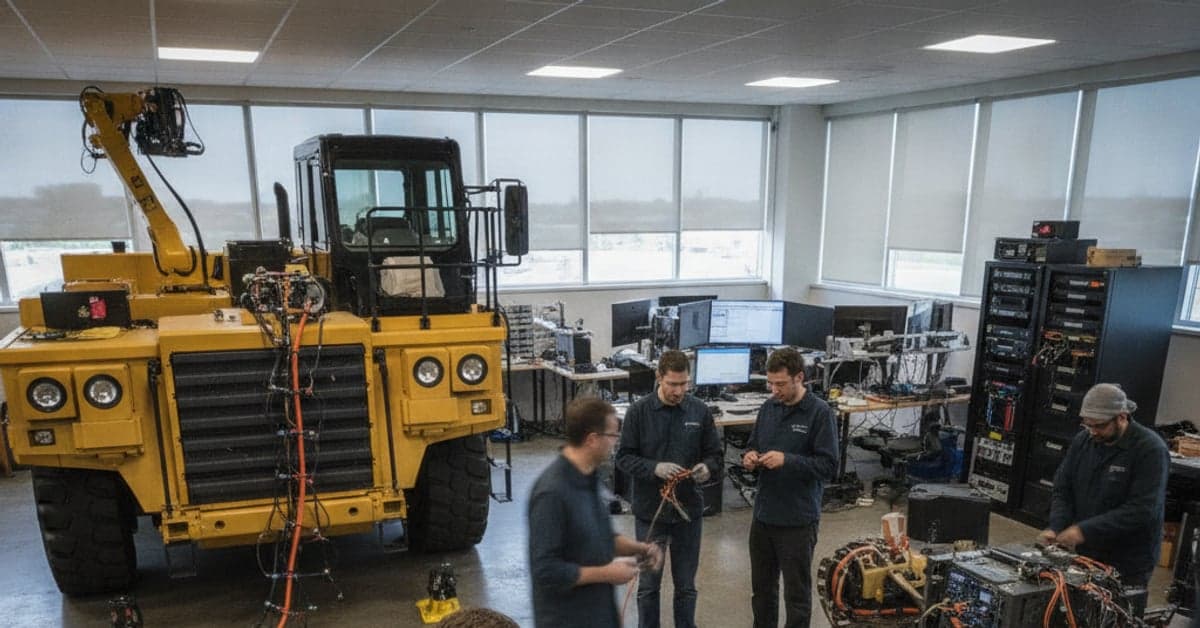
From a former SpaceX office in Redmond, Wash., a small team is teaching bulldozers and mining trucks to drive themselves. GeekWire reports that AIM Intelligent Machines, led by founder and CEO Adam Sadilek, is building retrofit systems that bring autonomy to existing heavy equipment rather than designing new vehicles from scratch (GeekWire).
Inside AIM Intelligent Machines’ ‘earth first’ autonomy plan
The company’s pitch is straightforward: start where the value is clearest. Construction and mining offer predictable routes, defined job sites, and a paying customer base that runs iron day and night. That operating profile favors autonomy, and it favors retrofits. According to GeekWire, AIM Intelligent Machines is focusing its systems on dozers and other heavy equipment that already earn revenue, so every hour of autonomy can be measured in fuel, time, and safety saved.
It’s a pointed contrast with robotaxis. General Motors’ Cruise suspended U.S. driverless operations after a high-profile incident in October 2023, underscoring how hard open-street autonomy remains (Reuters). Job sites are narrower arenas. Fewer edge cases, clearer maps, and defined right-of-way make autonomy upgrades easier to validate and insure.
From a former SpaceX office to real job sites
There’s symbolism in the address. A workspace once tied to Mars now houses a company saying “earth first.” That shift tracks where money meets practicality in AI. Industrial buyers care less about celebrity demos and more about repeatable cycle times and fewer accidents.
On safety alone, the upside is obvious. Construction remains one of the most dangerous U.S. occupations. Federal data show high rates of fatal and serious injuries on job sites each year, with heavy equipment incidents a recurring factor (OSHA data). Systems that keep people out of harm’s way, or that prevent fatigue-driven errors, have a simple business case.
Retrofits also sidestep a capital headache. Instead of buying new autonomous machines, a contractor can upgrade existing fleets as projects demand. That turns autonomy into an operating expense, not a multi-year bet on unproven hardware. It mirrors the approach seen in mining, where autonomy features have rolled out steadily on production machines from incumbents like Caterpillar’s Command suite (Caterpillar).
How self-driving bulldozers find a safer, simpler lane
Industrial autonomy succeeds when rules of the road are narrow and the payoff is near-term. A quarry haul road has a known grade, a fixed berm, and a handful of vehicles. An urban boulevard has kids on scooters, double-parked vans, and short-cycle jaywalkers. The first is a software problem with bounded risk. The second is a mess that forces exotic perception, complex planning, and years of public scrutiny.
That balance of complexity and benefit helps explain why physical AI is moving faster in warehouses, ports, and mines than on city streets. McKinsey has argued for years that construction lags other sectors on productivity growth, leaving room for digital and automated gains that translate directly to margins (McKinsey analysis). Autonomy that shaves minutes from grading passes or reduces rework lands on a CFO’s dashboard in the same quarter.
That is the bet behind AIM Intelligent Machines. Keep the domain tight. Retrofit the machine the crew already knows. Deliver reliable gains before chasing flashier demos.
What to watch next from AIM Intelligent Machines
Two questions will define the company’s trajectory. First, can its retrofit kits prove reliable across the messy long tail of job sites? Dust, rain, mud, and inconsistent GNSS reception have humbled plenty of industrial tech. Second, can buyers capture savings without hiring a full-time autonomy engineer? A good system must fade into the workflow and keep working when the foreman is short-staffed.
Regulatory posture will matter less than in robotaxis but still counts. Even on private sites, insurance carriers will want data, not promises. Expect buyers to ask for audit trails, hazard detection logs, and clear maintenance plans. Those demands will push vendors to ship tools that treat safety and telemetry as product features, not checkboxes.
Competition is already on the field. Incumbents bundle guidance, remote operation, and partial autonomy into new machines. Startups offer aftermarket kits that claim quick installs and rapid payback. In that crowd, AIM Intelligent Machines needs two edges: faster time-to-value and fewer surprises after deployment. If it shows a week-one lift on fuel and rework, word will spread quickly through regional contractors and mine operators.
There’s also the workforce question. Crews aren’t vanishing. Autonomy often shifts operators to higher-leverage roles—overseeing multiple machines, handling precision work, or jumping in when exceptions arise. On sites where labor is tight, that kind of reallocation is a selling point, not a threat.
The takeaway is simple. The path for physical AI runs through brownfield fleets and measurable wins. If AIM Intelligent Machines delivers those wins on active job sites, its “earth first” mantra won’t read as modesty. It will read as a plan.