
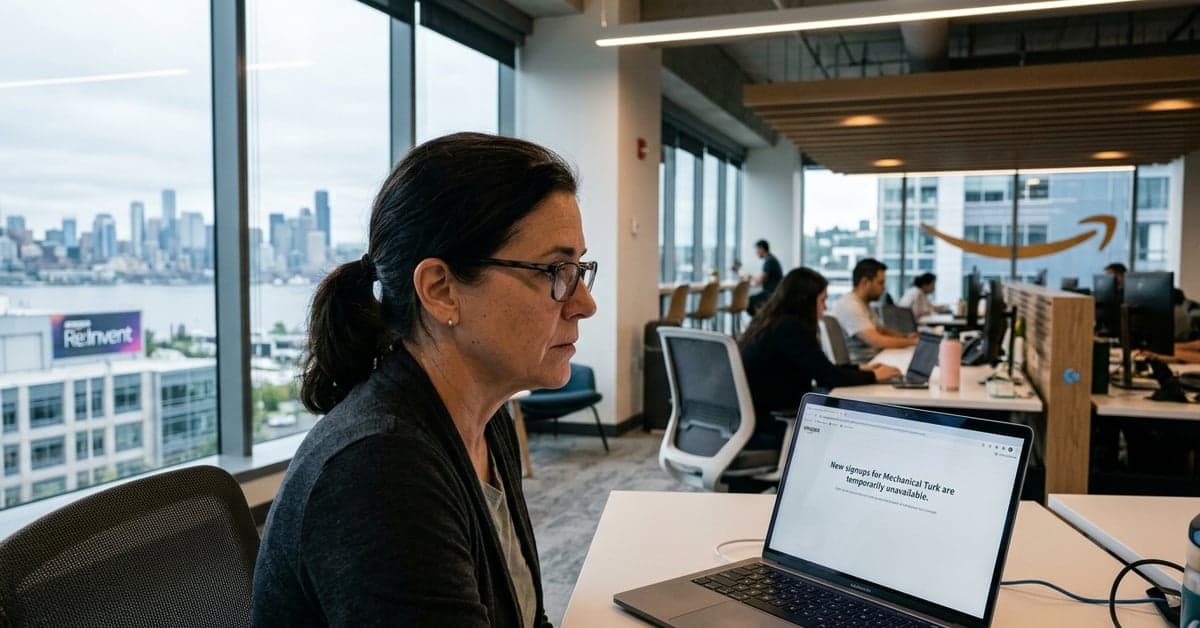
On July 6, 2026, TechCrunch reported that Amazon will stop accepting new customers for Mechanical Turk, the company’s long-running marketplace for microtasks and data work. The move lands amid fast-shifting demand for human annotation and growing pressure on platforms to police quality and compliance. It also raises hard questions about what comes next for the gig workers and AI teams that relied on MTurk’s scale.
Amazon pauses Mechanical Turk signups: what happened
According to TechCrunch, Amazon is closing the door to new customers on the platform, with no public timeline for reopening. Amazon has not released a public statement detailing the rationale. The marketplace, launched in 2005, has long offered a way to split repetitive or subjective tasks—like image labeling or content moderation—across a distributed workforce. Amazon’s own overview describes it as a way for businesses to access a global pool of on-demand workers for tasks that remain hard for software alone (Mechanical Turk).
The decision to pause Mechanical Turk signups is a narrow but telling change. It doesn’t alter existing access for current customers, based on TechCrunch’s framing, yet it will immediately affect startups and research labs that planned to spin up new projects on MTurk this summer.
Why a signups freeze matters for AI data work
AI development still hinges on labeled examples, preference data, and edge-case feedback. Crowdsourced markets supplied that at speed and at a price many teams could afford. A pause in Mechanical Turk signups forces new buyers to look elsewhere, either to managed vendors or to cloud-native tooling that bakes in workforce controls and auditing.
One obvious path sits inside Amazon’s own cloud. AWS SageMaker Ground Truth wraps annotation workflows with managed workforces and quality checks; it also allows companies to route work to private vendors or internal teams. That model has grown more attractive as organizations face tighter security reviews and data-handling rules. For AI leaders under governance pressure, a curated workforce can look safer than an open marketplace.
Quality concerns on open platforms have also mounted. Researchers and policy groups have flagged uneven pay, opaque moderation, and inconsistent task outcomes across global gig markets; the International Labour Organization’s reporting captured these frictions well in its review of digital labor platforms (ILO report). In the LLM era, an added worry is workers using AI tools to complete AI evaluation and labeling tasks, which can distort results unless carefully monitored.
Where demand goes next: cloud workforces, vendors, and synthetic data
Short term, the freeze on Mechanical Turk signups will likely push new AI teams toward managed annotation providers, or to cloud services with built-in workforce options. That shifts spend from an open marketplace to enterprise contracts, with stricter service-levels and audit trails.
Another pressure valve is synthetic data. For some domains—vision under varied lighting, rare failure modes in robotics, or long-tail text prompts—generated datasets can expand coverage without hiring more annotators. Industry trackers have documented the rising role of synthetic corpora in pretraining and fine-tuning, especially where privacy or scarcity makes real data harder to source. Expect more pilots here, paired with smaller but higher-quality human review loops.
There’s also a likely knock-on effect for evaluation. Many teams have leaned on crowd platforms to score model outputs. As procurement tightens, more of that evaluation may move into controlled panels, internal red teams, or academic partnerships, with clearer ground rules and reproducibility standards.
What to watch after the Mechanical Turk signups pause
First, whether Amazon provides a timeline or a stated reason. A temporary intake freeze suggests a policy or product shift; a longer pause could signal a deeper repositioning of MTurk alongside AWS-native services. Second, watch pricing from managed vendors. With fewer on-ramps to open markets, unit economics for annotation may rise for new buyers, at least until competition resets rates.
Third, look for clearer quality guarantees. If the market leans toward curated workforces, buyers will expect tighter gold-standard checks, better provenance, and stronger attestations about tool use by workers. That includes explicit policies on whether, and how, annotators can use AI assistance.
Finally, keep an eye on research and open science. Universities and nonprofits often used MTurk for small, time-bound studies. A pause in Mechanical Turk signups may nudge grants and labs to seek institutional review panels that approve alternative platforms, or to pool resources with partner universities to maintain access.
This is a small procedural update with big echoes. By constraining intake, Amazon is telegraphing where the next phase of data work is headed: fewer ad hoc crowd jobs, more auditable pipelines, and a tighter coupling between labeling, evaluation, and model governance. Teams that plan around that shift now will feel less pain if Mechanical Turk signups stay closed longer than expected. For more on this, see aws.amazon.com and reuters.com.