
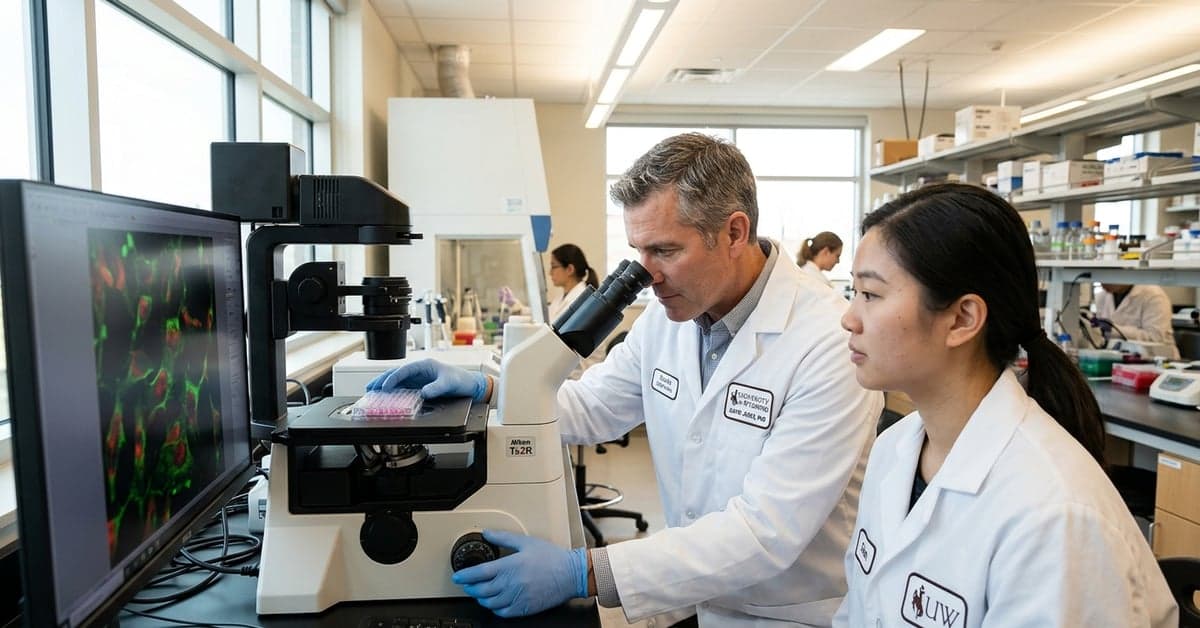
On August 24, 2026, the University of Wyoming announced an $18.9 million National Institutes of Health award under the IDeA Networks of Biomedical Research Excellence program — the largest single research grant in the university’s history, according to UW News. The money aims to strengthen biomedical research and education across the state.
What the University of Wyoming INBRE grant funds
INBRE awards are designed to build research capacity in states with historically lower levels of NIH funding. The program supports three familiar pillars: faculty development, student research experiences, and shared core facilities, according to the NIGMS INBRE program. While UW has not yet detailed a line-by-line plan, the structure of INBRE grants typically translates into lab upgrades, competitive pilot awards for investigators, and mentored research slots for undergraduates and graduate students.
That pattern matters. It spreads the benefit beyond a single lab or department. It builds the scaffolding that lets early-career scientists compete nationally, and it creates paid research time for students who might otherwise work off campus. In short, the University of Wyoming INBRE award is designed to make research a campus-wide activity, not a niche.
Who benefits on campus and across Wyoming
The near-term winners are students and faculty. Under the INBRE model, students gain paid hands-on experience, which increases retention in STEM fields and improves readiness for graduate or professional school, per the NIH IDeA overview. Faculty get pilot funding and mentorship networks that help them collect preliminary data and pursue their own NIH grants.
The impact stretches beyond Laramie. INBRE networks are built to include partner colleges and community institutions across a state. That distributes training opportunities and can seed small research nodes closer to where patients live. In a frontier state with long travel times between communities, more local training and lab capacity is not a luxury — it’s how you grow talent at home. The University of Wyoming INBRE award signals more of those on-ramps.
There’s also a workforce angle. Health systems and public health agencies track shortage designations for clinicians and allied health workers; the federal database of Health Professional Shortage Areas shows persistent needs across rural America. INBRE doesn’t fund medical residencies, but it does fund the pipeline that precedes them. Students who complete research fellowships and stay connected to in-state mentors are more likely to see a future in local labs, clinics, and state agencies.
NIH INBRE in rural states: how Wyoming fits
Wyoming is part of the NIH IDeA network, which focuses on states and territories with historically low success in winning NIH grants. The goal is capacity, not charity. NIGMS describes IDeA as a way to “broaden the geographic distribution of NIH funding,” supporting places where a modest investment can create outsized gains. That frame fits Wyoming, where a single core facility upgrade or a cluster of pilot awards can change the arc of several careers.
INBRE also raises the floor for collaboration. The program encourages multi-institution projects and shared instrumentation. When a campus adds a modern sequencing platform or imaging system under an INBRE core, nearby faculty can pivot their work to include biomarker validation, mechanistic studies, or population health analyses they could not run before. For a small state, each upgrade widens the set of questions that are practical to ask — and answer.
This is why the University of Wyoming INBRE award being the university’s largest single research grant is more than a headline. Size brings time and predictability. Multi-year funding lets coordinators plan cohorts, align training with the academic calendar, and commit to maintenance contracts that keep shared equipment online. It reduces the scramble and makes room for quality.
What changes next for students and labs
Expect visible signals of activity. INBRE cycles often begin with campus briefings, followed by calls for pilot proposals and student research placements. New or refreshed cores tend to publish access policies and training schedules so labs can plug in quickly. Those are program norms described by NIGMS and seen across other INBRE sites, and they are the kinds of practical steps that turn a large award into daily lab work.
For students, the bet is simple: more paid research roles and more mentors. For faculty, the bet is focus: small, well-scoped pilots to generate the data needed for an R01 or a K-series career award. For the state, the bet is reach: more partner campuses connected to UW, and more graduates with real lab time on their resumes.
The University of Wyoming INBRE grant will not solve every gap in one move. It can, however, change the default. When research is funded at scale, it becomes normal to ask better questions, to collect cleaner data, and to aim higher on the next grant. That’s how capacity is built — one cohort, one core, one pilot at a time.
Why this award matters now
Timing is part of the story. Federal science agencies have emphasized broader participation and workforce development. The INBRE mechanism sits squarely in that push, and Wyoming’s award shows how a campus can align with it. It’s a practical playbook: invest in people, open access to shared tools, and raise expectations for competitive grants that follow.
According to UW News, the $18.9 million figure sets a new high-water mark for a single research award at the university. The number matters because it buys time, equipment access, and a larger cohort of trainees. The stakes are clear: if the network does what INBRE is designed to do, Wyoming’s labs become more competitive, its students more prepared, and its research questions more ambitious.
The headline is the money. The story is what comes after. If the University of Wyoming INBRE award executes to the program’s strengths, the next big grant won’t be an exception — it will be a pattern. For more on this, see bloomberg.com and nytimes.com.
Related reading: AI Hardware • ChatGPT • AI Startups & Companies