
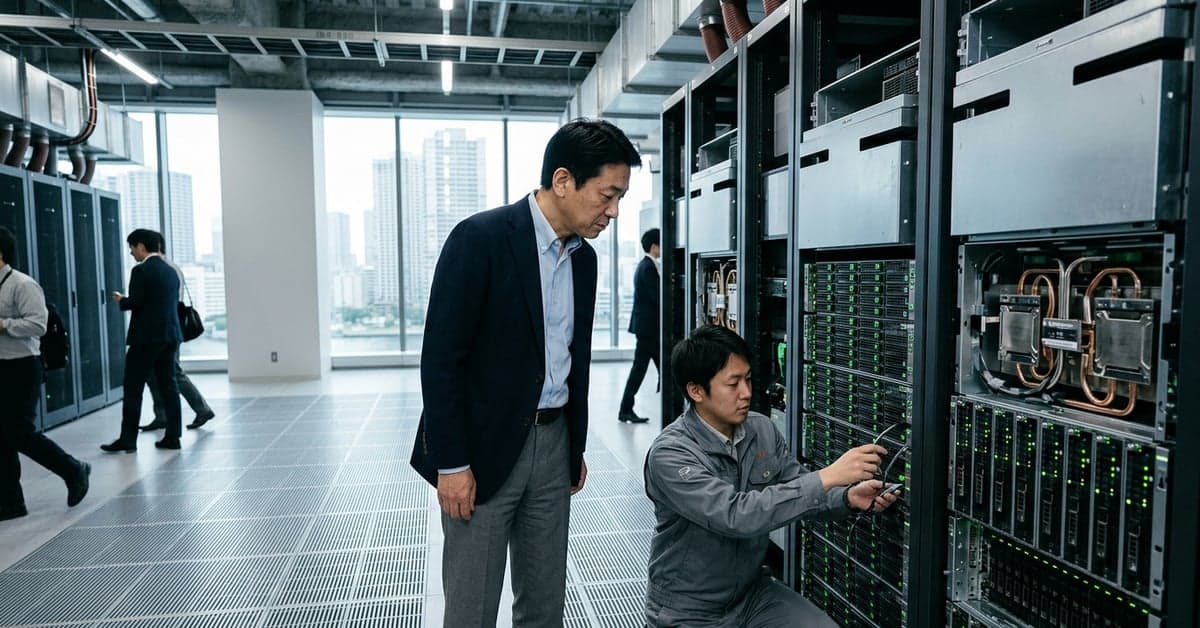
On July 16, 2026, NVIDIA said it will work with Noetra Corp. and Japanese government and industry partners to build what it calls the world’s first national AI infrastructure in Japan, anchored by a new Vera Rubin AI factory with 13,750 Vera CPUs and 27,500 Rubin GPUs. The company framed the project as national-scale capacity for physical AI. For startups and investors, the question is simple: will this Japan national AI infrastructure change where early-stage capital and founders go next?
What Japan national AI infrastructure actually funds
According to NVIDIA’s July 16, 2026 announcement, the plan centers on a large, purpose-built compute cluster designed for training and post-training work on intelligent agents and robotics (NVIDIA Newsroom). The hardware mix is explicit: 13,750 Vera CPUs paired with 27,500 Rubin GPUs, tied together as an AI factory. The goal is national access, with government and industrial stakeholders in the loop, rather than a single corporate tenant.
NVIDIA followed the next day with a technical pitch for Vera Rubin as a platform that maximizes “intelligence per dollar” for post-training workloads. The company argued that extreme co-design across hardware and software cuts cost per token, which it calls a key metric for agentic AI (NVIDIA blog, July 17, 2026). If those claims translate into real pricing, the factory could make fine-tuning, evaluation, and tool-use agents cheaper for teams that can’t prepay for hyperscale capacity.
The near-term read: the Japan national AI infrastructure is not just another enterprise cluster. It is being positioned as a shared, sovereign resource meant to bring down the effective cost of post-training and deployment. That’s where startups live.
Why this AI factory matters for startups and investors
Early-stage AI teams don’t fail because they can’t write code. They fail because they can’t afford iteration. NVIDIA’s “intelligence per dollar” framing, tied to a national AI compute pool, hints at a path to more experiments per dollar, especially for agentic systems that need long-context evaluation, retrieval, and tool orchestration. If access is broad and pricing reflects the cost-per-token gains NVIDIA touts, this could reset seed and Series A capital needs for physical AI startups.
Investor demand is already shifting in that direction. Y Combinator’s Summer 2026 Requests for Startups says “AI has stopped being a feature and started being the foundation,” and calls for founders who push AI into the physical world—from precision agriculture to robotics (Y Combinator RFS). Cheap, predictable post-training in Japan—backed by industry partners who can pilot deployments—would turn that thesis from slideware into pilots with measurable unit economics.
For VCs, a national facility also de-risks concentration. A single facility with public backing lowers counterparty risk compared with a patchwork of short-term cloud credits. It can also compress timelines to proof-of-concept, which affects ownership targets, reserve planning, and follow-on pacing. If the Japan national AI infrastructure offers transparent queues and published SLAs, expect funds to pencil in shorter build cycles and more aggressive go-to-market milestones.
Physical AI gets a tailwind
NVIDIA has been laying out the software and edge stack around this push. On July 15, 2026, it highlighted how Japan’s robotics and manufacturing leaders are building on its Cosmos, Isaac, Metropolis, and Jetson platforms to speed deployment of intelligent machines across factories and mobility systems (NVIDIA Newsroom). The same day, the company introduced new Jetson Thor computers pitched for mainstream robotics and edge AI—compact, power-efficient systems capable of running foundation models close to the action (NVIDIA blog). For teams building perception, control, and safety stacks, this matters because it shortens the path from training to field tests.
Put differently, the compute lives in the national AI factory, while the brains run near the robot. That division of labor—big training centrally, fast inference at the edge—could become the default for startups tackling logistics, manufacturing inspection, and micro-mobility. Founders who can show that their model improves on a line or route in days, not quarters, will have an easier time clearing procurement gates at large industrials.
Developers who want to explore the robotics side can review NVIDIA’s tooling directly. Isaac is the company’s robotics platform for simulation, perception, and manipulation (NVIDIA Isaac), while Metropolis targets vision AI in cities and facilities (NVIDIA Metropolis). Those pieces, paired with national compute, create a cleaner runway from prototype to pilot to scaled deployment.
What to watch next: access, pricing, and capital flows
The promise of a Japan national AI infrastructure will stand or fall on access rules. Who gets priority—state agencies, large industrial partners, or startups? Will there be a rate card for post-training jobs and long-context inference? If the queue is predictable and prices reflect the “intelligence per dollar” gains NVIDIA promotes, founders will move. If it looks like a private cloud with a long waitlist, they won’t.
Another open question is data. National facilities can attract sensitive industrial datasets that never leave the country. That’s a draw for startups building agentic systems that must learn from proprietary process data while staying within legal and contractual walls. Clear policies, and a technical plan for isolation and audit, will decide how much of that value reaches new companies rather than only incumbents.
Investors should also expect geography to matter more. If pilots and preferential access cluster around the factory’s partners, capital may follow them—first to Tokyo and Nagoya, then across the supplier networks that feed them. Watch term sheets add location-sensitive milestones, and pay attention to funds raising Japan or APAC sidecars tailored for physical AI.
Finally, the export value of the model: if Japan’s approach proves that a public AI infrastructure can cut iteration costs and pull in private capital, other countries will copy it. A few will try to outbid on raw GPU counts. Smarter ones will copy the pairing: national compute plus ready-made industrial pilots, then publish the numbers founders care about—jobs run, tokens per dollar, time-to-pilot.
The bet from NVIDIA and its partners is clear. Build a shared AI factory, cut the cost of post-training, and let startups do the rest. If the access and pricing line up with the pitch, the Japan national AI infrastructure won’t just power research. It will redirect where the next wave of physical AI companies gets built—and where investors show up first.